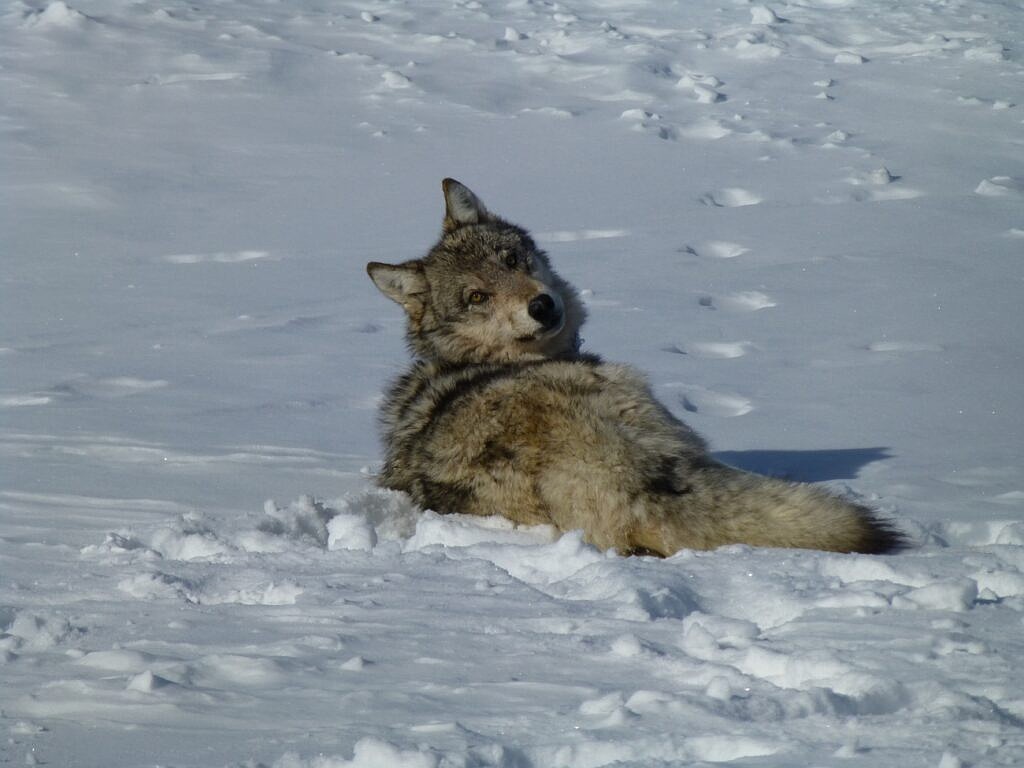
Conservationists and a lifelong hunter delivered a petition to the Idaho Fish and Game Commission on Tuesday demanding the state ban the killing of wolf pups and their mothers, a move triggered by revelations that Idaho paid $2,000 reimbursements for 12 pups legally killed this spring.
The petition, submitted by the International Wildlife Coexistence Network, Western Watersheds Project, Nimiipuu for the Environment and other groups, asks the commission to align wolf regulations with those protecting black bears, mountain lions and grizzlies — species whose young and accompanying females cannot be legally taken.
It also seeks to bar any state-administered payment for killing pups or lactating females and to close hunting and trapping seasons from April through July to shield the 2027 denning season while rulemaking proceeds.
“That’s not hunting. It’s not trapping. It’s not even professional control. That is simply persecution of a species that’s hated by someone, and I just think that’s the most disturbing thing that someone could approach animals so young, and have so little empathy, no empathy for them.”
Suzanne Asha Stone, executive director, International Wildlife Coexistence Network
Stone, who began as an intern on the federal and Nez Perce Tribe teams that reintroduced wolves to Idaho and Yellowstone in 1995, said she has never seen public outrage match the reaction since the Guardian and Public Domain reported the reimbursement payments on Nov. 6.
The state paid the money through a partnership with the Foundation for Wildlife Management, which reimburses expenses such as fuel, ammunition, traps, trail cameras, gear, license fees and even vehicles used to scout wolves.
Idaho Department of Fish and Game officials did not respond to requests for comment.
The hunter who said it made him sick
Kevin Brown, a 70-year-old hound breeder and trainer from St. Maries who has lost dogs to wolves, called the practice “f—king sick” and a violation of fair chase — the Boone and Crockett Club principle that game should not be pursued with an improper advantage. Brown told Bonner County Daily Bee the pups would have been helpless to escape or defend themselves.
“When I saw that the other day, I just about puked. Now that is just f—king sick. That’s what they were doing in the 1920s, the biological survey there at the end, killing the last few wolves.”
Kevin Brown, hunter and hound trainer, St. Maries, told Bonner County Daily Bee
Idaho Conservation League Wildlife Program Associate Jeff Abrams said the department’s 2002 Wolf Conservation and Management Plan, approved by the Legislature, committed the state to manage wolves like other big game. “Big game animals like black bears and mountain lions may not be taken weeks into their life cycle. The department needs to be consistent in setting big game management policies,” Abrams told Bonner County Daily Bee.
How the statutes opened the door
Idaho has managed wolves since federal Endangered Species Act protections were lifted in 2011. Senate Bill 1211, passed in 2021, expanded legal methods for killing wolves, removed tag limits, allowed year-round trapping on private land and authorized state contracts with third parties to kill wolves. The Legislature and commission have directed the department to reduce wolf numbers, arguing it will limit livestock and elk losses.

Between 2019 and 2025, the state paid $849,750 in reimbursement payments, the Idaho Capital Sun previously reported. Government-sanctioned pup killing is not new: USDA Wildlife Services killed pups from the Timberline pack in 2022 and confirmed killing young wolves in 2021 to protect livestock and push adults to relocate, according to a letter to Stone’s network.
The International Wildlife Coexistence Network, which submitted the petition, grew out of the Wood River Wolf Project in Blaine County. That project began in 2008 when three people — Lava Lake Land and Livestock manager Mike Stevens, USDA Wildlife Services Idaho representative Rick Williamson, and Suzanne Asha Stone — came together as co-founders to test nonlethal methods across a large landscape.
Over 17 years, the project area has averaged 20,000 sheep with fewer than five sheep losses to wolves annually and just two wolves lost to livestock conflicts, a record the network says is the best for coexistence in Idaho. Today the organization provides interdisciplinary assistance, training, collaboration and shared research to help communities worldwide coexist with wildlife.
What happens next
The commission will not hear the petition until its January 2027 meeting in Boise. Wolves den once a year; advocates are racing to secure protections before the April denning season.
Lisa Young, director of the Idaho Chapter of the Sierra Club, called the reimbursement program “more reminiscent of the 20th Century wolf extermination than modern wildlife management” and said Idaho has shown “we have so much further to go in wildlife management, and why states can’t be trusted to manage carnivore species including wolves, grizzly bears and mountain lions.”

ICE Detains Passenger During Alaska Airlines Flight 1306 Boarding at SeaTac Airport
"I’m outraged by masked agents, who do not identify themselves, dragging people off jetways as they board a...

Wheaton Leads Hartford Hawks 23–13 at the End of the First Half
Wheaton led the Hartford Hawks 23–13 at the end of the first half after scoring 13 unanswered points...

Max Verstappen will start the 2026 Las Vegas Grand Prix from pole position
Max Verstappen will start the 2026 Las Vegas Grand Prix from pole position after Kimi Antonelli’s five-place grid...

Vermont Artist Norton Latourelle Crafts Cardinals for Cancer Research
Vermont artist Norton Latourelle crafts red cardinals to help cancer research. Norton Latourelle of Shoreham, Vermont, is aiming...