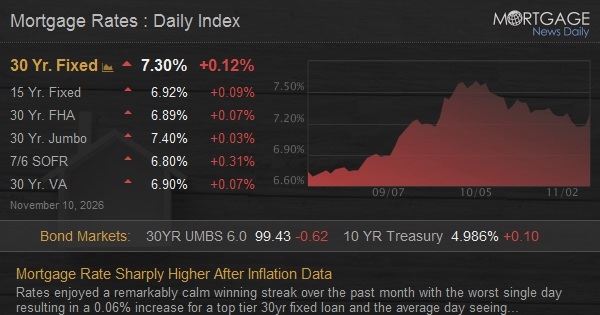
The calm that defined the mortgage market for the past month evaporated on Tuesday as a hotter-than-expected Consumer Price Index (CPI) report forced bond yields higher.
After a period of stability where daily fluctuations rarely exceeded two basis points, the average top-tier 30-year fixed mortgage rate jumped 0.12% in a single session to reach 7.30%, according to data from Mortgage News Daily.
The Bottom Line:
- The 30-year fixed mortgage rate hit 7.30%, the largest single-day increase in over a month.
- CPI data revealed broad-based price pressures, complicating the Federal Reserve’s inflation-fighting mandate.
- Bond market volatility remains elevated as traders prepare for the more comprehensive PCE inflation report due in two weeks.
Inflation Data Triggers Bond Market Sell-off
Mortgage rates rose in response to the CPI print, which showed that inflationary pressures are embedded across the economy. While the Federal Reserve officially targets Personal Consumption Expenditures (PCE) for its policy decisions, the CPI acts as a high-frequency proxy that drives immediate volatility in the bond markets. Mortgage lenders, who price loans based on the yield of mortgage-backed securities, reacted instantly to the news by repricing their offerings higher.
Most categories within the CPI report showed stubborn price stickiness, with fuel-related sectors leading the surge. The report also showed large non-fuel price increases, suggesting that fiscal tightening has not yet fully suppressed consumer demand. The Federal Reserve has previously stated it is prioritizing its inflation mandate over employment data, making today's CPI report the primary focus for institutional investors.
Institutional Sentiment and Market Reaction
The bond market's sensitivity to today’s data shows the current lack of liquidity and the caution with which institutional investors are approaching long-term debt. Investors are essentially recalibrating their expectations for the yield curve, as the prospect of sustained high interest rates becomes more likely. This shift is not merely a technical adjustment; it represents a fundamental change in the cost of capital for residential real estate.
Major institutional players are now closely watching the Federal Reserve’s upcoming commentary to gauge how the central bank will interpret these latest figures. With the next PCE report still two weeks away, the market is expected to remain volatile, reacting to any signals regarding potential shifts in monetary policy.
Impact on the Main Street Housing Market
For the average American, this move toward 7.30% represents a meaningful increase in monthly debt service requirements for new home purchases. The sudden jump exacerbates existing affordability constraints that have already cooled transaction volumes across the country. Potential homebuyers are now facing a reality where the cost of borrowing has significantly outpaced wage growth, leading to further margin compression for those trying to enter the market.
This volatility also influences the broader economy by affecting 401k portfolios heavily weighted in real estate investment trusts (REITs) and financial sector stocks. As mortgage rates trend upward, the refinancing market has effectively stalled, leaving homeowners with little incentive to move or tap into home equity.
The market is currently waiting to see if these rates will stabilize or if the upward pressure will persist through the end of the year.
While 7.30% is a sharp increase from yesterday’s levels, it remains below the 7.6% peaks recorded in early October. The market trajectory now depends entirely on whether the subsequent PCE report confirms the trend identified in today’s CPI data.
Disclaimer: The information provided in this article is for educational and market analysis purposes only and does not constitute financial, investment, or legal advice. Always consult with a certified financial professional before making investment decisions.

Lee’s Cut Bridge Closure Will Block a Section of the Loop
State transportation officials will shut down the Lee’s Cut bridge on West Salisbury Street on Nov. 30, marking...

No. 1 Florida Defeats Florida State 81-72 Behind Thomas Haugh’s 21 Points
Thomas Haugh scored 21 points and grabbed 10 rebounds as No. 1 Florida defeated Florida State 81-72 on...

Southern Connecticut State Beats Saint Anselm 3-0 in NE10 First Round
Opening the Northeast 10 tournament with authority, Southern Connecticut State swept Saint Anselm 3-0 at Pelz Gym, relying...

RTD Leaders Reaffirm Commitment to Safety Following Lakewood Tragedy – RTD-Denver
An RTD bus shooting in Lakewood on November 5 resulted in the death of Lakewood Police agent Nicholas...