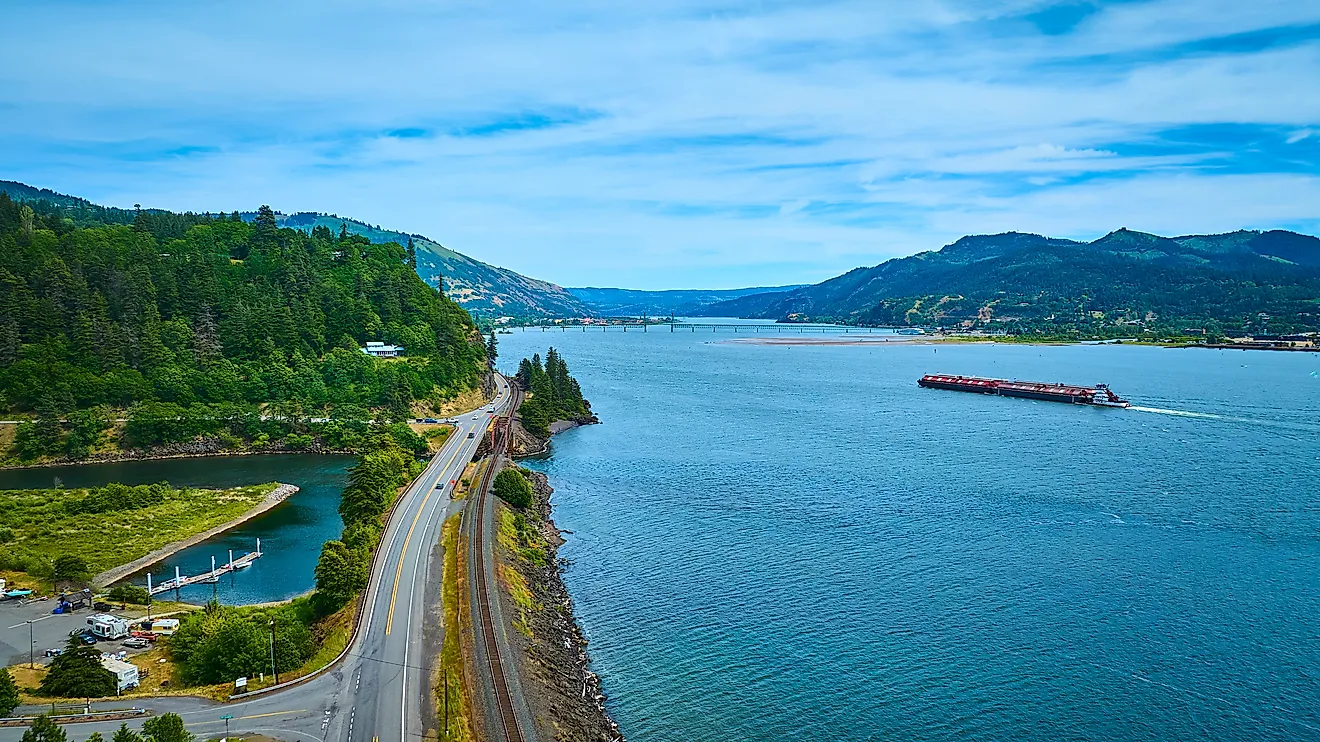
A barge traveling between the Pacific Ocean and the Port of Lewiston, Idaho, takes roughly three days to complete the 465-mile journey through a system of eight locks and dams that raise vessels 740 feet from sea level, World Atlas reported.
The route follows the Columbia River east from Astoria, Oregon, past Portland and through the Columbia River Gorge, then turns onto the Snake River at the confluence in southeastern Washington for the final 140 miles to Lewiston.
Eight dams form a liquid staircase
Four dams on the lower Columbia and four on the lower Snake each require a barge to enter a navigation lock, wait for water levels to adjust, and proceed — a process that takes anywhere from half an hour to much longer if a queue has formed. Together, the eight locks function as a staircase climbing the height of a 70-story building.

Lewiston is the farthest-inland West Coast seaport
Where the Snake meets the Clearwater River, the Port of Lewiston sits at the eastern terminus of the navigable system. Ocean-bound cargo departs from a dock hundreds of miles from saltwater, carried entirely by barge. The port exists only because the dams turned a once-un-navigable river into a dependable shipping channel maintained at a steady depth.
Grain dominates the freight
Most cargo moving on the river highway is wheat from the Palouse region of eastern Washington and northern Idaho. The Columbia is the top wheat-export gateway in the country, and a large share of that harvest begins its journey as a barge load leaving inland ports. Peas, lentils, timber, and containerized goods also ride the route.
One tow replaces hundreds of trucks
A single four-barge tow hauls the equivalent of roughly 140 rail cars or more than 500 trucks, moving tens of millions of tons of freight annually with remarkable fuel efficiency.
Worth a look

North Dakota GOP Files Federal Suit Challenging Open Primary System
The North Dakota Republican Party filed a federal lawsuit Tuesday challenging the constitutionality of the state’s open primary...

Three Citadel Cadets Arrested in a Week on Assault Charges
Three Citadel cadets were arrested on second-degree assault and battery charges in two separate incidents spanning a single...

Wyoming Mule Deer Migration Threatened by Climate, Development
Mule deer in Wyoming undertake one of the longest land migrations in the Lower 48 states, walking 300...

North Alabama Edges Alabama A&M 77-74 With Late Three-Pointer
North Alabama defeated Alabama A&M 77-74 on Tuesday night at Flowers Hall, with Cortez Graham-Howard scoring 14 points...