“There is no safe level of lead in the body, and when inhaled or swallowed, it can pose serious health risks,” said Dr. Sameer Vohra, Director of the Illinois Department of Public Health, as state officials race to prepare residents for a controlled detonation of 68 barrels of degraded lead azide at the Iowa Army Ammunition Plant in Middletown, Iowa, scheduled for noon on Friday, November 20.
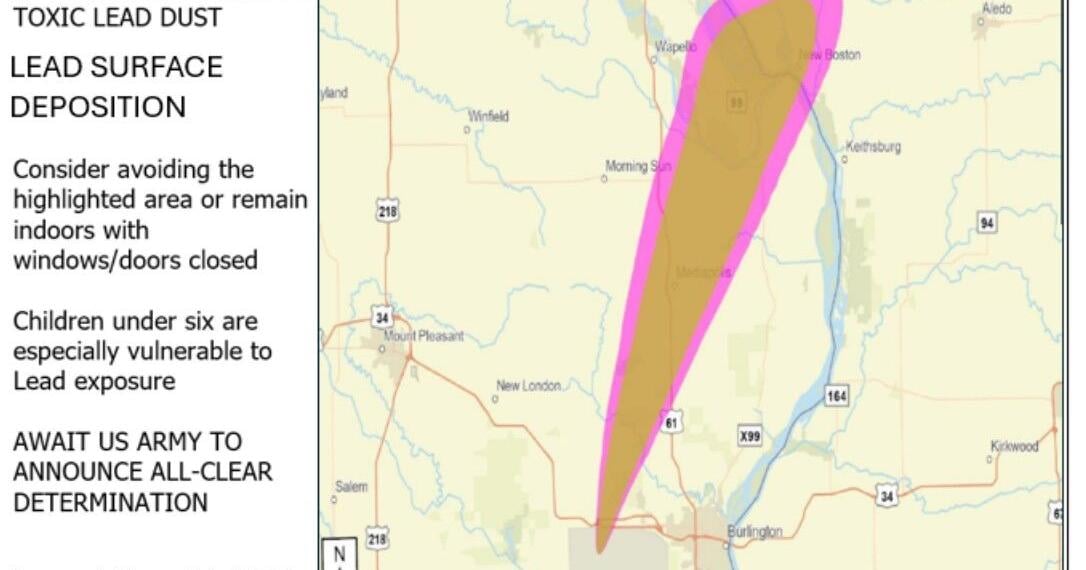
The U.S. Army plans to destroy the unstable explosive material in a controlled detonation, acknowledging the operation will send a plume of lead dust airborne. Current air modeling shows the dust could drift north and east up to 100 miles, potentially reaching Mercer County, Illinois, and possibly other western Illinois communities depending on wind shifts in the 48 hours before the blast.
Illinois EPA Director James Jennings said the Department of Defense has a responsibility to ensure its operations do not jeopardize the health of Illinois residents or the environment, noting that air pollution does not respect state lines.
A fracture in federal coordination
The Illinois EPA was not notified of the planned detonation by U.S. EPA Region 7, which covers Iowa and issued the permit under the Resource Conservation and Recovery Act. Illinois falls under Region 5.
Jennings said his agency has been in contact with Region 5 to obtain modeling and air sampling information, but no details on the breadth or methodology of the Army’s post-detonation monitoring have been shared with Illinois officials to date.
In Middletown, a town of about 300 people, City Clerk and Municipal Officer Brieanna Beck told KWWL that residents are “freaking out.” Some never received the mailed warnings from the Army. Others worry about children, livestock, and the prospect of lead dust settling on fields and playgrounds.
A shelter on the base has been offered, and some nearby residents have been warned of possible window damage from the concussive shock wave. Beck said the city has been working overtime to fill the communication gaps left by federal outreach.
Governor Reynolds learned of the plan two days before the public
Iowa Governor Kim Reynolds only became aware of the detonation on Monday, November 16, after the Army issued its public advisory, her office told KWWL.
The Army has held public meetings and a safety outreach campaign, but the late notice to the governor's office highlights what local and state officials on both sides of the river describe as a fragmented communication chain. All planning and permitting were managed at the federal level between the Army and U.S. EPA Region 7.
‼️The Army will set off two controlled detonations at the Iowa Army Ammunition Plant near Middletown on Friday, Nov. 20, to dispose of an old cache of lead azide. The Army found 68 barrels of the explosive that had been stored at the plant for more than 20 years. Lead azide… pic.twitter.com/BMWV9huBQ0
What the Army says it is doing
The Army maintains the controlled detonation is the safest way to remove the degraded lead azide from the site. In an informational PDF, officials said they have taken extraordinary measures to mitigate the plume by following strict permit requirements, including earthworks, soil wetting, and air sampling.
Pre-detonation sampling has been completed, perimeter air monitors will operate during the event, and environmental sampling of the blast radius will follow. The Army will update its exposure maps at 48 hours, six hours, and hourly until detonation, posting them at its official site.
Illinois prepares its own watch
Illinois EPA will monitor data from its northern Illinois air monitoring network and independently evaluate the Army’s modeling to determine if more Illinois communities than currently identified should take precautionary steps. The agency urged the Defense Department to conduct comprehensive post-detonation environmental sampling — air, soil, and surface dust — in potentially impacted areas of Illinois, publicly share those results, and address any impacts.

Residents in the potential path are advised to stay indoors with windows closed for 24 to 48 hours after the blast, run HVAC systems on recirculate, use portable air cleaners, wash outdoor surfaces with soap and water, and wash hands before eating.
Anyone concerned about exposure should contact a doctor about a blood lead test. Claims for alleged property damage can be filed with the U.S. Army per the FAQ document posted online.
The plume does not stop at the river
“As we witnessed during this summer’s wildfire season, air pollution does not respect state lines,” Jennings said. The detonation is permitted, the Army says, and the material must be destroyed. But the disparity between federal permitting authority and the downwind reality has left two states, a handful of local governments, and hundreds of residents waiting for a wind forecast they cannot control.
Iowa Army Ammunition Plant detonates unstable lead azide in place creating toxic dust plumes that residents cannot fully avoid. On November 20, 2026, at approximately noon, the U. S. Army will conduct two controlled detonations of 68 barrels of degraded lead azide at the Iowa… pic.twitter.com/XLgK6fRqOZ
Worth a look

Oscar Goodman Book Alleges Decades of Government Misconduct and Illegal Surveillance
"Don't accept the word of the Law simply because they wear a badge, or trust judges just because...
Can’d Aid and The Ball Foundation Announce 2026-27 Crush It Crusade Grant Recipients
Can'd Aid and The Ball Foundation have announced the 2026–27 Crush It Crusade grant class, backing more than...

Suspect Booked in Murder of 15-Year-Old Monroe High School Student
Tyson Grant, the 27-year-old charged in the October stabbing that killed 15-year-old Trenton Grant, was booked into the...

Richard H. Howard, Jr., Berlin Resident, Dies at 65
Richard H. Howard, Jr., a longtime Berlin resident known for restoring Chevrolet Novas and working the counter at...