
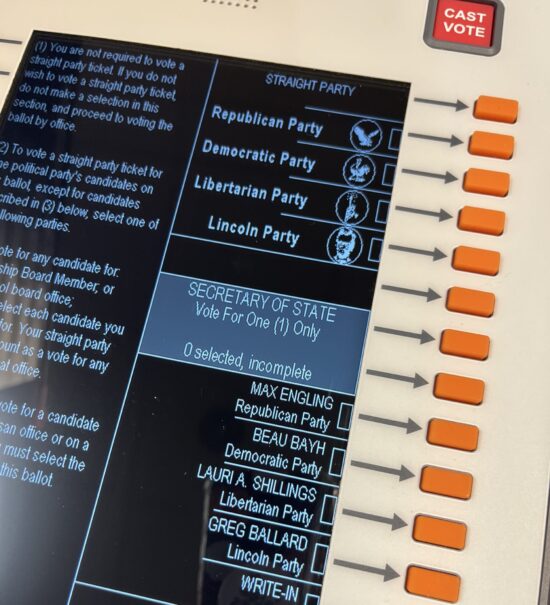
Libertarian Lauri Shillings finished 253 votes short of the threshold that has kept her party on Indiana ballots automatically for 32 years.
Preliminary returns from all 92 counties show Shillings at 38,663 votes — 1.987 percent of the 1,945,765 cast in the secretary of state race — while the 2 percent line sits at 38,916, Indiana Capital Chronicle reported. Former Indianapolis Mayor Greg Ballard, running for the Lincoln Party, cleared the bar comfortably with 70,068 votes, or 3.60 percent. County certifications were due Tuesday, but the Indiana Election Division gives counties until Friday to submit corrections.
The stakes are mechanical but severe: a minor party whose secretary of state candidate lands between 2 and 10 percent may nominate by convention. Fall short, and every Libertarian candidate in 2028 must gather signatures equal to 2 percent of the last secretary of state vote in their district. Democrat Beau Bayh won the race with 51.8 percent; Republican Max Engling took 42.6 percent.
“We cannot know anything until the final certified results are out,” Stephanie Dasbach, chair of the Libertarian Party of Indiana, told Indiana Capital Chronicle. “We will pursue any avenues we can to ensure that every vote is counted and that the election is secure.”
Dasbach said the party expected Shillings to clear 2 percent despite being “largely locked out of the media coverage given to her three opponents.” Nearly 6 percent of Hoosiers voted for minor-party candidates in a high-turnout race where the major-party nominees spent millions.
The spoiler effect nobody planned for
Ballard’s 70,068 votes — concentrated in Marion and Hamilton counties, where he drew 5.9 and 5.3 percent respectively — likely siphoned moderate Republicans who wanted an alternative to Engling, said Laura Merrifield Wilson, a political science professor at the University of Indianapolis.
Chad Kinsella of Ball State University agreed: “I think there’s a group of people out there that are disaffected … a lot of Republicans that were very happy to go for any third party because they were really angry with their party.”
Shillings still topped 2 percent in 62 counties, but the Lincoln Party’s debut cracked the coalition the Libertarians have relied on since 1994. If the preliminary numbers hold, the Libertarians lose convention nomination rights while the Lincoln Party gains them.
Absentee surge reshapes the map
The broader story is how Hoosiers voted. Nearly 45 percent of ballots were cast absentee — a category Indiana defines to include both in-person early voting and mail ballots — up from 37 percent in the 2022 midterms. Overall turnout rose to 41.9 percent of registered voters from 39.5 percent four years earlier, but Election Day voting dropped by about 94,000 ballots even as the total grew by 116,000.
“To see increases in terms of early voting and absentee voting certainly speaks to voter enthusiasm,” Wilson said. Kinsella expects the trend to accelerate: “I do expect there are going to be more people that are going to be taking advantage of those options for voting absentee.”
What happens Friday
Counties have until Friday to correct certified returns. Dasbach would not say whether the party would seek a recount or file a legal challenge if the gap remains. The next secretary of state race in 2030 offers another shot at automatic access; until then, the Libertarians will help 2028 candidates gather signatures.
The Libertarian Party of Indiana, founded in July 1974 by roughly two dozen activists meeting at the Holiday Inn near what is now Indianapolis International Airport, has held continuous ballot access since 1994 when Steve Dillon crossed the 2 percent threshold in the secretary of state race.
The party’s strongest statewide showing came in 2006, when U.S. Senate candidate Steve Osborn won about 13 percent of the vote, and again in 2020 when gubernatorial nominee Donald Rainwater received 11.44 percent, the second-best Libertarian gubernatorial performance nationally since 1982.
“Obviously, our expectations were to reach the 2% ballot threshold, but this was a uniquely challenging race and environment this season,” Dasbach said.
New 5.5-Mile Trail Network Opens on Bolen Hill in Liberty
A new 5.5-mile trail network opened this month across two protected tracts on Bolen Hill in Liberty, linking...

Blaine Girls Bowling Opens Season With Loss to Burlington-Edison
The Blaine High School girls bowling team opened the winter sports season Friday with a 1,360–1,133 loss to...

Tennessee State QB Daylin Lee Accounts for 75.5% of Offense This Season, Team Visits Gardner-Webb Saturday
Daylin Lee has accounted for 75.5% of Tennessee State's total offense this season, a figure that distills the...

North Dakota HHS Urges Food Safety, Illness Prevention and Mental Wellness for Thanksgiving
North Dakota Health and Human Services is urging residents to plan ahead on food safety, illness prevention, and...