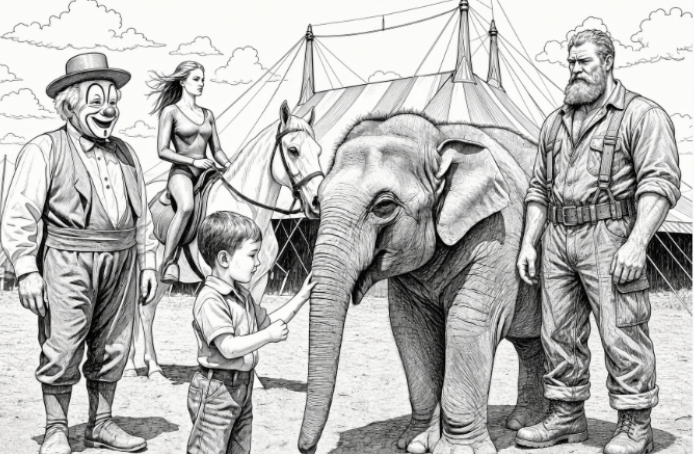
In a personal essay for Columbus County News, Jefferson Weaver recounts the summer his newspaperman father took a press job with a traveling circus and the boy found a home among the Black Gang.
The piece opens with a faded poster in a dusty storefront window — red, yellow, and blue letters spelling “CIRCUS” beneath a clown even a coulrophobic child could love. That artifact pulls Weaver back to the spring after The Dunn Dispatch closed, when a local businessman named Mr. Robert bought a circus and hired Weaver’s father as the front man, booking shows and writing publicity.
Weaver, then a self-described rotund boy nearly a foot taller than his classmates, writes that he was a misfit at school but judged on merit once he joined the crew. He became part of the Black Gang — the hands who never stood in the spotlight, who raised the bleachers for 300 spectators and ran the lights while the generator truck, the jenny, growled in the background.

Carlos, a Texan-born Mexican horseman, and his wife, a former beauty queen who rode as the featured equestrian, welcomed the boy. Pete the mechanic played drums, drove a semi, and once kept Weaver awake with a mournful flute solo long after lights-out.
The clown, billed as the oldest working clown in the world, also managed the elephants, llamas, and petting zoo; his wife reminded Weaver of his grandmother on a good day.
Closest of all was Scott, a big red-haired Pennsylvanian everyone called Kazoo because his surname was too complicated. Kazoo “pushed the jenny,” welded anything that broke, and kept a sleeper stocked with comic books, Mad magazines, and a small library of Faulkner, Shakespeare, and Hemingway. He steered the boy away from the crew quarters on “break nights” and made her laugh — a feat, Weaver notes, that year.
The circus unraveled the way small shows often do: money ran out. Carlos and his wife left for South Carolina to fetch lions and tigers and never returned. Pete won a gambling stake, unloaded his buddy’s gear, spun his tires, and vanished.
The clown and his wife, independently wealthy, departed when a promised hay load failed to appear; years later Weaver spotted the clown’s obituary — retired to Florida’s Circus Town. Finally Kazoo cranked his truck, shook the boy’s hand like a grown man, and pulled out.
Years afterward, Weaver and his wife Miss Rhonda cut through a service lane at the State Fair hoping to show her the carny row. Cables and hoses snaked between campers; a big, older man with a wild shock of red hair streaked gray worked an electrical box. The man stared at Weaver’s hat, then his face. They nodded. Both groups moved on.
The essay closes on the poster in the window: “The fears and uncertainty of the spring disappeared under a big top festooned with colored bulbs and held up with tent poles painted by hand. I was in love with a beauty queen who rode horses, I could feed elephants and llamas every day, and I had a best friend named Kazoo. What more could a boy want than to run away with the circus, even just one more time?”
Related reading

New 5.5-Mile Trail Network Opens on Bolen Hill in Liberty
A new 5.5-mile trail network opened this month across two protected tracts on Bolen Hill in Liberty, linking...

Blaine Girls Bowling Opens Season With Loss to Burlington-Edison
The Blaine High School girls bowling team opened the winter sports season Friday with a 1,360–1,133 loss to...

Tennessee State QB Daylin Lee Accounts for 75.5% of Offense This Season, Team Visits Gardner-Webb Saturday
Daylin Lee has accounted for 75.5% of Tennessee State's total offense this season, a figure that distills the...

North Dakota HHS Urges Food Safety, Illness Prevention and Mental Wellness for Thanksgiving
North Dakota Health and Human Services is urging residents to plan ahead on food safety, illness prevention, and...