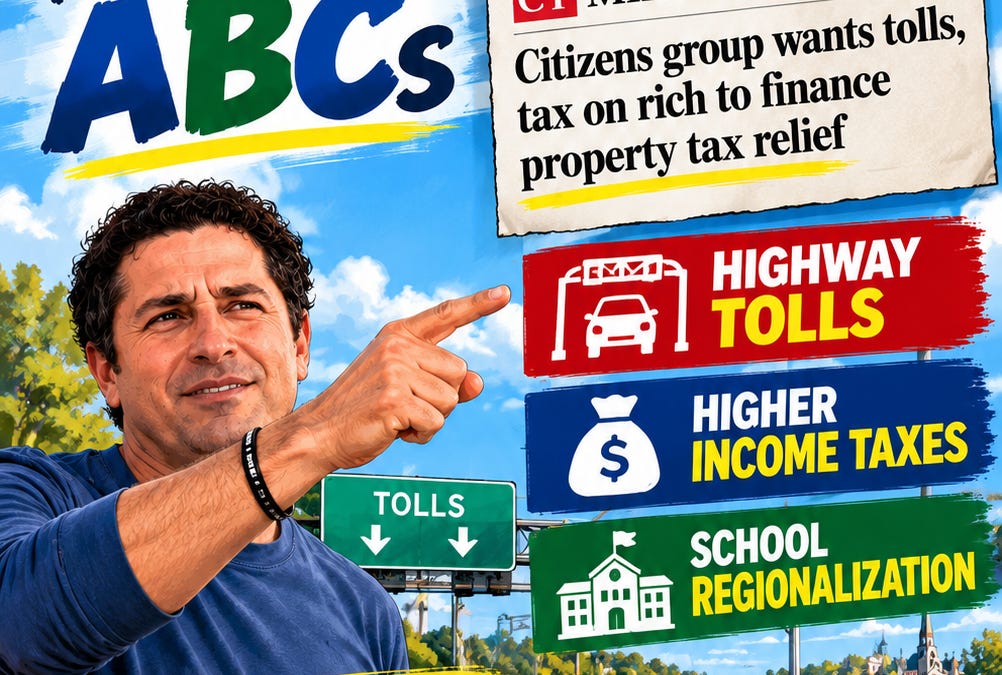
Jonathan Goldstein, a candidate for the Connecticut General Assembly, argues that recent proposals to restructure state taxes and education funding threaten the local autonomy of Greenwich and could lead to a net increase in the financial burden on residents. In a column published via his campaign platform, Goldstein claims that efforts to provide property tax relief through new levies are not reducing the cost of living for Connecticut families, but are instead just rearranging the bill.
The debate intensified following an October 26 report from the CT Mirror, which detailed recommendations from the Connecticut Citizens’ Assembly. The assembly proposed implementing highway tolls, increasing income taxes on wealthy residents, and creating incentives for school regionalization to finance property tax relief. While these are recommendations and not laws, Goldstein views them as a signal of Hartford’s intent to shift more control from towns to the state government.
The Math of Property Tax Relief
Goldstein challenges the premise that shifting tax burdens provides genuine relief. He points out that Connecticut residents already pay a complex web of income, sales, gasoline, and diesel taxes, alongside local property taxes and Public Benefits Charges on utility bills. He argues that if the state takes money from one “pocket” to put it back in another, the taxpayer hasn’t actually saved anything.
The Citizens’ Assembly did suggest eliminating municipal motor vehicle taxes and shifting special education costs to the state—ideas Goldstein says deserve examination. However, he maintains that the government must first scrutinize existing spending and resource allocation before introducing new taxes. To Goldstein, the core issue is whether the state is lowering the cost of living or simply finding more efficient ways to collect revenue.

Funding Disparities in School Construction
A central point of contention in Goldstein’s analysis is the perceived inequity in how Hartford distributes school construction reimbursements. He contrasts the experience of different municipalities to argue that Greenwich is not receiving a fair return on the billions it contributes in state taxes.
| Municipality | Reported Reimbursement Rate | Project Context |
|---|---|---|
| Fairfield | Up to 75% | General school projects |
| Greenwich | Approximately 20% | Central Middle School |
Goldstein asserts that while different rules govern these reimbursements, the gap is stark. He argues that his opponent, who has served eight years in the majority party in Hartford, has failed to secure a fair deal for the town, citing a specific instance where $8 million was brought back to the community as an insufficient return relative to the town’s total tax contributions.
The Risk of School Regionalization
The proposal for school regionalization is another flashpoint. While the Connecticut Citizens’ Assembly recommended incentives for regional cooperation rather than mandatory consolidation, Goldstein warns against the use of state funding as a tool to pressure towns into surrendering local control.
Because Greenwich already funds its schools through substantial local property taxes, Goldstein argues that any restructuring of education funding must be weighed against its impact on school quality and local accountability. He contends that Greenwich shouldn’t have to buy back its independence from Hartford, especially when the town is already paying for it.
Connecticut Women Went From Earning 97 Cents To Less Than 80 Cents On The Dollar — Hartford Must AnswerGreenwich State Rep. Candidate Jonathan Goldstein Connects Widening Wage Gap, Affordability, Domestic Violence and Women’s Economic Independencehttps://t.co/SpyQsWPEl7
“I’d rather be heard from the minority table than sit quietly with the majority.”
Goldstein acknowledges that if elected, he would likely be in the minority in Hartford. However, he frames this not as a lack of power, but as an opportunity to be the “noisy” voice at the table that forces the majority to listen. Drawing on his background as an attorney and construction professional, he claims that influencing outcomes is about facts and negotiation rather than simply controlling the room.
Priorities for the General Assembly
Looking toward the November 3 election, Goldstein has outlined a platform centered on affordability, local control, and environmental infrastructure. He is calling for a temporary suspension of gasoline and diesel taxes and a more transparent approach to the Public Benefits Charge in state budgeting.

Beyond taxes, he identifies sewage pollution in Long Island Sound and the resulting beach closures as a critical infrastructure failure that requires state attention. On the issue of governance, he insists that Greenwich must retain authority over its own zoning, housing, and infrastructure to prevent Hartford from dictating the town’s future growth.
The tension between state-level redistribution and municipal independence remains the defining friction of the campaign. As the state considers the Citizens’ Assembly’s blueprint, the question for Greenwich voters is whether the current representation in Hartford is sufficient to protect the town’s interests or if a more adversarial voice is required to prevent the rearranging of the bill.
Keep reading

Paul Pierce reportedly drowning financially per court documents
Paul Pierce, the 2008 NBA Finals MVP who earned nearly $200 million during a 19-year professional career, is...

Gov. Wes Moore Campaigns Across Western Maryland for Second Term
Governor Wes Moore is spending the final days of his re-election campaign in Maryland's western counties, framing the...

83% Higher Elk Harvest Reported at Augusta Game Check Station
Opening weekend for the 2026 general rifle season saw a surge in both hunter participation and big-game success...

Gayle Benson Praises Fans After Historic Saints Game in Paris
The New Orleans Saints are pivoting from a disappointing performance on the field to a long-term economic play...