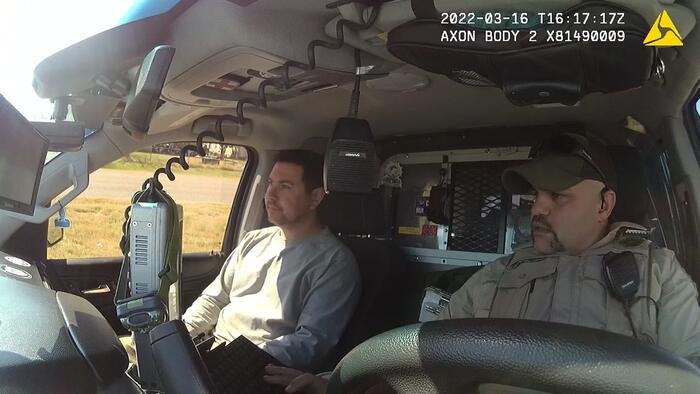
A federal jury in Bexar County awarded Houston resident Alek Schott $76, one dollar for every minute deputies detained him during a March 2022 traffic stop on Interstate 35.
The jury found the county violated Schott’s Fourth Amendment rights three times, according to his attorney Christie Hebert of the Institute for Justice.
Schott, who works for his dad’s company, RMS Controls, was driving north near San Antonio on March 16, 2022, when Deputy Joel Babb ran his license plate twice and pulled him over for allegedly drifting over the fog line. Schott’s dash camera showed he stayed in his lane, and Babb’s patrol vehicle lacked a forward-facing camera.
Babb told Schott he was with a criminal interdiction unit targeting human and drug smuggling. He questioned Schott for 76 minutes, called a K-9 unit, and searched the truck without consent or a warrant after the dog alerted. Deputies found nothing illegal.
About 34 minutes into the stop, Deputy Martin Molina arrived with the K-9. Body camera footage captured Babb telling him, “It’s the one I was looking for. They’ve been tracking it.” Court filings cite “prior intelligence” from a “Laredo Fusion Law Enforcement Center,” but no agency contacted — including the Laredo Police Department, San Antonio Police Department, Texas Department of Public Safety, and U.S. Customs and Border Protection — confirmed such a center exists.
“It seems as if everything that he said before is all based upon this being tracked already,” said Howard Henderson, professor of justice administration and the founding director of the Center for Justice Research at Texas Southern University, who reviewed the footage.
“So, I don’t know how valid anything else he said is.”
Hebert alleges deputies used an unofficial WhatsApp group to share automated license plate reader data and target drivers based on travel patterns, including trips to border towns. “They wouldn’t have actual traffic violations to pull people over,” she said. “Instead, what was happening was license plate readers were flagging people for their travel.”
The Bexar County Sheriff’s Office stated it could not comment on cases involving past or current litigation. An open records request seeking policies on data access, interagency sharing, and misuse safeguards had not been answered by the time the story was published.
“This isn’t about money,” Schott said. “This is about protecting people’s rights.”
Related reading

No. 1 South Carolina Routs Tennessee State 119-38 in PowerHER Player Classic
No. 1 South Carolina routed Tennessee State 119-38 on Saturday in the PowerHER Player Classic, improving to 8-0...

UNL Professors Host Black Friday Pizza, Pie and Board Games for Students
University of Nebraska–Lincoln mathematics instructor Kevin Gonzales and accountancy instructor Amanda Gonzales hosted their annual Thanksgiving-week gathering for...

Patrick P. Henry, West Seattle Mortgage Lender and Bocce Player, Dies at 68
Patrick Picardo Henry, 68, of Seattle, died on November 12, 2026, West Seattle Blog... reported. He was born...

Globe: Lawmakers Load Essential Bills With Giveaways in Lame-Duck Session
Massachusetts lawmakers were expected to use a new lame-duck rule to pass essential bills but instead loaded major...