
The NASDAQ dropped 10% last week, its steepest weekly decline since the pandemic, as investors fled the concentrated tech trade that has driven U.S. markets for years.
Financial Times markets columnist Katie Martin told Wyoming Public Media the selloff was brutal but not shocking. “I’ve been writing about what’s been going on with tech in the U.S. stock market, which obviously is the biggest, baddest stock market of all,” she said. “It’s been looking frothy for a while, right? There’s been lots of signs of excess there.”
Warning signs appeared months ago
The first tremors hit Korean markets over the summer. Those exchanges are packed with semiconductor and memory-chip makers, making them a leading indicator for the global tech cycle. When they cracked, Martin said, it signaled the broader unwind was coming. “And then there’s just been one thing after another that has made it worse and worse.”
Institutions can’t hide from the trade
Big institutional investors are the ones heading for the exits, but escaping is difficult. Tech stocks now account for roughly half the U.S. market, and a tiny clutch of names commands at least a quarter to a third of total market capitalization. “If you don’t like tech, it’s very, very difficult to hide from it,” Martin said.
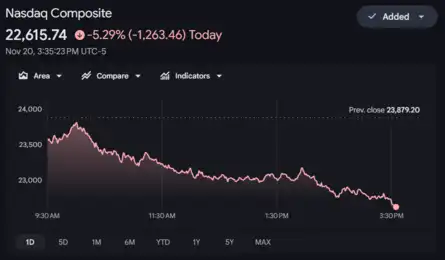
Diversification hasn’t offered much shelter. Emerging-market indexes have become heavily weighted toward the same Asian chip stocks, so rotating geographically just replicates the bet.
Debt-fueled buildout raises rate sensitivity
The massive data-center projects powering the AI boom aren’t funded from cash “kicking around behind the sofa,” Martin said. They’re financed with borrowed money, which makes the sector acutely sensitive to interest rates and the appetite of corporate-bond buyers. That leverage amplifies any downturn.
Anthropic listing marked a sentiment peak
Martin pointed to Anthropic’s massive stock-market listing as a classic signal of excess. “When you have really big kind of fizzy investment themes, and they start to get a bit stretched and a bit too much, one of the ways you can often tell that these things are getting a bit too much is that you have massive stock market listings,” she said.
“And I think for a lot of people, that was just the point at which they said, OK, I’m out. This is just making me uncomfortable.”
Thanksgiving week adds volatility risk
Markets reopen Monday into a truncated Thanksgiving week. Thin holiday volume tends to exaggerate price swings. “There’s generally not so much trading that happens in that week, so it could be quite jerky,” Martin told Wyoming Public Media. The index isn’t deeply negative for the year yet, but she called it “a real stinker of a year for U.S. stocks so far.”
What happens next
The critical question is whether buyers treat the drop as a bargain opportunity or the start of a deeper unwind. “It will be really interesting to see next week whether people say, ooh, there’s some bargains there, I’m going to pick up some stocks on the cheap, or whether they think this is just the beginning of something really ugly,” Martin said.
Worth a look

Lions Place Cade Mays on IR, Re-Sign CB Whiteside, Elevate LB Pappoe
The Detroit Lions bet $25 million on Cade Mays to fix their center problem; instead, he has played...

Wichita State Athletics Reports on Family Experience at Nov 21 Game
The pursuit of a core family memory often involves a high degree of unpredictability, especially when the participants...

IU Indy Swim Team Finishes Men Second Women Third at Invitational
IU Indianapolis swim and dive closed the House of Champions Invitational with men second and women third on...

Connecticut River Museum Hosts Story of Snow With Mark Cassino and Jon Nelson, PhD on January 2, 2027
The Connecticut River Museum hosts The Story of Snow with Mark Cassino and Jon Nelson PhD on January...