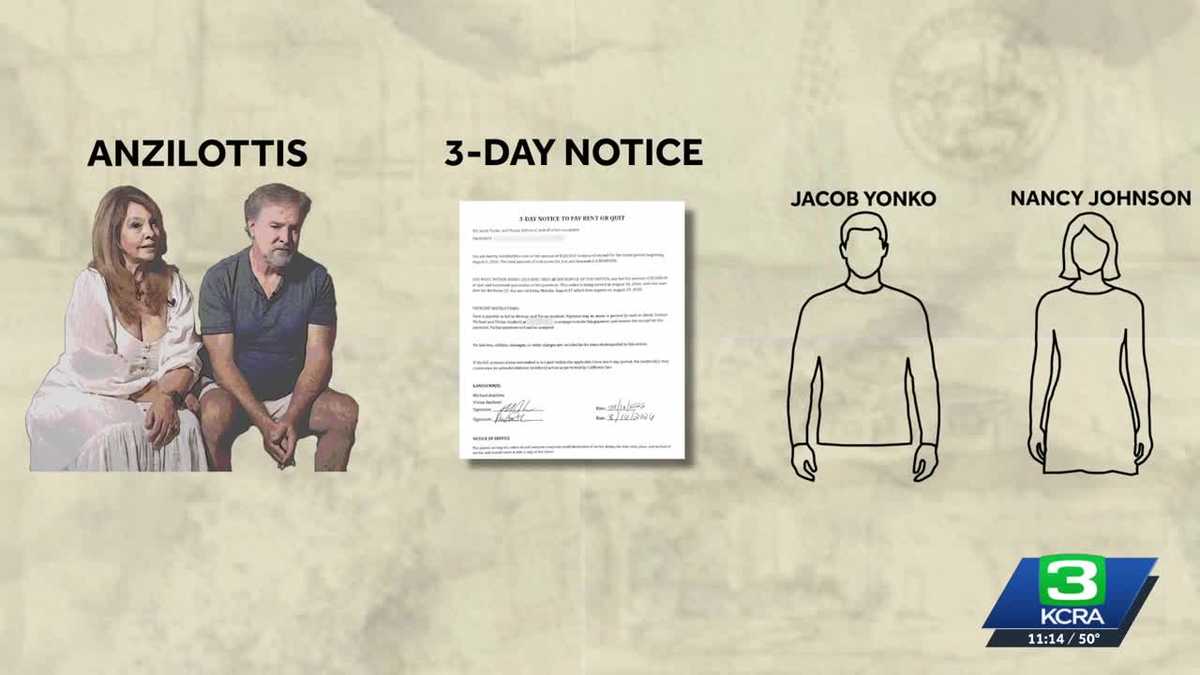
In California, some evictions are confidential and restricted from public access, unless a landlord can get a judgement within 60 days of filing suit.
A KCRA 3 investigation highlights a potential loophole in California’s tenant-court process. In Placer County, Roseville landlord Amanda D’Amico rented a home to Jacob Yonko and Nancy Johnson. They paid a deposit and rent for two months, then stopped paying while still occupying the property.
After the payments stopped, D’Amico initiated an unlawful detainer case. Yonko and Johnson never appeared in court, resulting in a default judgment in her favor. However, she incurred substantial costs. “They punched holes in the doors. In the walls.”

A similar situation unfolded for Michael and Vivian Anzilotti, who rented their newly purchased Carmichael home to the same couple. “They were our first renters,” said Vivian Anzilotti. “They sent us a lot of documentation that looked very good.” The couple paid the deposit and first month’s rent before payments ceased.
D’Amico reported that the documents Yonko and Johnson presented to rent her home weren’t real.
Attorney Mark Reichel, who is not involved in the cases, explained that California laws like the 2019 “Tenant Protection Act” were designed to protect tenants from bad landlords. “The problem with that is if the landlord is the victim of a crime, right?” he said.
Reichel argues these laws may have created a loophole. “There’s a huge hole in good legislation that is going to be abused and the victim is going to be the landlord,” he said.
Under California law, most evictions are confidential and restricted from public access unless a landlord obtains a judgment within 60 days of filing suit. This means many evictions do not appear on background checks, allowing problematic renters to pass scrutiny.
KCRA reported finding two more restricted cases in Northern California involving Yonko and Johnson. While more than a dozen cases were found in Texas and Arizona, they lack personal identifying information, making it impossible to confirm they are the same individuals.
Both landlords filed police reports. D’Amico with Roseville Police and the Anzilottis with the Sacramento County Sheriff’s office, alleging fraud. When confronted, Yonko and Johnson vacated the property. “He [Yonko] said ‘well, we’re going to get out,’ you know, ‘I’m ashamed of myself’ and things like that. They wanted to be out by the 20th and they were,” the Anzilottis said.
KCRA 3 Investigates attempted to contact Yonko and Johnson but was unsuccessful, as two of their phone numbers were disconnected and the third went to voicemail. An email to Nancy Johnson also received no response.
Keep reading

Maryland State House Second-Floor Leadership Transition Announced
Yesterday, November 25, marked a formal transition in leadership on the second floor of the Maryland State House,...

North Dakota State Needs Win at San Jose State to Reach 10 Victories
North Dakota State sits 9-2 and needs a win at San Jose State on Friday to become only...

Eastwood Christian School Area Lists 3,300 Homes for Sale
Eastwood Christian School, a private K-12 institution in Montgomery, Alabama, serves 234 students and anchors a residential market...

Necedah Man Charged After Striking Deputy With Crowbar
TOWN OF NECEDAH, Wis. — A Necedah man was shot by a Juneau County sheriff's deputy Wednesday after...