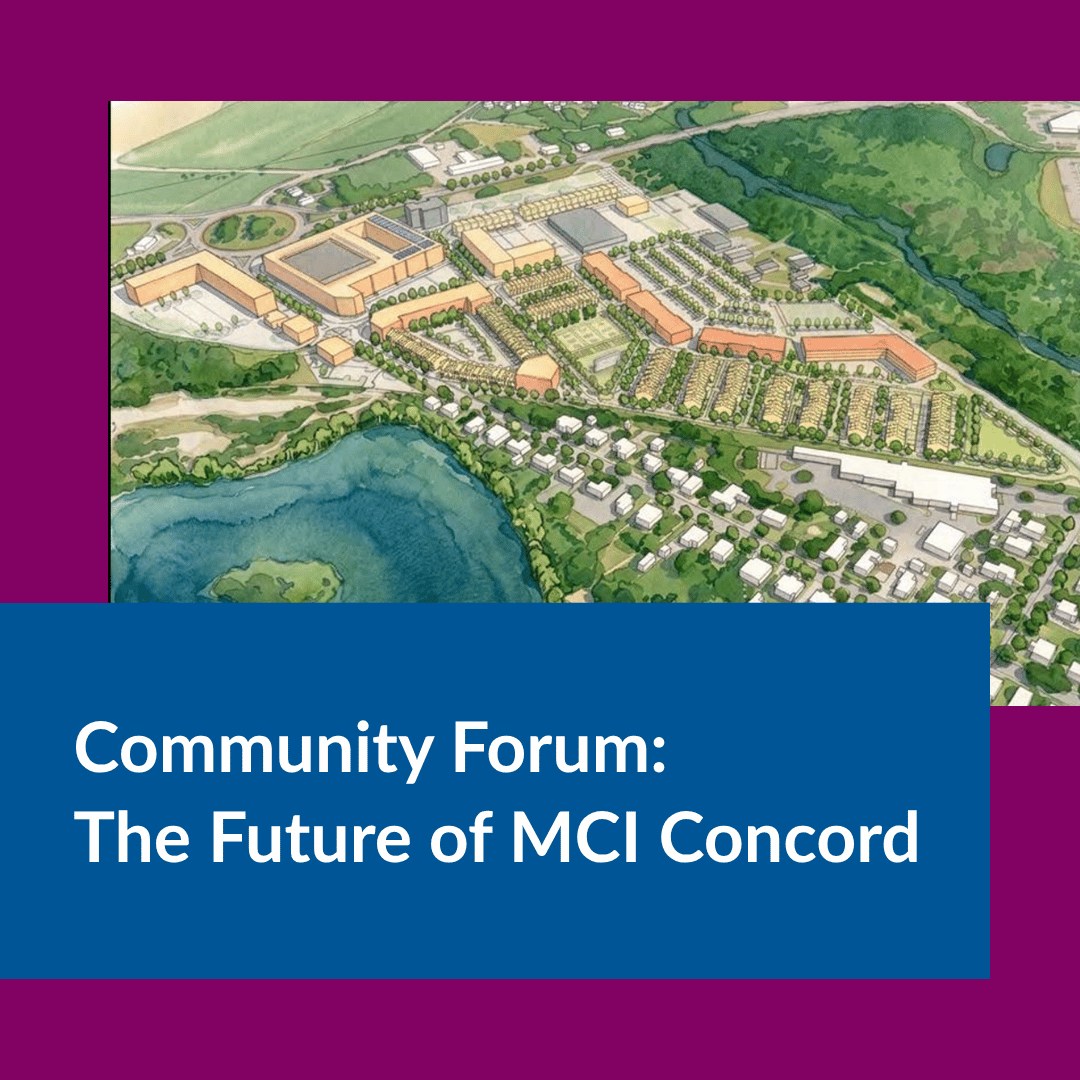
State legislators are pressing Concord to hold a rezoning vote at the May Town Meeting to guide redevelopment of the former MCI-Concord prison property, The Concord Bridge reported.
The state owns most of the MCI property and plans to transfer it to developers. Local zoning rules would shape the project, but the package must pass Town Meeting to take effect. Without local action, the state could build more than 200 housing units without town input under the Massachusetts Affordable Homes Act, and the reuse could include certain industrial uses, Simon Cataldo said.
“We should figure out a way to get to yes,” Cataldo told The Concord Bridge. “We need to be thinking about ‘What is the community benefit for Concord? What’s going to get people to vote yes, and what is a realistic number of housing [units] to get enough people to vote yes?’”
At a League of Women Voters forum on November 6, Cataldo described volunteers being “met with pitchforks” and warned that delaying the vote would “shift the conversation in ways that don’t benefit the town.”
Incoming state Rep. Ravi Simon, who ran uncontested to succeed retiring state Rep. Carmine Gentile, echoed the urgency. “That agency comes with a responsibility to deliver a yes vote on time at Annual Town Meeting,” Simon told The Bridge.
State officials estimate the site could support up to 1,000 housing units alongside stores and a new public works campus. Concord Housing Foundation President Frank Feeley is pushing for 600 to 700 new homes, warning that traffic concerns could torpedo the project.
“The last thing we want is either to kill this or have the state find some way to go around the town,” Feeley told The Bridge.
DCAMM spokesperson Hannah Carrillo said the town’s work “has provided great momentum for this effort,” adding that a rezoning holdup “will result in an equivalent delay in the state’s ability to advance the project.”
Opened in May 1878 as the New State Prison, MCI-Concord became the Massachusetts Reformatory in 1884 and was renamed MCI-Concord in 1972 as the state’s oldest running prison for men under the Department of Correction. Before its 2024 closure, the medium-security facility operated a reception and diagnostic center and housed central administrative units including the Central Date Computation and Central Records units, with a design capacity of 550–600 that had fallen to roughly 300 inmates.
MCI Concord Master Plan Committee co-Chair Dan Gainsboro said officials are working to answer key questions and “enhance the likelihood that [plans] won’t be dead on arrival.”
Torrington Attorney and Community Leader Charles Frederick Brower Dies at 88
Charles Frederick Brower, a Torrington attorney and community leader, died November 15, 2026, at age 88, Phalen Funeral...

Sue Ann Litster Thomas, 79, Dies in West Valley City, Utah; Known for Voice, Potato Salad
"She could reach notes with her voice so high she gave you chills," the obituary said of Sue...

2023 Lincoln Corsair Standard Listed at $30,995 With 5.99% APR Financing Offer in Vandalia, Ohio
A 2023 Lincoln Corsair Standard is listed for sale as a certified pre-owned vehicle at Beau Townsend Nissan...

Leanne Morgan Brings ‘Time of Our Lives’ Tour to North Charleston Coliseum; Calls Charleston a Second Home’
Comedian Leanne Morgan will bring her "The Time of Our Lives" tour to the North Charleston Coliseum on...