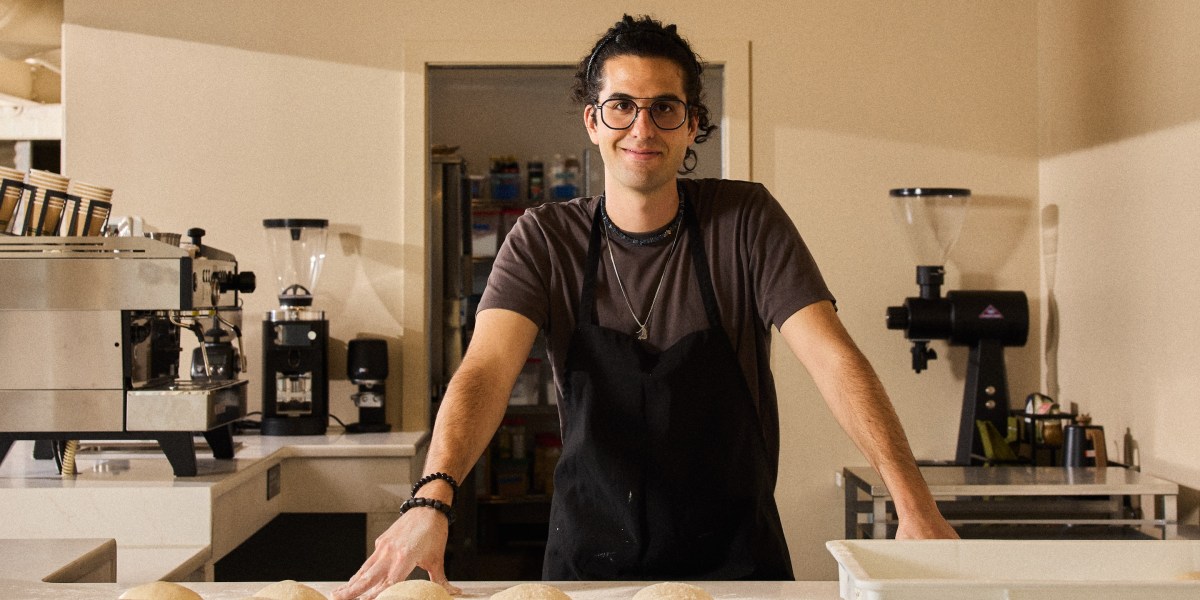
Manna Bakery in Philadelphia now generates about $120,000 in monthly revenue, up from a college apartment operation where founder Saif Manna mixed every batch by hand without a stand mixer.
- Manna launched the business in March 2021 while studying political science at Temple University.
- He opened the permanent storefront for a little over $100,000 after declining spaces requiring $300,000-plus buildouts.
- The bakery employs around 20 people and projects $1.8 million in first-year revenue.
- Philadelphia magazine named his extra-brown-butter chocolate chunk cookie the city’s best in 2026.
From lobby table to citywide pop-ups
Manna began selling cookies in his apartment building lobby and on campus, taking orders through Google Forms for pickup downstairs. His building, home to roughly 200 residents, allowed the sales. “To be honest, at that point, I really wasn’t thinking of permits,” Manna said. “I was just, you know, a young college student just trying to do what I love.” He kept prices in line with other local bakeries rather than charging a premium or compromising on ingredients, making less than $2 in profit per baked good at the start.
A customer suggested he take his pop-ups beyond campus and recommended Herman’s Coffee, known for hosting vendors. Manna secured a date and baked pastries in his apartment kitchen for the event. Other café owners saw the lines and began inviting him through Instagram. “Customers who came for his pastries often bought coffee as well,” Manna said, describing the mutual benefit.
By 2023, farmers’ markets with years-long waiting lists were inviting him in, first in Germantown and then at larger markets across the city. “We became part of people’s weekly or weekend habits,” he said. At peak, he sold 800 to 1,000 pastries in three hours at a market.
Borrowing a pizzeria’s kitchen at 2 a.m
When his apartment kitchen reached its limit, Manna avoided renting a commercial kitchen — where rent could run around $2,000 — by using the off-hours kitchen of Char Pizza, owned by his friend Viraj Thomas. Char did not open until 4 p.m., so Manna woke at 2 a.m. to bake when the space was empty. The pizzeria was four blocks from his apartment, letting him run back and forth throughout the day. “I just need to mix one time instead of mixing ten times,” he said of the commercial mixer.
The arrangement grew from a one-time favor to five days a week of production.
His first hire was his now-wife, Stefaniya Surikova. “She was a free hire though,” Manna laughed. “I didn’t need to pay her actually.”
He built a team of four bakers for the markets but found himself working 18 hours a day, every day of the week. “When I started to work 18-hour days every single day, I realized that I can’t survive doing this for very long,” Manna said.
Beyond the kitchen share, Manna turned campus density into a zero-rent launchpad: he sold cookies from the lobby of his 200-resident Temple apartment building and on university grounds, taking orders through Google Forms for pickup downstairs. He priced at market rates rather than a premium, accepting under $2 profit per item to build volume and habit.
A customer’s tip led to a Herman’s Coffee pop-up, where lines drew other café owners who invited him via Instagram, creating a mutual traffic loop — “Customers who came for his pastries often bought coffee as well.”
Found ready space after long search
Manna spent more than two years searching for a storefront, passing on locations that would have required substantial renovations or stretched his budget. He signed the lease on March 1, 2026, for a space on West Berks Street formerly occupied by Essen Bakery. “The space was basically ready,” he said. "I just had to get a few chairs and opened it." He bought the existing equipment at a large discount. Total opening costs, including equipment, renovations, and maintenance, came to a little over $100,000, financed mostly through a loan supplemented by savings from his pop-ups.
“The most important business decision was to wait for the right place,” Manna said. He had considered properties that would have left him carrying much more debt, potentially hurting profitability for years. “Food businesses, again, like I said earlier, the margins are slim. Every dollar counts,” he said.
The bakery opened on July 30 and currently operates four days a week, driven by staffing capacity and quality control. Manna plans to expand to five days and eventually six as the team grows.
Keep reading
Brew Crew Ball: Brewers’ Senzatela Deal Has Up to $3M in Start Incentives
The Milwaukee Brewers re‑signed right‑hander Antonio Senzatela to a one‑year contract for 2027 that includes up to $3 million...

Job Outcomes Drive Enrollment Surge at Maritime, Aviation, Nursing Schools
Students and families are choosing colleges based on proven job placement and earnings data, driving enrollment surges at...

Meaty Cheesy Pizza Soup Recipe 20-Minute Comfort Food Fix
East Idaho News published a recipe for meaty and cheesy pizza soup on November 29, 2026, describing the...
Airbnb Listings in Sioux Falls Target Travel Nurses Near Sanford, Avera Hospitals
Airbnb listings in Sioux Falls, South Dakota, show a concentration of condos and private rooms marketed directly to...