
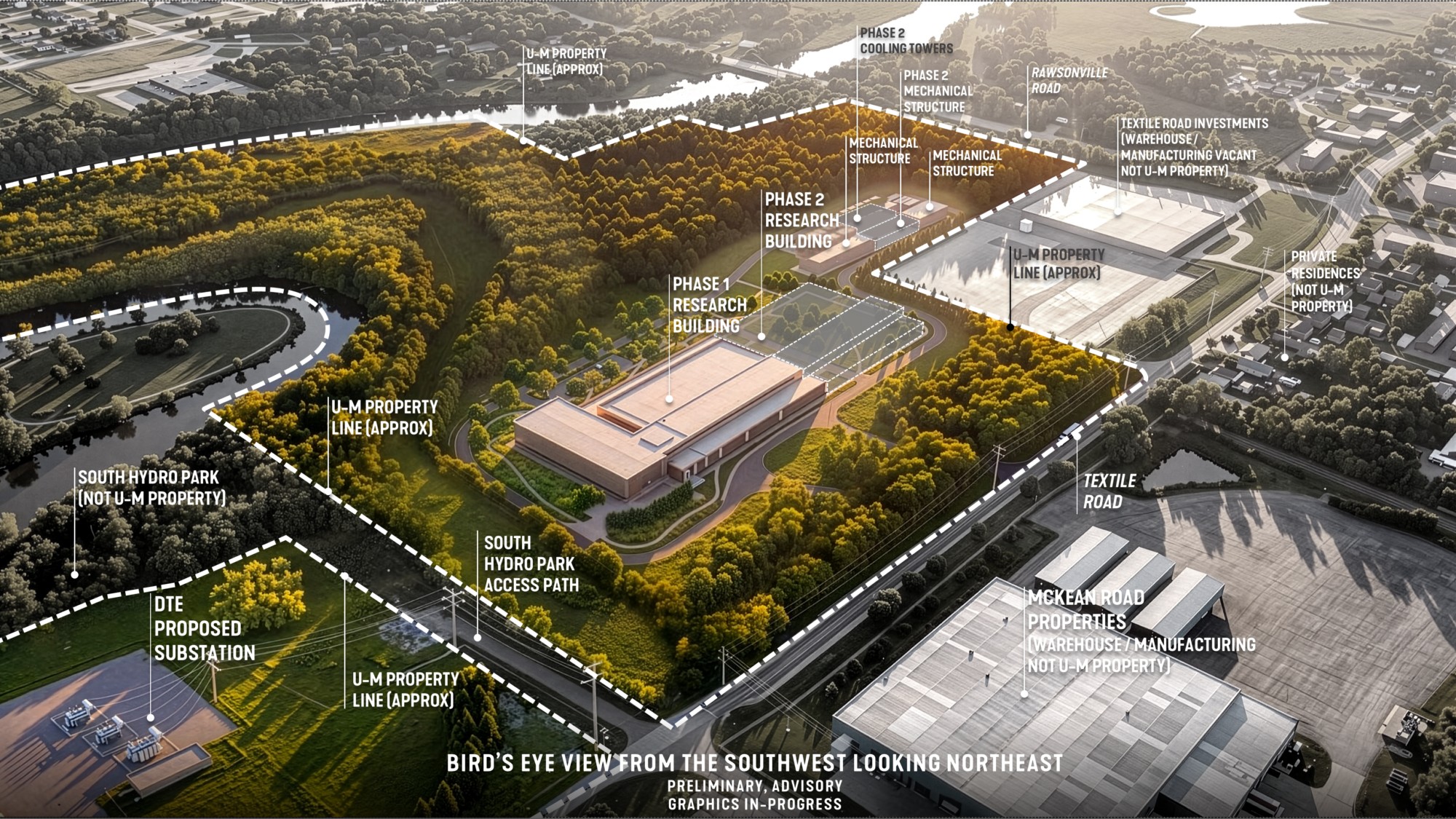
The University of Michigan Board of Regents voted 7-1 Thursday to move forward with a computing center developed alongside Los Alamos National Laboratory, authorizing bids and construction contracts for a project capped at $785 million on a 144-acre site in Ypsilanti Township.
The decision overrides formal opposition from the township board, the United Tribes of Michigan, and residents who argued the Ann Arbor university is using its state authority to bypass local zoning and place a 100-megawatt facility in a community with higher concentrations of low-income residents and people of color. Regent Paul Brown cast the lone dissenting vote.
“We worked very hard to find the right balance between the project and the community, and I think we’ve been successful,” Regent Carl Myers said during the meeting, citing planned research into cancer, clean energy, and extreme weather. The university pledged $5 million over five years for Ypsilanti-area projects spanning education, parks, public safety, and environmental enhancements, according to a community partnership resolution attached to the board agenda.
Township officials and legal counsel dismissed the package as insufficient. “The community benefits package is not a substitute for democracy,” Doug Winters, an attorney for Ypsilanti Township since 1985, told a panel discussion hours after the vote. “A check is not an environmental impact statement. A donation is not an archaeological investigation. And money is not a license to disregard a community’s rights,” he said.
Two-Phase Project Costs $785 Million
Phase one carries a $450 million price tag for 150,000 square feet, with completion targeted for fall 2031. The full build-out across two phases is not to exceed 300,000 square feet and $785 million, according to Chief Financial Officer Robert Hewlett’s memo to the regents.
Funding for the first phase combines a $100 million grant from the Michigan Strategic Fund and Michigan Economic Development Corp. — awarded in 2024 — with university bond proceeds serviced by rental payments from Los Alamos and general fund resources.
GovTech, citing previous reporting by The New Mexican, placed the total investment higher at $1.25 billion when factoring in $300 million from Los Alamos, $220 million in direct university financing, and $630 million in facilitated financing beyond the regents’ approved cap.
| Phase | Square Footage | Cost Cap | Target Completion |
|---|---|---|---|
| Phase I | 150,000 sq ft | $450 million | Fall 2031 |
| Phases I & II Combined | ≤ 300,000 sq ft | ≤ $785 million | TBD |
Nuclear Stewardship Work Raises Community Concerns
The facility will support “modeling, simulating and analyzing massive data sets,” according to the university. Its website notes Los Alamos’ national security research at the center will include nuclear stewardship and computational modeling to ensure the safety and reliability of the aging U.S. nuclear stockpile. The partnership dates to 1973 and has produced nearly 2,000 co-authored publications.
“The name ‘Los Alamos’ is synonymous with the production of nuclear weapons, going back to the Manhattan Project, when they first invented the atomic bomb. They cannot guarantee the security of our community.”
Winters said at the township panel. Jay Coghlan, director of Nuclear Watch New Mexico, echoed those concerns to residents Thursday evening, warning of the risks tied to nuclear weapons-related computation.

Environmental worries center on the site’s location along the Huron River. Outgoing President Domenico Grasso stated Thursday, “We will not have any negative impact on the Huron River.” Yet opponents cite noise, generator emissions, and the strain of a 100-megawatt load on local infrastructure as unresolved threats.
Tribes Oppose Project over Burial Sites
The United Tribes of Michigan, representing the state’s 12 federally recognized tribes, passed its own resolution opposing the project. “Ypsilanti Township is along the Huron River in Southeastern Michigan and is located in an area that was used by Indian tribes for river and trail travel throughout history,” the resolution says. “The area includes many sites of burials and other locations indicating indigenous usage.”
Hours after the regents’ vote, the township hosted a public panel detailing opposition. The university’s community partnership resolution commits to establishing a Community Advisory Committee and measurable goals for transparency, but township leaders argue the process lacked genuine consultation from the start.
Los Alamos National Laboratory was established in 1943 as Project Y, the secret Manhattan Project site where the first atomic weapons were designed and assembled, including those used at Hiroshima and Nagasaki. Chosen for its remote New Mexico mesa location at J. Robert Oppenheimer’s suggestion, the laboratory brought together thousands of scientists, including numerous Nobel laureates, under strict secrecy.
After the war, it became the primary hub for U.S. thermonuclear weapons development, producing the first hydrogen bomb designs and later pioneering the supercomputing advances required for stockpile stewardship. Today, operated by Triad National Security, LLC for the Department of Energy, it remains central to nuclear stockpile safety and reliability missions while conducting multidisciplinary research in energy, medicine, and space exploration.
Construction bids are now authorized. The first contracts will test whether the university’s financial modeling — reliant on Los Alamos rent to cover debt service — holds up under market conditions.
Worth a look

Chris Armas’ Crossword Puzzles Bring Joy to Kansas City Current
Kansas City Current forward Haley Hopkins scored the winner in the last minute of regulation against Gotham FC...

VFW Post 406 Rededicates Memorial Boulevard on Veterans Day
"Memorial Boulevard is more than a roadway; it is a lasting tribute to the courage, patriotism and sacrifice...

Randy Pierce — known to everyone
Randy Pierce — known to everyone who crossed his threshold simply as "Frog" — died on November 20,...
Sacramento Mayor Kevin McCarty Settles With Ethics Watchdog for $29,500
Sacramento Mayor Kevin McCarty paid for his family's cellphone bills with campaign money for years, a habit that...