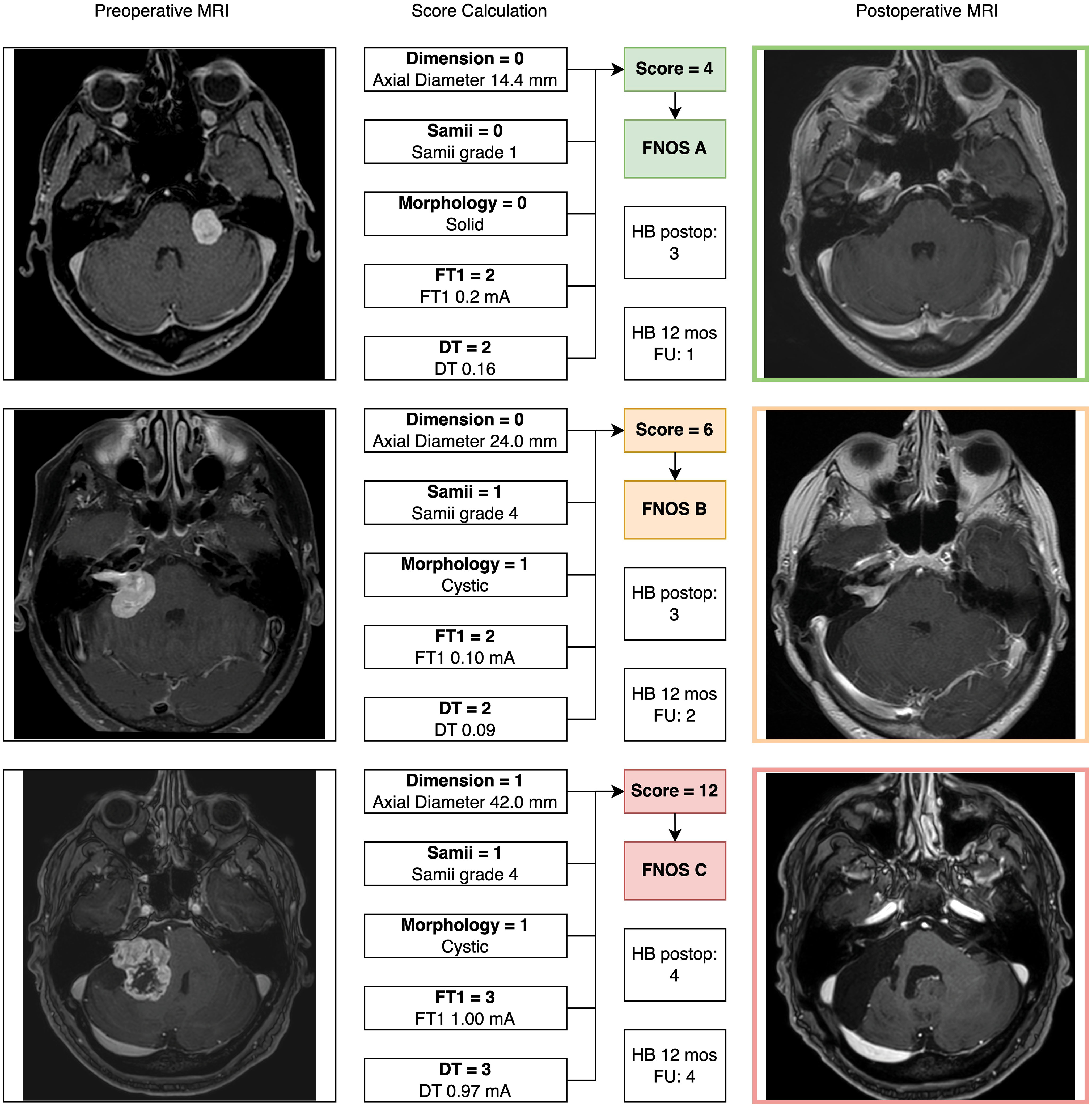
A three-patient case series published in Cureus details microsurgical outcomes for cystic vestibular schwannomas, tumors that make up an estimated 5.7% to 48% of all vestibular schwannomas and are linked to higher postoperative morbidity. The series, performed by a single surgeon using a retrosigmoid approach, achieved gross- or near-total resection in all cases with anatomical facial nerve preservation, though functional outcomes varied.
Why do cystic variants pose distinct surgical challenges?
Cystic vestibular schwannomas (CVS) differ from solid tumors in growth pattern, symptom timeline, and adherence to the facial nerve. The Cureus report notes these tumors may exhibit rapid growth and a shorter duration of symptoms before presentation.
Histologically, they arise from expansion of the Antoni B area — loosely arranged cells with microcystic spaces that can coalesce into macrocysts — surrounded by an Antoni A membrane-like sheet. Vascularization in the Antoni B region is often aberrant, with frequent hemorrhage and thrombosis, Cureus reported.
How do classification systems guide operative planning?
Two morphological classifications were applied in the series. Piccirillo et al. categorize cysts by location and wall thickness — predominantly central, thick-walled (type A) versus peripheral, thin-walled (type B). Metwali et al. emphasize cyst size, distribution, and wall thickness, identifying medially located thin-walled cysts as particularly challenging for facial nerve preservation.
In the Cureus series, one tumor was Piccirillo type A1 and two were type B4; Metwali patterns included multiple small thick-walled cysts, multiple large thin-walled cysts, and a mixed pattern.
A separate 64-patient retrospective series published on pmc.ncbi.nlm.nih.gov found that poor facial nerve outcomes were associated with giant tumors and peripherally located, thin-walled cystic tumors. That study reported complete tumor removal in 83% of patients, though ninety percent had intermediate or poor facial nerve function at follow-up despite anatomical preservation in most cases.
What were the functional outcomes in the three cases?
All three patients underwent retrosigmoid craniotomy in the semisitting position with continuous intraoperative electrophysiological monitoring. A 52-year-old man with a left-sided tumor maintained House-Brackmann (HB) grade I facial function at five-year follow-up but experienced hearing decline from Gardner-Robertson grade I to III.
An 85-year-old woman with a giant right-sided tumor (>4.5 cm) and preoperative HB grade V facial palsy remained at grade V despite anatomical nerve preservation and five-year recurrence-free survival. A 50-year-old woman with a large right-sided tumor (3–4.5 cm) maintained HB grade I facial function and had stable non-serviceable hearing at seven-year follow-up with only a small residual capsule.
The Cureus authors considered HB grades I–III as good outcomes and grades IV–VI as poor. They said that recent studies suggest facial nerve outcomes may be similar between solid and cystic tumors when matched for size and assessed after one year of rehabilitation, citing Samii and Matthies’ historical data showing anatomical preservation rates of 93% for solid versus 88% for cystic tumors.
Proposed mechanisms explain cyst formation and symptom onset
Cyst pathophysiology remains incompletely understood. Proposed mechanisms include direct osmotic effects or serum protein leakage from a disrupted blood-tumor barrier, myxomatous degeneration of Antoni B microcysts coalescing into larger cysts, and a role for matrix metalloproteinase II in degrading collagen, fibronectin, and laminin — potentially increasing peritumoral adhesions. Repeated intratumoral hemorrhages, evidenced by hemosiderin deposition, are associated with more frequent acute symptoms, Cureus reported.
Unresolved questions limit conclusions on prognosis and treatment
The Cureus series lacks a comparator group and includes only three patients, limiting conclusions about prognostic factors or comparative treatment outcomes. The response of CVS to radiotherapy remains debated, though Gamma Knife stereotactic radiosurgery has been evaluated in selected patients.
Hydrocephalus occurs in some vestibular schwannoma cases, with some becoming shunt-dependent; rapid growth, brainstem compression, and hyperproteinorrachia — commonly associated with cystic lesions — increase this risk. Whether cysts deform neural structures rather than compress them remains a contested pathophysiological question.
Related reading

Corporation Primary School Supervisor Jailed 3½ Years for S$400k Theft
A former student care supervisor at Corporation Primary School received a three-and-a-half-year prison sentence on Nov 23 for...

Joburg Council Postpones Mayoral Election to Friday as Coalition Talks Continue
Johannesburg’s inaugural council meeting adjourned on Monday without electing a mayor, speaker or deputy mayor, postponing the vote...

Cannabis Users Develop Psychosis 2.5 Years Earlier, Gap Widens to 6 Years After Age 30, Study Finds
Cannabis users develop psychosis 2.5 years earlier than non-users, a gap widening to 4.43 years for onset between...

University of Edinburgh Study Finds Personality Traits Explain Quarter of Mental Health Risk
Personality traits account for about a quarter of the overall risk for common mental health conditions, according to...