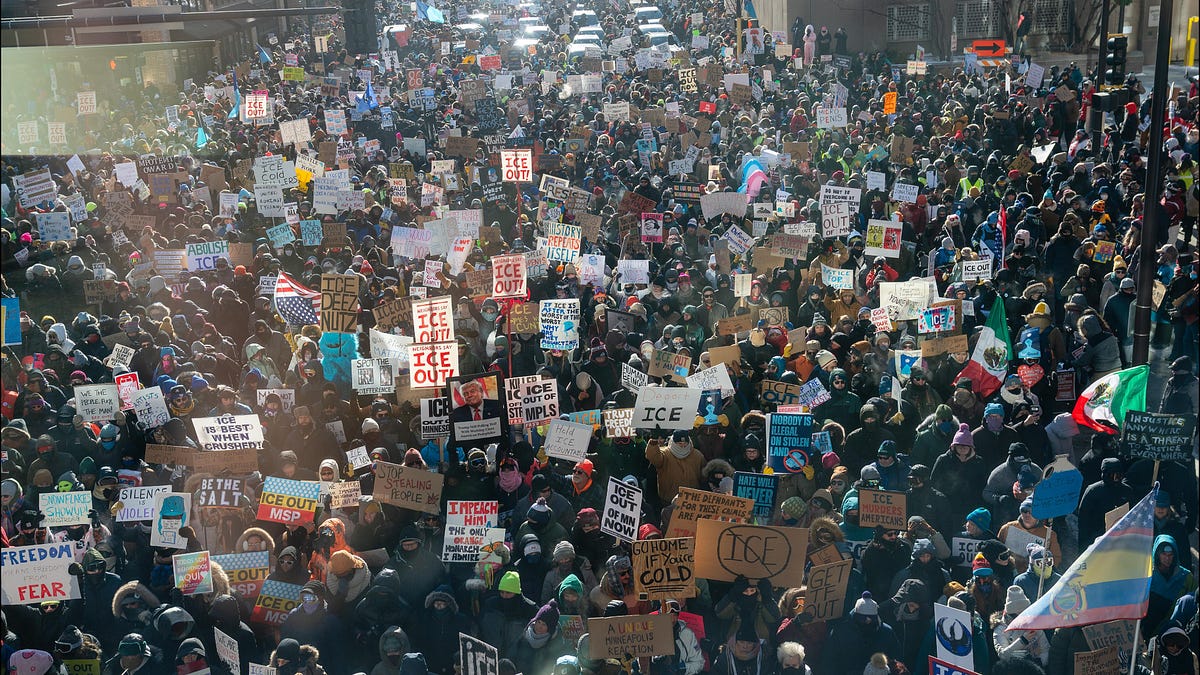
Democratic Midterm Sweep Entrenches Capitol Hill Power, Traced to Minneapolis Protests
Last night’s elections delivered a decisive rebuke to President Trump and MAGA Republicanism, with voters entrusting Democrats with entrenched power on Capitol Hill and creating a formidable barrier to the administration’s policy agenda. Despite the President’s insistence that he was not on the ballot, the results functioned as a clear referendum on his leadership, delivering numbers that will constrain his legislative ambitions in the months ahead.
Democratic wins reached far into regions where the party had previously struggled, penetrating Kansas, Florida, Ohio, Texas, and potentially Mississippi—states that will prove essential in coming years for constructing a lasting governing coalition. These advances occurred even as Elon Musk poured record amounts of cash into the political arena, and they yielded a remarkable group of new Democratic representatives, spanning the ideological spectrum, who understand the priorities of young people, are adept with media, and reject being confined by conventional, obsolete political doctrines.
January Killings in Minneapolis Sparked National Mobilization
The road to last night’s outcome ran through Minneapolis, where protests against ICE in January 2026 became a pivotal moment during Trump’s second term. During those protests, federal agents fatally shot Renee Nicole Good and Alex Jeffrey Pretti, and the demonstrations energized the country while illustrating a way to advocate for an alternative American narrative to the one promoted by MAGA Republicanism.
When numerous influential institutional figures, as Jacob Weisberg documented in his book, chose not to resist the administration and swiftly acquiesced to its requirements, prioritizing immediate personal gain over enduring institutional welfare, Minneapolis residents refused to do so. As many affluent middle- and upper-class Americans switched off the news and accepted a politics of hopelessness, and as many accepted federal agents violating the same rights the nation was supposedly about to commemorate on the 250th anniversary of the Declaration of Independence, the people of Minneapolis went into the streets and made their voices heard. In some cases, they gave their lives to make America great again.
Family of Renee Good sues US government and Trump officials over her fatal shooting by an ICE agent in Minneapolis. https://t.co/JXTNqDeHOs pic.twitter.com/SPADAlfgMu
“Citizens stood for justice, their voices ringing through the night.” — Bruce Springsteen
The protests galvanized the nation by demonstrating that ordinary Americans refused to accept the political status quo as inevitable. Federal district judges blocked unconstitutional White House actions, sometimes facing physical threats, while pro-democracy organizations prevented the administration from undermining the election—either stopping their plans or ensuring they never took off.
Grassroots Action Flipped Gerrymandered Seats
Democratic officials responded aggressively to the Republican mid-decade gerrymander, flipping the very seats that the GOP had redrawn. Party leaders and primary voters had selected smart, savvy candidates who could win in different parts of the country, a strategy that depended on the hard work of all the Americans who registered, canvassed, and turned out on Election Day.
The protesters understood the famous saying of former Speaker of the House Nancy Pelosi:
“Nobody gives you power in Washington, you have to take it.” — Nancy Pelosi
Big changes in politics depend on the extraordinary actions of ordinary people choosing to think about the “we” rather than the “I,” a choice that has driven the most consequential movements in American history. Last night, that fight bore electoral fruit. Democrats now have power, and what they do with it has the potential to redirect national politics.
Keep reading

Thrive Academy’s perfume-making STEM event inspires Baton Rouge students
At Thrive Academy in Baton Rouge, the boundary between a beauty aisle and a chemistry lab blurred recently...
Christ Episcopal Church Hosts Free Violin and Piano Recital
NEWTON, N.J. (Sussex County) — According to WRNJ Radio, Christ Episcopal Church at 62 Main St. will host...
Louisville Metro Council balance of power remains unchanged after election
Louisville voters kept the Metro Council's balance of power exactly where it was on Nov. 3, re-electing every...
Iowa Senate election results: Republicans maintain 29 seats, six uncalled
“If there is any kind of, call it whatever you want, a blue wave, a historical trend that...