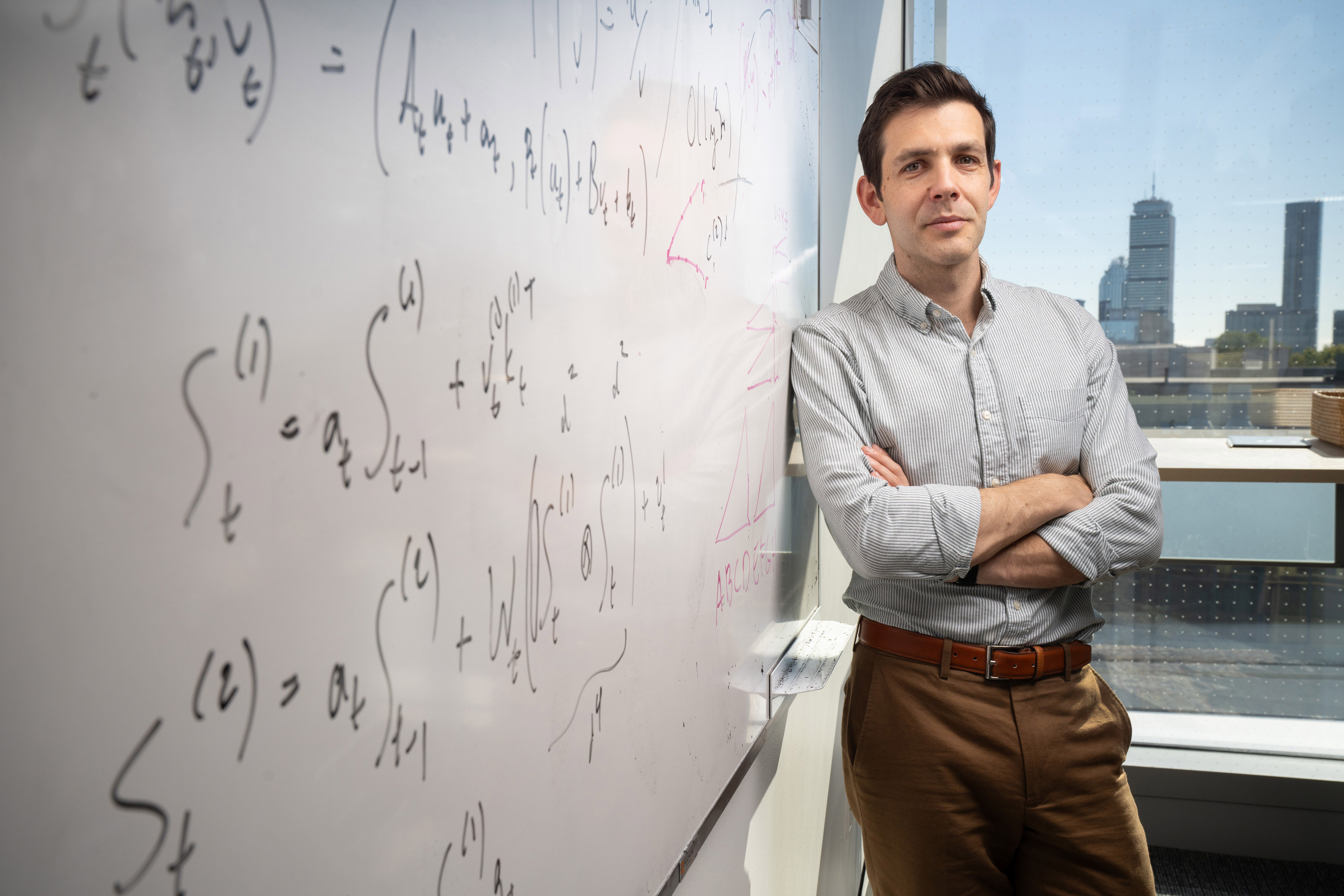
Jacob Andreas and his research group at the Massachusetts Institute of Technology want to help people design more accurate and reliable deep-learning models that are better suited for their intended application.
The rapid acceleration of artificial intelligence has left researchers staring into a digital black box. While early systems could be checked by examining their parameters, modern neural networks operate through opaque algorithms that learn complex meanings from massive amounts of text data.
“We used to debug systems just by looking at their parameters and figuring out whether they make sense or not. Now, we need ‘mind-reading tools’ that can take this really complicated neural computation and translate it for us because it is just not in a language that we, as humans, know how to speak,” he says.
Growing up in the San Francisco Bay Area, Andreas developed an early interest in computers after reading a book about a character who hacked a system to save the day. His father eventually brought home a simple BASIC Engine, launching him into computer programming.
When he arrived at Columbia University as an undergraduate, he signed up for research projects because his friends were doing it. After email-blasting the computer science department, the natural language processing faculty replied first, landing him in the lab of Michael Collins, the Vikram S. Pandit Professor of Computer Science.
Andreas completed a thesis on machine translation, adapting statistical techniques to build more powerful AI systems. He then earned a master’s degree at Cambridge University before heading to the University of California at Berkeley for his PhD under computer science professor Dan Klein.
That transition period changed the field. Statistical methods, which relied on transparent mathematical formulas, gave way to deep learning techniques.
After spending a year at the startup Semantic Machines, Andreas joined the MIT faculty in 2019. Today, his lab tackles two primary fronts: studying the science of large language models and designing new training algorithms.
His team has developed techniques that assign natural language descriptions to every information-processing node inside a massive neural network. For instance, one such description might represent an individual node that identifies “patches of grass near animals” in input images.
The field seems to completely change every three to five years, forcing Andreas and his fellow instructors to constantly rebuild undergraduate and graduate courses like Natural Language Processing. With coding agents capable of completing assignments, he pushes students to master the foundational mechanics under the hood.
“Figuring out how to enable these models to verbalize all of this hidden knowledge they have about things people have never written about explicitly will be a huge challenge and opportunity for people who work in machine learning,” he says.
Worth a look

Virginia Beach Man Sentenced to 25 Years for 2022 Fatal Shooting
Cameron Michael Mooty, 22, will serve 25 years in prison for the December 2022 shooting that left 18-year-old...
Sustainable Aviation and Green Infrastructure at Burlington International Airport
The Patrick Leahy Burlington International Airport is changing its infrastructure to prioritize carbon reduction. As passenger demand rises,...

4-Bedroom, 2-Bath Home at 3010 E. 3345 South Is for Rent
A 4-bedroom, 2-bath home located at 3010 E. 3345 South in Salt Lake City, Utah, has entered the...

Texas High School Football Playoffs: Statewide Area Round Schedule – Houston Chronicle
The University Interscholastic League (UIL) Texas high school football playoffs move into the area round this week, with...