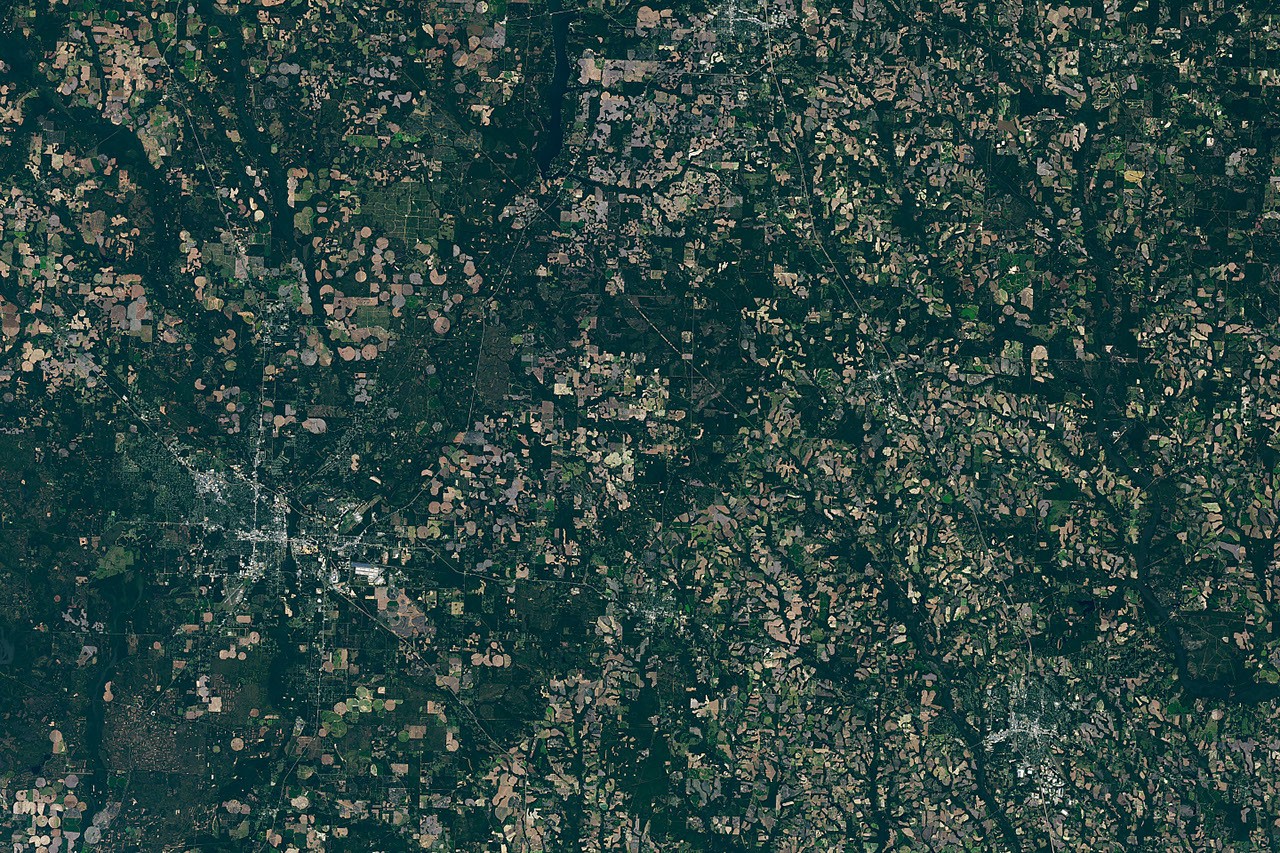
Satellite imagery captured on October 23 shows pecan orchards clustered along the Flint River in southwest Georgia, where harvest is underway and growers are managing fungal disease and hurricane recovery.
- Landsat 8 imaged Georgia’s pecan belt around Albany on October 23, 2026, during harvest season.
- USDA data show Georgia production topped 100 million pounds annually from 2023 to 2025 despite hurricane damage.
- A wet 2026 summer fueled pecan scab, a fungal disease that spots twigs, leaves and nut shucks.
- Some growers reported a solid 2026 crop while still recovering from Hurricane Helene in September 2024.
Landsat 8 captures harvest-season view
The Operational Land Imager on Landsat 8 photographed Dougherty County and neighboring counties on October 23, 2026, about two weeks into the typical October-to-December harvest window, NASA Science reported. Green and brown fields form a geometric patchwork around Albany, with vegetation tracing the Flint River north and south of the city. The image was processed by Lauren Dauphin for the NASA Earth Observatory using U.S. Geological Survey data.
Orchards clustered on sandy soils above the Floridan aquifer
The USDA’s Cropland Data Layer shows pecan groves concentrated along the Flint River within the Coastal Plain, NASA Science reported. Pecan trees require abundant water and thrive in the region’s well-drained sandy soils that sit above the Floridan aquifer system, which growers tap for irrigation.
From a 1900s planting boom to national leadership
In the late 1800s, Georgia had fewer than 100 acres of pecan orchards. An early-1900s boom in Dougherty and Mitchell counties brought thousands of acres into production, much of it sold to investors, according to historical research cited by NASA Science.
By the end of the 1950s, Georgia led the nation with more than 17 million pounds, based on the 1959 agricultural census. Production has since expanded in New Mexico and Texas, but Georgia has still topped 100 million pounds in each of the past three years (2023–2025), USDA numbers show.
Pecan scab spreads amid wet summer conditions
A wet summer across parts of Georgia in 2026 created favorable conditions for pecan scab to take hold in orchards, NASA Science reported. Growers faced added disease pressure while still managing the lingering effects of earlier hurricane damage.
At the 2026 Fall Field Day, some growers told the Farm Monitor they were seeing a solid crop return despite the scab outbreak and ongoing recovery from Hurricane Helene. The event highlighted the persistent challenge of controlling the pathogen in a season marked by above-average rainfall.
Other crops grow alongside pecan groves
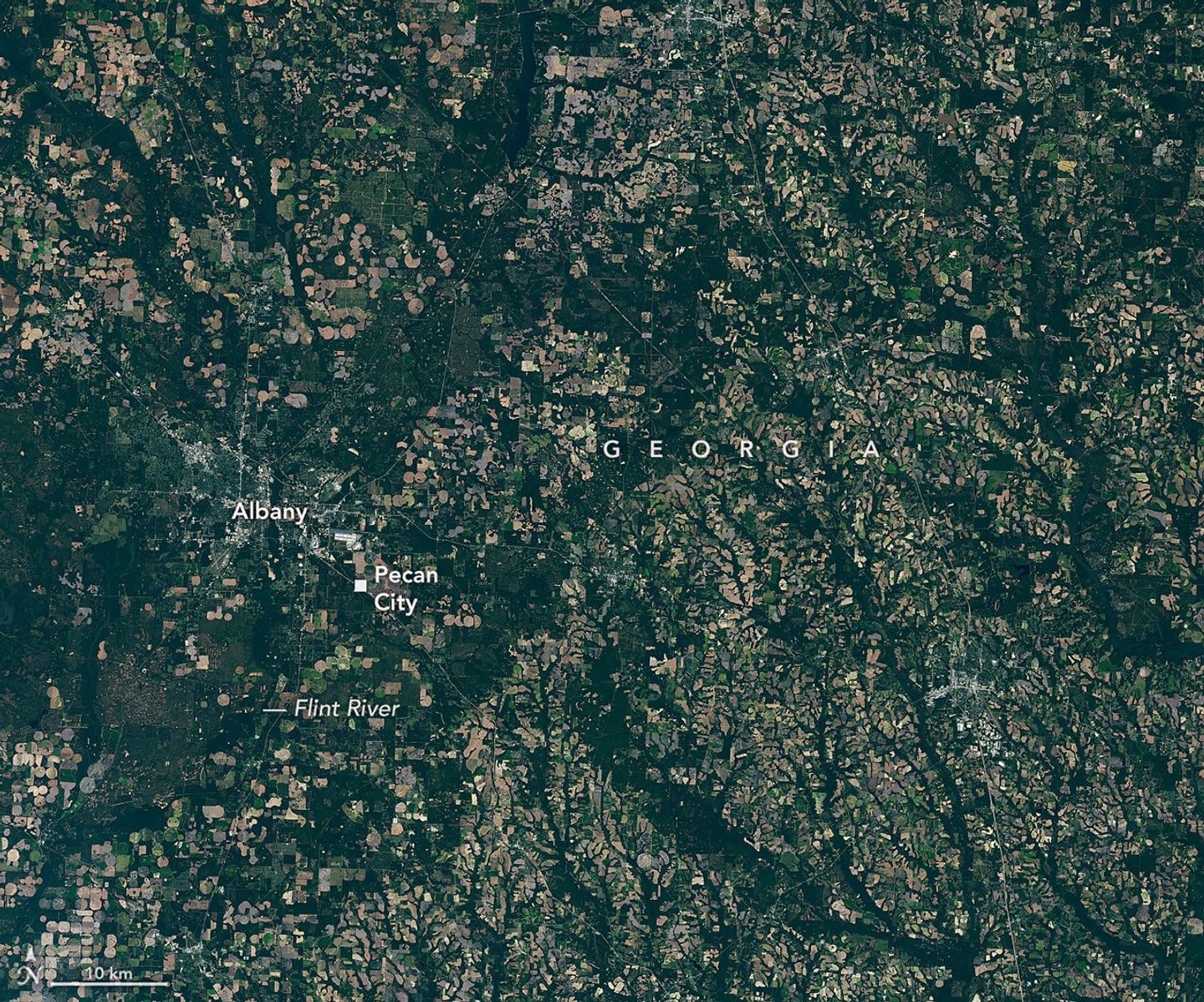
The 2025 Cropland Data Layer produced by the USDA National Agricultural Statistics Service shows that pecan orchards are interspersed with fields of peanuts, cotton and corn across southwest Georgia, NASA Science reported. The annual map of crop types across the contiguous United States draws on Landsat observations to classify land cover each year.
The diverse cropping pattern reflects the region’s well-drained sandy soils and access to irrigation from the Floridan aquifer system.
Back-to-back hurricanes and a scab outbreak
Hurricane Michael damaged orchards in October 2018, and Hurricane Helene struck inland in September 2024, NASA Science reported. A wet summer in 2026 helped pecan scab — a fungal disease that causes brown spots on twigs, leaves and nut shucks — take hold in parts of the state. Even so, some growers still recovering from Helene reported the return of a solid crop, according to the Farm Monitor’s coverage of the 2026 Fall Field Day.

South Carolina Beats UConn 65-56 Without Edwards; Arnold, Heckel Out for Huskies
No. 1 South Carolina beat No. 7 UConn 65-56 Tuesday at Mohegan Sun Arena after both teams lost...

Judge Has Not Ruled on Joint Request to Pause DOJ Lawsuit Over Utah Tuition Law
A federal judge has not yet ruled on a joint request to pause a U.S. Department of Justice...
Alaska Holiday Events Begin With 30+ Community Gatherings
Holiday events begin across Alaska this week with more than 30 community gatherings scheduled through Dec. 2. The...

Kansas Jayhawks Defeat Denver 84-67 at Allen Fieldhouse
The Kansas Jayhawks defeated Denver 84-67 on Monday night at Allen Fieldhouse, opening their version of Feast Week...