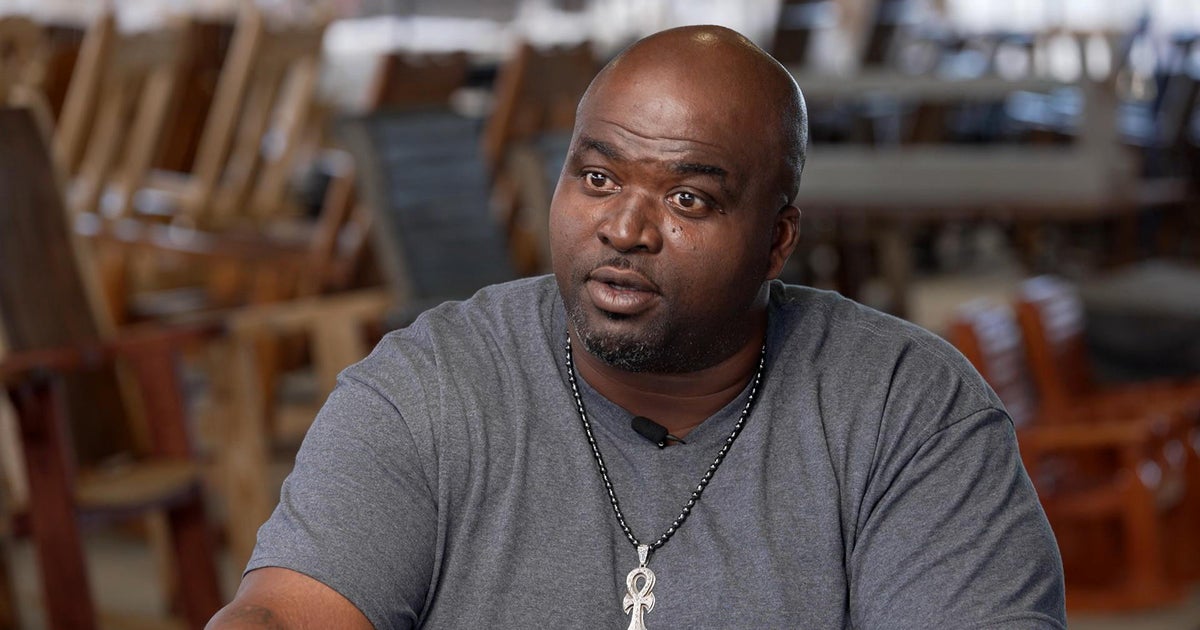
Nearly 800 people remain incarcerated in Louisiana after being convicted by non-unanimous juries, a practice the U.S. Supreme Court declared unconstitutional in 2020 but that the state declined to apply retroactively.
The high court’s ruling struck down split-verdict convictions, which Louisiana and Oregon had uniquely allowed. Oregon applied the decision retroactively, overturning hundreds of convictions. Louisiana did not, leaving inmates like Kenny Palmer and John Corley serving life sentences without parole under a system the court has since invalidated.
Palmer, known as “300,” was sentenced to life almost 20 years ago for killing a man in a drug deal. His jury voted 10-2 to convict, with the lone Black woman and an elderly white woman voting not guilty.
He spoke with 60 Minutes contributor Sebastian Junger during a visit to the Louisiana State Penitentiary, known as Angola, where Palmer sells handmade chess boards and wooden jewelry at the prison rodeo to send money to his niece.
“The only Black woman on there [and] the one elderly White woman voted not guilty,” Palmer told Junger. “You’re able to convict me with a reasonable doubt…. I’m supposed to be given either a new trial or be given a plea bargain.”
“The non-unanimous jury system is like fighting a 10,000-pound silverback gorilla on steroids. Real talk. How can you win?” he said.
Non-unanimous juries date to 1880 and were enshrined in the 1898 state constitutional convention, which hoped to “establish the supremacy of the white race in the state.” The Promise of Justice Initiative counts almost 800 people still imprisoned under such verdicts.
Corley, serving life for second-degree murder on a 10-2 verdict, said his conviction would be illegal today.
“If I were convicted today, I would not—well, I wouldn’t be convicted. That’s an illegal conviction today. They can’t do it today,” Corley told Junger.
He said the Louisiana Supreme Court deferred the retroactivity question to the legislature, where partisan politics and a lack of political will have stalled action.
“The legislature says, ‘Well, we’re not gonna mess with that.’ And so we’re still fighting,” Corley said.
Palmer now advocates with the 10-2 Committee for Equal Justice.
“What are you fighting for?” Junger asked.
The Promise of Justice Initiative (PJI) has filed more than 30 petitions seeking new trials or time-served sentences for the more than 1,500 Louisianans still imprisoned under non-unanimous jury convictions, a system the U.S. Supreme Court declared unconstitutional in the April 20, 2020 Ramos v. Louisiana ruling.
Executive Director Mercedes Montagnes and Managing Attorney Jamila Johnson of PJI’s Jim Crow Juries project have urged the Court, the legislature, and local officials to apply the decision retroactively, arguing the Jim Crow-era law continues to inflict devastating harm on predominantly Black inmates serving life without parole.
Working with over 40 pro bono law firms and 150 attorneys nationwide, PJI pursued this unprecedented litigation campaign against an April 20, 2021 deadline and filed an amicus brief in Edwards v.
“To get out of here. That’s what makes me the freedom fighter I am,” Palmer said. “We got people who’ve been locked up… 30, 40, 50 years on this law. We’re the only ones in this entire country with a non-unanimous jury verdict. Only thing we asking for is equal protection. We just want the same protection that everybody else in the country got.”
Worth a look

Montana Political Consultant Abbey Lee Cook Sentenced to Prison for $280K Campaign Fraud
Montana political consultant Abbey Lee Cook was sentenced Tuesday to 12 months and one day in federal prison...

US Education Dept. Probes St. Paul, Five Other Districts Over Gender Transition Policies
The U.S. Department of Education announced it will investigate St. Paul Public Schools and four other districts over...
Ewa Beach Man Sentenced to 204 Months for Drug Conspiracy, Felon Ammo Possession
An ʻEwa Beach man was sentenced to 204 months in federal prison on Nov. 19 for conspiring to...

South Dakota Supreme Court Orders Administrative Merger of 4th, 7th Judicial Circuits; Keeps Boundaries Intact
The South Dakota Supreme Court ordered the administrative merger of the Fourth and Seventh judicial circuits while keeping...