
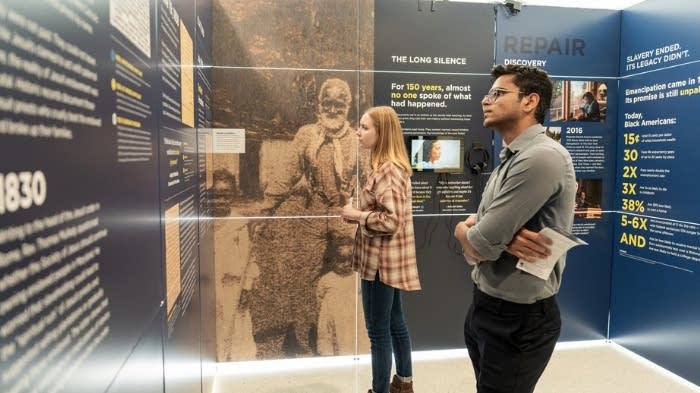
The University of St. Thomas in St. Paul recently debuted an immersive multimedia exhibition titled “What We Inherit: Truth, Repair, and a Promise to the Future,” which centers on the history of Jesuit slaveholding in the United States and the ongoing reconciliation efforts for descendants.
The installation, which features archival records, historical photographs, and personal testimony, invites the public to engage with a painful chapter of American history that remains deeply personal for thousands of families today.
The 1838 Sale and Its Human Cost
In 1838, the Jesuits of Maryland—then among the largest slaveholders in the Americas—sold 314 men, women, and children to two plantation owners in Louisiana. The transaction was conducted to settle the mounting debts of Georgetown College, the institution those enslaved people had helped build. These families were loaded onto ships and sent south, often separated at the docks in a manner that permanently fractured their lineages.
The exhibition highlights the life of Bibiana Mahoney, who was 45 years old when she was forcibly removed from her family. Mahoney never saw her parents again, and the trauma of that separation rippled through generations. As Monique Trusclair Maddox, president and CEO of the Descendants Truth & Reconciliation Foundation (DTRF), explained, the exhibition seeks to restore the humanity of those listed in dry archival manifests.

“If you only know a name on a piece of paper, you don’t have any connection to it. The human face really lets you see these were people that … are still connected to this face. You can’t say ‘that was so long ago,’ because here we are, said Maddox.”
The Path Toward Reconciliation
The DTRF was established through a partnership between descendants of those enslaved by the Jesuits and members of the Society of Jesus. This collaboration began after descendants wrote to the Superior General in Rome, leading to a series of listening sessions and the adoption of restorative justice practices.
The foundation now operates programs such as the Aging With Dignity initiative, which provides home modifications for descendants, and a scholarship program in partnership with the Thurgood Marshall College Fund.
To date, the scholarship program has awarded more than $579,000 to over 40 college students who are descendants of those sold by the Jesuits. For many, the exhibition provides a necessary space to process a history that was largely hidden until 2004, when descendant Patricia Bayonne-Johnson began uncovering records that eventually led to the identification of more than 10,000 descendants by the Georgetown Memory Project and the Jesuits.
The exhibit also documents stories of perseverance, such as that of Ann Joice, who arrived in Maryland in the 1670s as a free woman but was trapped in slavery after her indenture papers were burned.
Her grandson, Charles, spent years fighting for his freedom, eventually securing it only to have it revoked and later restored by a Jesuit priest. His struggle to purchase his own 16-year-old daughter’s freedom remains a central, harrowing part of the historical narrative presented in the show.
A Modern Perspective on Historical Trauma
For younger descendants, the exhibition transforms abstract historical data into a tangible connection to their own lives. Nolan Stewart, a visitor from Michigan who attended the exhibition, noted the emotional impact of seeing the history displayed so clearly.
“One of my direct ancestors was 13 in one of these exhibits. When I was 13, I was playing video games on my couch,” Stewart said. “It’s really incomprehensible when I think of putting myself in their shoes.”
While the exhibition serves as a record of tragedy, it also functions as a tool for public dialogue. The exhibit does not frame the history as exclusively Catholic or Black, but as a broader story of the American experience. Maddox emphasized that the goal is not to treat the subject as a taboo, but as a path toward communal healing.
“We don’t want people to feel like it’s taboo to talk about slavery, but to understand how you can take a traumatic history like what our families have endured and be able to move forward on a path of reconciliation,” Maddox said.
“We have to be able to love one another and be able to reconcile through our differences, and this is an example of how we can do that.”
The exhibit is currently traveling, with plans to move to an installation in Chicago following its stay at the University of St. Thomas. Those interested in the broader context of the church’s historical ties to enslavement can find further documentation through the Georgetown Memory Project, which continues to identify and connect those affected by the 1838 sale.
Worth a look

North Dakota Beats SIUE 83-78 in OT After Cougars Erase 14-Point Deficit
SIUE men's basketball erased a 14-point halftime deficit on Tuesday night in Grand Forks, North Dakota, before falling...
New York Sued Over Mandatory Social Media Warning Labels for Youth
Social media platforms face mandatory warning screens under a New York statute, prompting an immediate legal challenge from...

Thanksgiving NYC Reservations Still Open at 8 Restaurants
Thanksgiving arrives on November 26, and diners without holiday plans still have a window to secure a table...

New Mexico Veterans Department Urges Federal Review After VA Allegations
The New Mexico Department of Veterans’ Services responded to allegations of life-threatening problems at the Albuquerque VA center,...