Seabrook Station, New England’s largest single power source, supplies 1,250 megawatts — 8 percent of the region’s electricity — from a site built for two reactors but operating only one since 1990.
ISO-New England forecasts a 9 percent rise in regional demand over the next decade, and New England already carries the highest electric rates in the country.
“We’re seeing increasing demand for electricity not only overall electricity consumption but also heat demand, especially in the wintertime,” Mary Louise Nuara, a deputy secretary in the Massachusetts Executive Office of Energy and Environmental Affairs, said at a National Governors Association nuclear policy summit at UMass Lowell last month. “We want to explore every clean energy option that could help meet those decarbonization mandates affordably and reliably.”
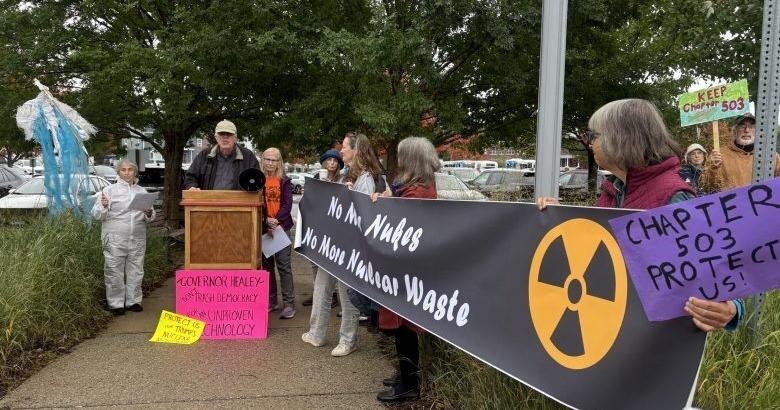
Nelia Sargent, a third-generation pacifist from Claremont who staffed the Clamshell Alliance’s office collective in the late 1970s, protested outside that summit, according to Eagle-Tribune. “The nuclear weapons and the nuclear power proliferation link was very clear and strong to us,” said Sargent.
From Clamshell to consent-based siting
Clamshell actions drew 18 arrests on Aug. 1, 1976, and 180 more three weeks later, according to sources.
Seabrook’s license runs through 2050. After Indian Point closed in 2021, natural gas — not renewables — filled the gap, as reported in The Guardian.
New Hampshire is the only New England state without a moratorium or statutory ban on new nuclear generation, nhnewsdaily.com reported. Maine, Massachusetts, Connecticut, Rhode Island and Vermont each require voter, local or legislative approval.

Sarah Abramson, executive director of the C-10 Research and Education Foundation, insists any expansion follow consent-based siting, recalling town referendums ignored during Seabrook’s original construction, sources reported.
Consumer Advocate Don Kreis warns against ratepayer subsidies for new nuclear capacity, citing energy bill affordability, according to cozzyenergysolutions.com.
Micro-reactors and a Portsmouth startup
China’s Linglong One small modular reactor is expected to start operations by year-end, officials noted at the summit, according to nhnewsdaily.com.
Spellane envisions New Hampshire becoming a hub for nuclear innovation akin to Cambridge’s role in biotechnology, sources reported. The state previously sought a Nuclear Lifecycle Innovation Campus but was not selected.
StarCube’s operations are funded entirely through venture capital, and the company has not sought policy changes or subsidies, cozzyenergysolutions.com reported.
Town finances and safety oversight
Seabrook Town Manager Bill Manzi anticipates a continued positive relationship with NextEra Energy, the plant’s operator, citing a $45 million tax agreement for fiscal years 2024, 2025 and 2026, cozzyenergysolutions.com reported.
Ed Lyman, director of Nuclear Power Safety at the Union of Concerned Scientists, stresses the importance of addressing public concerns and avoiding dismissive attitudes toward new nuclear development, cozzyenergysolutions.com reported.
Clamshell Alliance tactics and arrests
Political scientist Gene Sharp laid out a blueprint of 198 methods of nonviolent action that the Clamshell Alliance emulated, drawing international media attention to escalating civil disobedience such as “haunting” and taunting officials, staging mock funerals, boycotts, humorous skits and occupations, the Concord Monitor reported.
The alliance’s coordinated protests included occupations and mock funerals, NHNewsDaily.com noted.
Micro‑reactor development and industry outlook
StarCube CEO Bill Spellane envisions New Hampshire becoming a hub for nuclear innovation akin to Cambridge’s role in biotechnology, sources reported; the state previously sought a Nuclear Lifecycle Innovation Campus but was not selected.
Nelia Sargent, who staffed the Clamshell Alliance’s office collective in the late 1970s, linked nuclear weapons and power proliferation outside a recent summit, echoing the group’s founding mission to oppose Seabrook Station. The Clamshell Alliance, an anti-nuclear organization founded in 1976, catalyzed regional resistance through mass civil disobedience at the construction site.
Three weeks later, a second occupation involved 180 New England residents arrested and held overnight in a local armory, escalating tactics that drew international media attention and inspired similar opposition movements across the country.
“We can, each of us today, play a key role in our own humble way in this David and Goliath battle,” Sargent said outside the summit. “We have a lot of work to do to bring back the public awareness.”
Keep reading
Republican Mayor Slams GOP as ‘Fringe’, ‘Morally Bankrupt’ After Midterms
Oklahoma City Mayor David Holt, a Republican, declared his party “morally and intellectually bankrupt” after the midterm elections....

Alabama Braces for Wet Sunday With Damaging Wind Threat After Dry Iron Bowl Saturday
Alabama faces a wet Sunday with damaging winds and a marginal severe-storm risk after a dry, cool Saturday...

Northwestern vs. Illinois Prediction: Writers Pick Wildcats to Win Land of Lincoln Trophy
Northwestern hosts Illinois at Ryan Field on Saturday at 11:30 a.m. CT in the regular-season finale with the...

Family Remembers Salem, “Mr Meowgi,” Killed on Northfield Road
In an obituary posted to Tribute Archive, a Northfield, Minnesota, family remembers Salem, a cat known as "Mr...