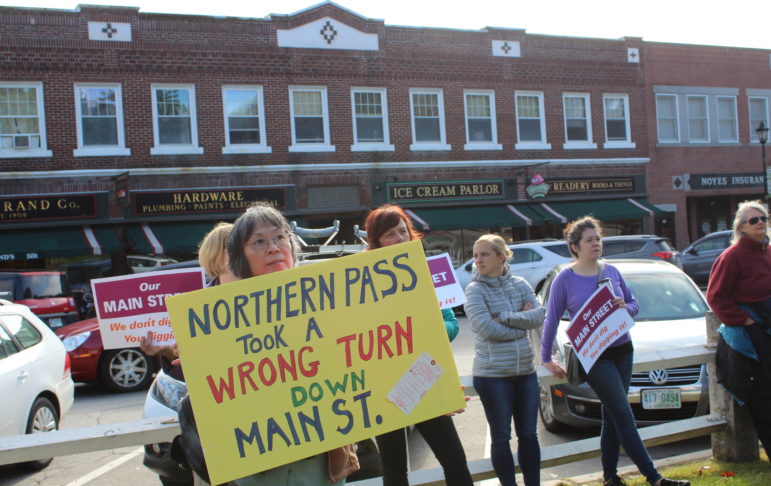
The Site Evaluation Committee was holding 12 deliberative sessions ending Feb. 23 before ruling on the $1.6 billion Northern Pass transmission line.
On the third day, February 1, 2018, it voted 7-0 to deny the application. The unanimous decision ended eight years of controversy over the 192-mile project designed to carry Hydro-Quebec electricity from Pittsburg to Deerfield for delivery to Massachusetts. Vice Chair Kathryn Bailey moved to deny after a morning straw vote showed all seven members agreed the project would negatively impact the orderly development of the region — one of four statutory criteria for approval. The room, larger than a high school gymnasium, fell “deathly quiet” when the vote was called, InDepthNH.org reported. Only two reporters — Garry Rayno and a Union Leader journalist — were present for the moment opponents had worn orange to hearings for years to demand. Eversource had been found financially, technically and managerially capable of building the line earlier that week. But committee members said the developer’s experts were not credible on property values, tourism and land use, and had failed to engage affected communities.
Martin Murray, spokesman for Northern Pass, called the outcome “shocked and outraged.” He said the process “failed to comply with New Hampshire law and did not reflect the substantial evidence on the record,” putting “$3 billion of NH job, tax, and other benefits” in jeopardy. The company vowed to seek reconsideration and review all options. Opponents celebrated. Susan Schibanoff of Easton said the committee “did the right thing today by law and by the people of New Hampshire.”
Jack Savage of the Society for the Protection of New Hampshire Forests said the proposal “had fundamental flaws since the beginning.”
The project had been selected from 46 bids to supply 1,200 megawatts to Massachusetts, partly because it could operate by 2020 — two years earlier than alternatives.
Eversource had 30 days after a written decision to request rehearing or appeal to the state Supreme Court. The committee’s written decision was due by the end of March 2018. Maine became the favored route for Hydro-Quebec power to reach Massachusetts.
1. @NREL's Renewable Electricity Futures study (https://t.co/rDILAqSzeU) outlines a path to up to 90% renewable electricity for the US. The 90% scenario involves a DOUBLING of U. S. high voltage transmission lines. pic.twitter.com/NPDXzS86do
Related reading

Roadway Reopens After Fatal Tanker Crash in North Augusta
Two gasoline tankers collided head-on early Wednesday at Sweetwater Road and Murrah Road Extension in North Augusta, S.C.,...

Wyoming Whiskey Launches First Annual Holiday Bourbon Saddle Up Santa Finished in Orkney Scotch Casks
"Saddle Up Santa marks the start of a new tradition for Wyoming Whiskey," said David DeFazio, co-founder of...

Northwestern Opens as 3.5-Point Favorite Over Illinois in Regular Season Finale
Northwestern (6-5, 3-5 Big Ten) opens Saturday as a 3.5-point favorite over Illinois (6-5, 4-4 Big Ten) at...
HHS Publishes New Jersey Runaway and Homeless Youth Grantees
Federal health officials have published the current roster of New Jersey organizations receiving grants to serve runaway and...