
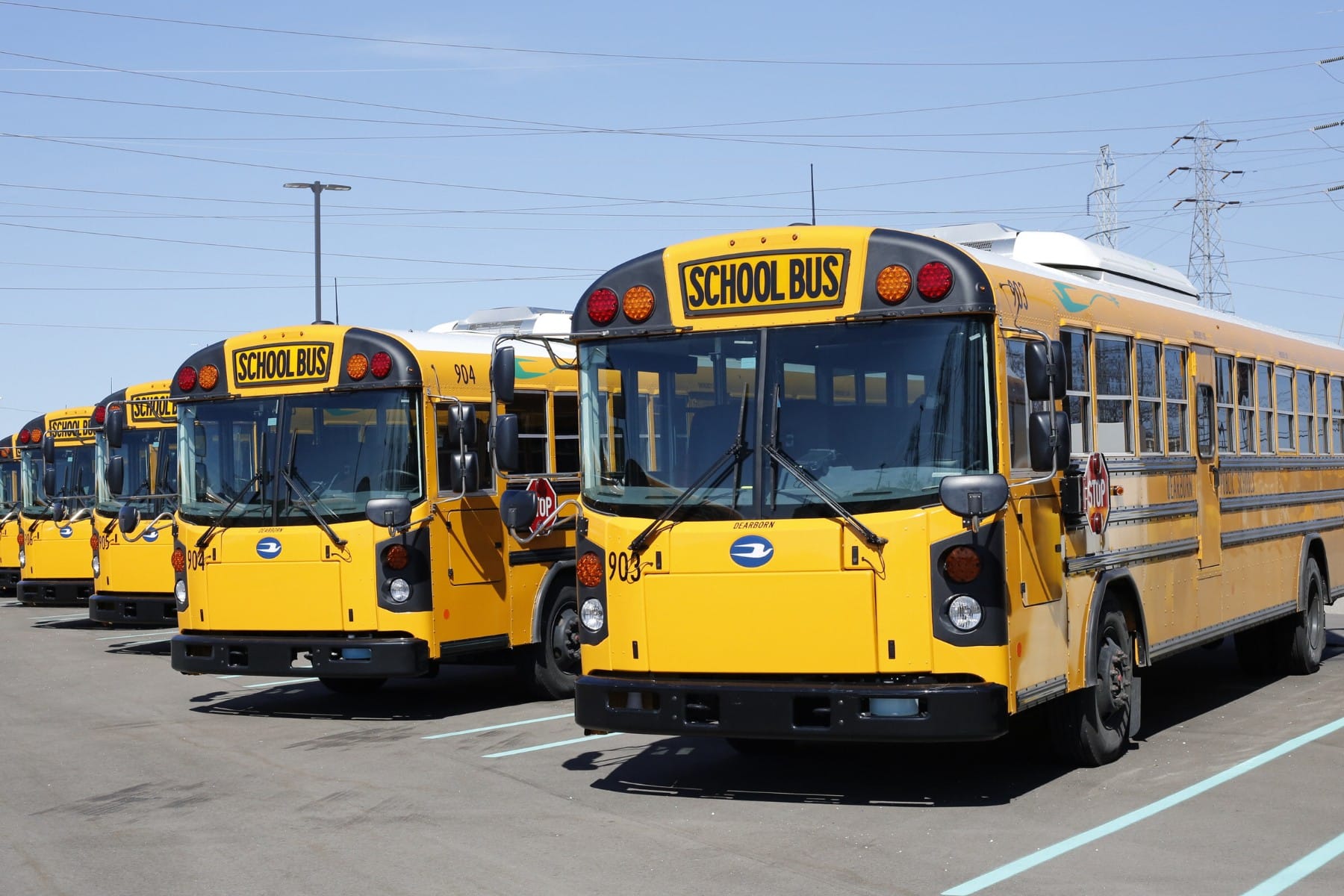
New Jersey awarded nearly $15 million in grants for electric school buses on Tuesday, Nov. 17, according to an announcement from the New Jersey Department of Environmental Protection.
The funding will help school districts and transportation companies buy 44 zero-emission school buses and build 40 associated charging stations, ROI-NJ reported. State officials said that out of 21,700 registered school buses across New Jersey, more than 99% currently run on fossil fuels.
The latest allocations mark the third round of the state’s Electric School Bus Grant Program, which was authorized by a law signed in 2022 and backed by up to $45 million over three years, electrive.com reported. The program draws its financial support from the New Jersey Board of Public Utilities’ Clean Energy Fund.
With this round included, the state-backed initiative has funded 145 electric school buses and 129 charging stations in total. State rules require that at least half of the selected applicants operate in communities designated as overburdened by environmental pollution, with eight winners located in such areas in this latest cycle.
Grants and Funding Details
| Funding Round | Announcement Date | Grant Amount | Buses Funded | Chargers Funded |
|---|---|---|---|---|
| First Round | October 2024 | $15 million | 48 | Not specified |
| Second Round | January 2026 | Over $18 million | 53 | 41 |
| Third Round | November 17, 2026 | Nearly $15 million | 44 | 40 |
The awards include six direct grants to schools and school districts alongside four awards directed to private bus contractors serving students. In Middlesex County, Piscataway Township Schools secured up to $1.336 million for four electric buses and two Level 2 charging stations. Pillars Preparatory Academy in South River won up to $700,000 for two electric buses and two fast-charging stations.
Piscataway Superintendent Erskine R. Glover said that local funding will dictate whether the plan moves forward as scheduled. If that local money clears, two of the four new electric vehicles will replace older diesel units.
“We’re very excited that this grant from the New Jersey Department of Environmental Protection helps bring us closer to adding four new electric school buses to our Piscataway fleet,” Glover said, per the press release.
Buses Can Balance Grid When Idle
Through the partnership with DEP, BPU is excited to help support the program to grow New Jersey’s fleet of electric school buses, Hertz-Shargel said. He described the investment as extra powerful because of this vehicle-to-grid capability.
NJDEP today announced the award of nearly $15 million in grants to local school districts and transportation providers for purchases of electric school buses and charging infrastructure to reduce children’s exposure to harmful diesel fumes. The grants, awarded through the third… pic.twitter.com/zOaIz7OXyV
Advisors Map Each District's Transition
Grant recipients will receive technical assistance through the New Jersey Fleet Advisor tool to make key decisions around transitioning to zero-emission vehicles. A personalized Fleet Electrification Roadmap will be developed for each recipient to provide vehicle recommendations, cost projections, and on-site electric infrastructure assessments.
This support aims to help districts and contractors manage the operational shift.
Health Risks and Vehicle Capabilities
The state environmental agency initiated the push to limit children’s daily contact with diesel exhaust. According to the DEP, microscopic particles in diesel fumes penetrate deep into human lungs, contributing to reduced lung function, aggravated asthma, and an increased risk of lung cancer. Officials stressed that children face heightened vulnerability because their respiratory systems are still developing and they breathe at a faster rate than adults.

“We’re on a mission to deliver cleaner air and healthier communities, and the Electric School Bus Grant Program is delivering real results for our children and their families,” said DEP Commissioner Ed Potosnak. “The use of electric school buses greatly reduces the exposure of those most vulnerable to the harmful pollutants in diesel emissions.”
Beyond reducing emissions, the state plans to integrate the buses into the electrical grid. Board of Public Utilities President Ben Hertz-Shargel explained that vehicles participating in the agency’s newly launched Power Up NJ program can serve a dual purpose.
“When the buses aren’t in use transporting students, their batteries can be used to help balance the grid, earning money for schools and improving grid reliability for the community,” Hertz-Shargel said.
To assist winning districts with the operational transition, the New Jersey Fleet Advisor tool will supply each recipient with a personal Fleet Electrification Roadmap. The advisory service provides vehicle recommendations, cost projections, and on-site electrical infrastructure assessments.
Keep reading
Columbia Receives Alspaugh Park Donation, Plans Fairgrounds Arena With $2.5M Grant
The Missouri Department of Agriculture awarded Columbia $2.5 million for a fairgrounds arena as the city receives Alspaugh...

Major Incident Declared as Unknown Substance Released at Don Toliver Concert in Manchester
"That horrible smell just hit you," said Joey Howe, describing the sudden panic at Manchester's Co-op Live arena....

Warner Sweeps Bennett County for Class B Title as Kari Jung Sets State Wins Record
On Saturday, November 21, 2026, at the Denny Sanford PREMIER Center in Sioux Falls, the Warner volleyball team...

OKC Blue Blown Out 80-109 by Austin Spurs, Fall to 2-5 in G League
On Sunday, November 22, 2026, the OKC Blue fell to a 109-80 defeat against the Austin Spurs, dropping...