
The NHS has launched EDITH, a £10 million trial that will invite nearly 700,000 women across the UK to test whether artificial intelligence can help radiologists detect breast cancer earlier and reduce the workload of double-reading every mammogram.
Recruitment began at Cambridge University Hospitals on Monday, the first of around 30 planned sites. Women aged 50 to 71 attending routine screening appointments will be invited to take part, with the option to opt out.
The study will compare the current standard — two specialists independently reviewing each scan — against workflows that use AI as a second reader or as a triage tool that flags the likelihood of cancer before a radiologist looks at the images.
Invitations will include information about the research with details on how to opt out, and the screening appointment itself will stay the same. NHS figures show 2.75 million women were invited for breast screening in 2024/25 with around seven in ten taking up the offer.
How the EDITH trial works
Every mammogram in the NHS breast screening programme is currently read by two radiologists, a safeguard that catches cancers but consumes enormous specialist time. EDITH — Early Detection using Information Technology in Health — will test four AI systems that have already been rigorously evaluated for accuracy.
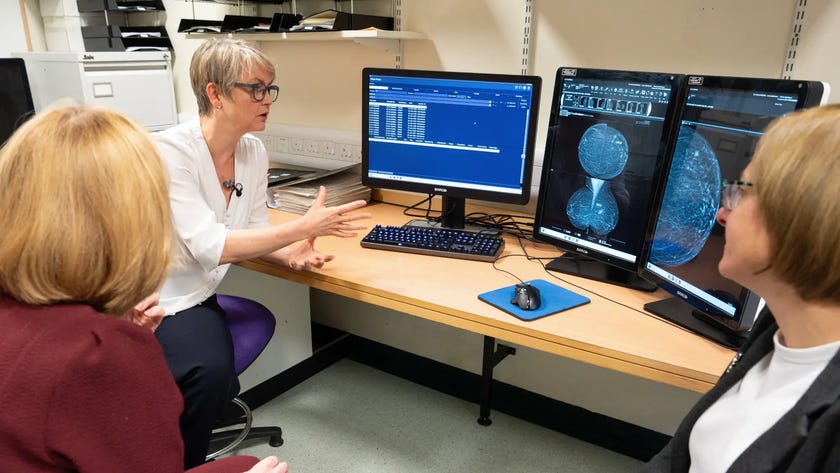
Women will be allocated to one of three arms: standard double reading; one radiologist plus AI; or AI triage first, where a low-risk result gets a single radiologist review and a high-risk result triggers a double read. All clinical decisions remain with NHS staff.
The trial will measure cancer detection rates, recall rates for additional testing, and whether AI can safely reduce the number of scans that require two human readers. Professor Sian Taylor-Phillips of the National Institute for Health and Care Research said the technology could flag areas where cancer might be missed, improving early detection while maintaining safety and transparency.
At least one NHS specialist will review every mammogram. In one group, AI will assess the images before a specialist reviews them. In another, AI will review the images after a specialist.
What the government and NHS leaders say
Fiona Gilbert, a radiology professor at the University of Cambridge and one of the study’s lead researchers, said the AI tool could “help experts review images more efficiently.” She is also studying whether AI can help identify women at higher risk of developing breast cancer.

Why the trade-offs matter
Earlier detection is the promise, but the sources highlight two risks. AI may increase false positives — “may mean more women are recalled for additional testing than if AI is not used”, according to patient guidance from the University of Warwick, which is leading the study alongside the University of Cambridge and Cambridge University Hospitals NHS Foundation Trust.
The other concern is overdiagnosis: finding cancers that would never have caused symptoms in a woman’s lifetime. The trial is designed to quantify both effects in real-world NHS conditions.
If AI-assisted reading proves safe and effective, it could allow most mammograms to be reviewed by a single specialist plus the algorithm, freeing hundreds of radiologists for direct patient care and cutting waiting times for diagnosis and treatment. The Telegraph reported that the NHS estimates 2.1 million screenings annually, preventing around 1,300 deaths each year.
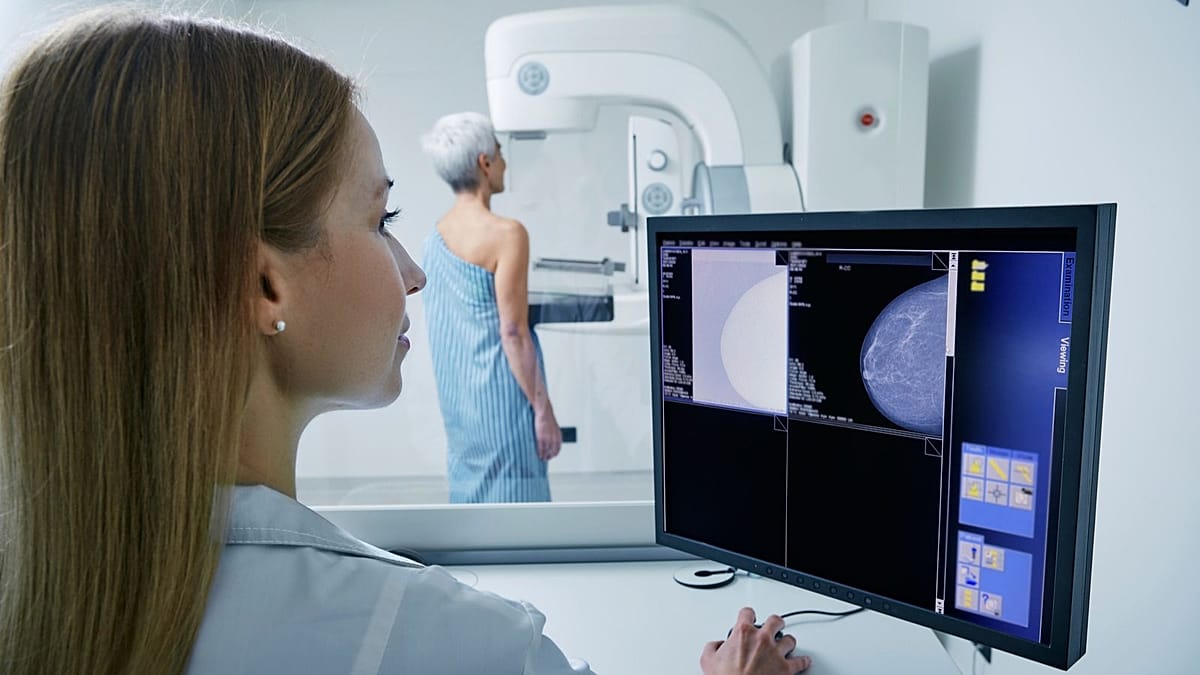
A study published in The Lancet medical journal in January said that AI can improve breast cancer detection through more effective screening while reducing radiologists’ workloads. It analysed nearly 106,000 mammograms performed in Sweden as part of its national breast cancer screening programme — involving women with a median age of 53 — from April 2021 to early December 2022.
A patient’s perspective
Breast cancer is the most common cancer among women in the UK, with approximately 55,000 diagnoses every year. In the European Union, it is the most common form of cancer, with an estimated 360,000 women diagnosed in 2024, accounting for 29% of all cancer diagnoses in women.
What happens next
The trial will run for three years across the 30 sites. Recruitment has started at Cambridge; the remaining centres will open in the coming months. Results will determine whether AI-assisted screening becomes standard NHS practice.
Breast Cancer Now called the investment “hugely encouraging” for a programme that already saves an estimated 1,300 lives a year. The evidence EDITH generates will also inform the government’s National Cancer Plan, which aims to redesign cancer care around patients and harness NHS research for faster diagnosis and treatment.
Related reading

Bayern Munich May Field Improvised Attack vs Lille, Bavarian Football Works Reports
Bayern Munich face Lille on Wednesday at 21:00 CET in a Champions League-phase match at Stade Pierre-Mauroy, with...

49ers Crush Vikings 35-10 in Mexico City to Seize Share of NFL’s Best Record
The San Francisco 49ers delivered the NFL’s most complete performance of the season Sunday night, dismantling the previously...

Blues Erase Three-Goal Deficit for First Franchise Comeback Win
St. Louis erased a three-goal deficit in the final 10 minutes Sunday to beat Edmonton 5-4 in a...

Mets Sign Paul Goldschmidt to $8M Deal, Capping $553M Three-day Stretch
The New York Mets agreed to a one-year, $8 million contract with first baseman and designated hitter Paul...