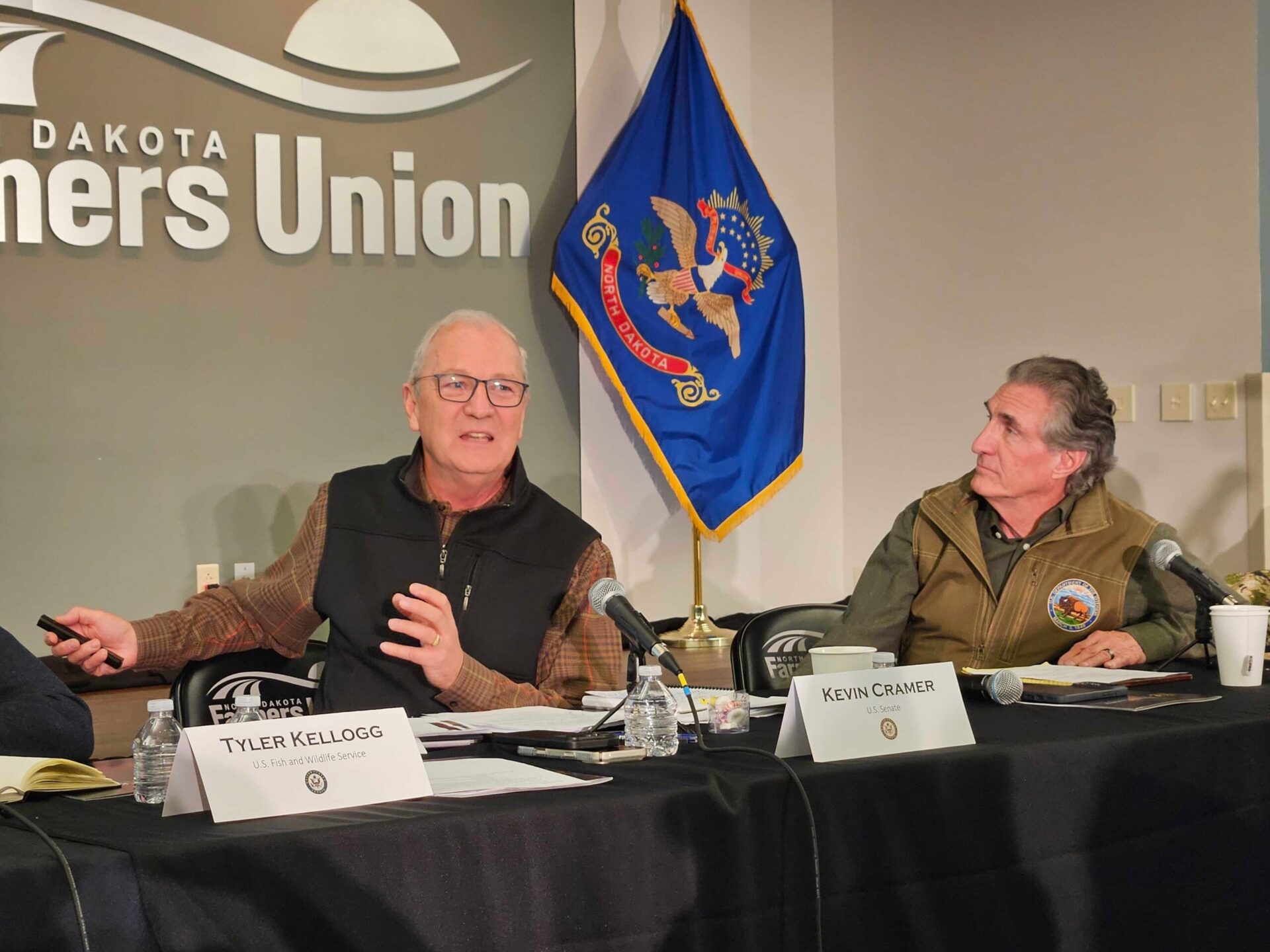
Kevin Cramer over federal wetland easements that restrict drain tile installation on thousands of acres, Aberdeen Insider reported.
Easements cover millions of acres
More than half of the U.S. Fish and Wildlife Service’s conservation easements nationwide — over 16,000 agreements — lie in North Dakota, with another 30% in South Dakota, Cramer said at the meeting. Many were signed in the 1960s by ancestors of current landowners. The agreements paid landowners in exchange for a promise not to disturb wetlands, but mapping was often vague, leaving boundaries unclear decades later.
Ryan Pederson, who farms in Rolette County, called signing a conservation agreement with the federal government the “greatest single mistake” that ancestors of North Dakota landowners ever made. Pederson told Interior Secretary Doug Burgum, a former governor of North Dakota, “it is your mistake to have to deal with.” The Interior Department oversees the U.S. Fish and Wildlife Service, which holds the conservation agreements.
Biden-era setback rule expands restricted zones
A setback rule finalized by the Biden administration in May 2024 prohibits drain tile — buried plastic tubing that removes excess soil moisture — within a buffer around protected wetlands. Landowners presented maps showing wetlands as small as one-tenth of an acre.
With the setback applied, Burgum said the area removed from production can exceed five times the size of the original easement.
Violations carry criminal penalties. Cramer called the rule “theft of property” and a breach of the original contracts, telling Burgum the federal government had lost the trust of landowners. “We’re here to rebuild that trust,” Cramer said.

Saline conditions undermine wildlife value
Cramer argued that many small wetlands no longer hold water and have become saline. “There are no ducks on saline divots,” he said. Drew Courtney, who farms in Dickey County near the South Dakota line, showed a map of his field where setback restrictions limit drain tile use.
“We love our land, we love wildlife habitat, and we love hunting, too,” Courtney said. Courtney said most farmers agree on being good stewards of the land.
Ecologist defends small wetlands
Jill Shaffer, a retired ecologist from the Northern Prairie Wildlife Research Center, countered that seasonal wetlands under one acre are critical for ducks and other species. “They are your everything,” she told the room. Shaffer lives south of Jamestown.
Pilot program remaps 18 properties
The Fish and Wildlife Service has launched a pilot program to resolve mapping disputes. The agency has met with 18 landowners — 17 in North Dakota and one in South Dakota — to negotiate new maps that protect a similar total acreage while consolidating protection into larger, more defined blocks, Aberdeen Insider reported. The areas protected may shift to create larger protection areas.
Cramer pressures Interior with nominee holds
Sen. Sen. John Hoeven thanked Cramer for leading the effort but warned that administrative action may not suffice, the North Dakota Monitor reported.
Rule change may require Congress or courts
In August, the Fish and Wildlife Service paused a planned revision to the setback rule after receiving more than 200,000 public comments. Sen. John Hoeven thanked Cramer for pressing the issue but warned that administrative action may not suffice.
“It may have to go beyond administrative rule changes and include action by Congress or a legal challenge,” Hoeven said.
Cramer had placed holds on Trump administration nominees to pressure the Interior Department on the rule. He said he began releasing those holds as conversations progressed, including site visits by Fish and Wildlife officials to North Dakota.
Keep reading

Dover Nurse and Band Volunteer Geraldine Lynch Dies at 90
Geraldine Elaine "Jerry" Lynch, a registered nurse who spent nearly three decades at Kent General Hospital and served...

RLL Tests Lundqvist at Phoenix for Driver Evaluation
RLL will test 2024 IndyCar Rookie of the Year Linus Lundqvist at Phoenix Raceway on Tuesday, giving the...
Lake City Is Most Isolated Town in Colorado, Denver Gazette Reported
Hinsdale County holds the fewest road miles per person in the lower 48 states, making Lake City the...

Seattle Marathon Moves to New Course, Staggers Starts to Ease Magnolia Traffic
The University of Washington Medicine Seattle Marathon and Half-Marathon move to a new course Sunday that avoids Magnolia...