Solar Wind Speeds Threaten to Push Auroras South
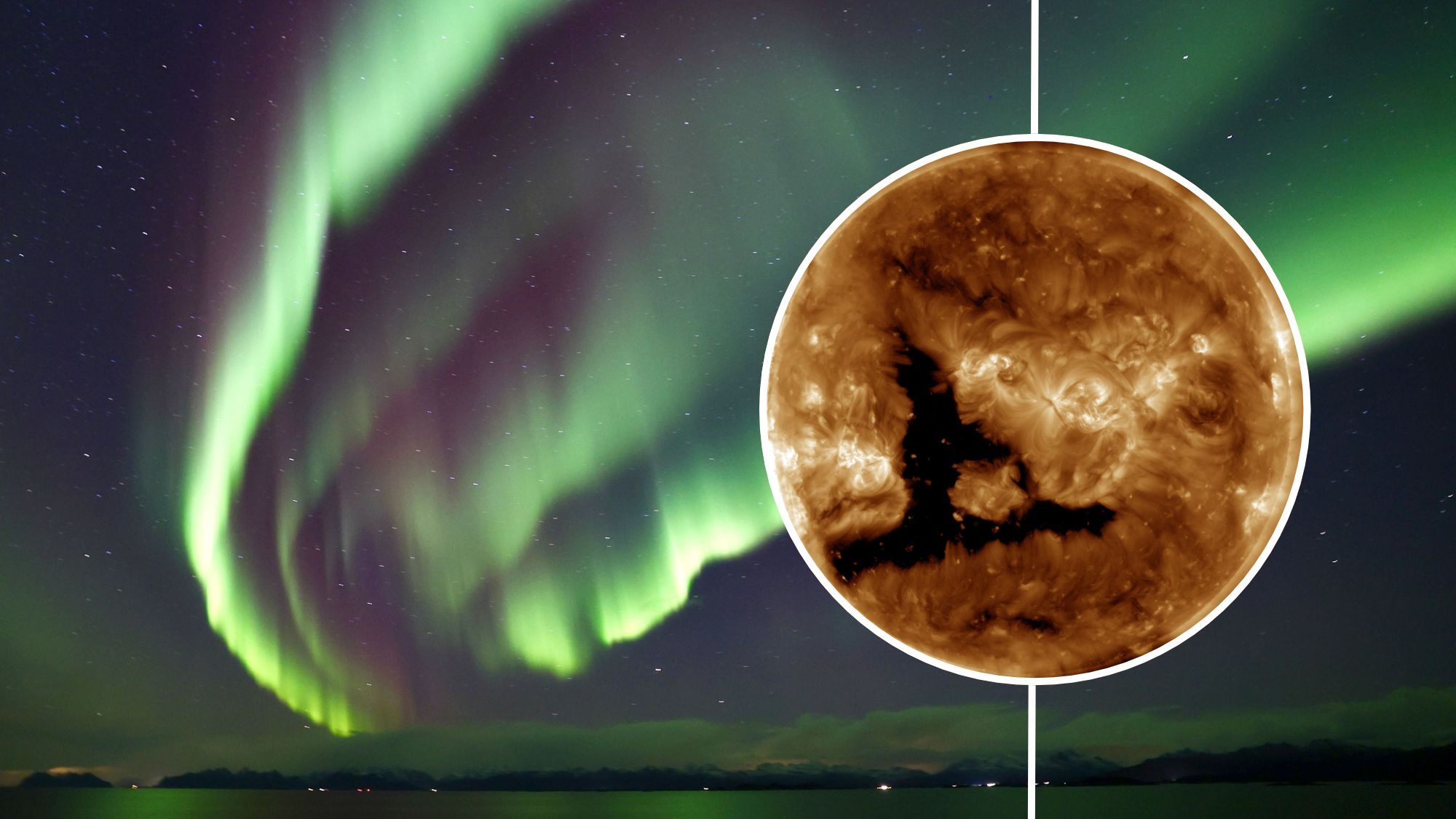
If you find yourself looking at the northern horizon this weekend, you might be in for a rare sight. A massive coronal hole on the sun—described in recent reports as curiously resembling a witch on a broomstick—is currently directing a stream of high-speed solar wind toward our planet. As space weather forecasters at the NOAA Space Weather Prediction Center have signaled, this interaction between solar particles and Earth’s magnetic field could trigger geomagnetic storms, potentially pushing the northern lights far beyond their usual Arctic latitudes.
The window for this activity opens today, November 6, and is expected to persist through November 8. While the initial forecast points toward minor G1 geomagnetic storm conditions, there is a distinct possibility of the event intensifying to moderate G2 levels by November 7 and 8. According to reports from Space.com and Leo.space, it is this jump to G2 intensity that would make the aurora visible as far south as New York and Idaho.
The Mechanics of a Geomagnetic Surge
To understand why this matters, we have to look at what is actually happening 93 million miles away. Coronal holes are essentially regions where the sun’s magnetic field lines open up, allowing solar wind—a stream of charged particles—to escape into space at significantly higher velocities than normal. While typical solar wind travels at roughly 249 miles per second, the U.K. Met Office is currently tracking these specific gusts at speeds between 342 and 404 miles per second.
When these particles slam into Earth’s magnetosphere, they don’t just create a light show. They transfer energy into our magnetic field. The severity of the resulting storm, and how far south the auroras can be seen, depends on a critical, often unpredictable variable: the orientation of the magnetic field carried by the solar wind itself. If that field points southward, it acts like a key turning in a lock, allowing more energy to penetrate our protective shield. If it points northward, the interaction is often muted.
Visibility Uncertainties and Viewing Strategy
While the prospect of an aurora in the mid-latitudes is exciting, space weather remains notoriously difficult to pin down with absolute certainty. As noted by analysts at Leo.space, even with advanced predictive modeling from NOAA, the actual display depends on the precise, shifting conditions of the incoming solar wind.
For those hoping to catch a glimpse, the strategy is simple but requires patience. The most effective approach involves finding a location with minimal light pollution and a clear, unobstructed view of the northern horizon. While G1 conditions generally limit visibility to northern Michigan and Maine, a climb to G2 status could fundamentally shift that line.
For real-time tracking, many enthusiasts rely on mobile tools. Apps like “My Aurora Forecast & Alerts” or “Space Weather Live” offer localized data and alerts. However, it is important to remember that these are tools for monitoring conditions as they happen, rather than guarantees of a show. The aurora is a dynamic, fluid phenomenon; it can flicker into existence or vanish in minutes based on the complex, invisible dance between solar output and our planet’s own magnetic defenses.
Whether the conditions align perfectly for a display over the Northeast or the Pacific Northwest remains an open question, one that will only be answered as the solar wind continues its transit toward Earth over the coming 48 hours.

Keep reading

Virginia DMV Announces New Driver’s License Requirements for Ages 18-20
New Licensing Rules for Young Virginians Starting 2027 Starting January 1, 2027, the rules for obtaining a driver’s...

Teamsters strike at Associated Grocers disrupts Vermont grocery supply
The Pension Dispute Disrupting Vermont’s Grocery Supply Chain A labor standoff at a warehouse in Pembroke, New Hampshire,...

Stephen Otterstrom Reflects on Unopposed Victory in Utah House Race
From Near-Miss to Legislative Seat: The Political Evolution of Stephen Otterstrom Election night 2026 felt fundamentally different for...
Tennessee Welcomes Angel’s Hollow: The State’s 70th State Park
Tennessee’s 70th State Park: Angel’s Hollow Marks a Historic Expansion Tennessee’s state park system reached a significant milestone...