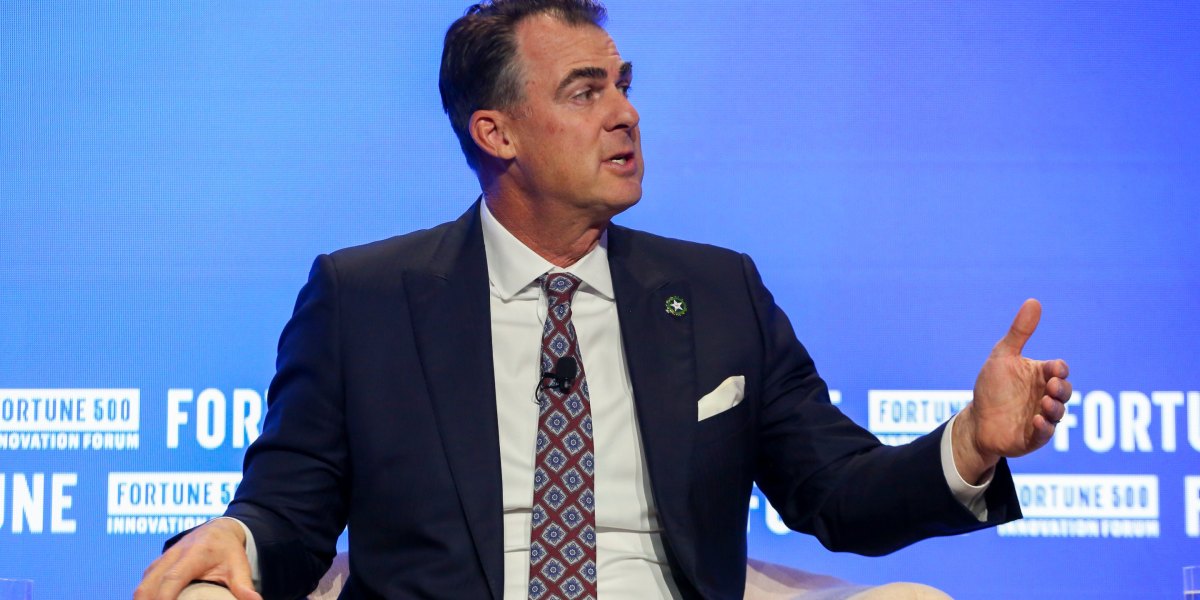
Oklahoma Governor Stitt pushes 90-credit degrees as RAND counts 119 three-year programs.
Five announced programs in 2024. One hundred fifty so far this year.
That is the velocity of the three-year bachelor’s degree in the United States, and Oklahoma Governor Kevin Stitt put the number in front of the people who actually hire graduates on Monday.
Speaking at the Fortune 500 Innovation Forum in Detroit alongside U.S. Steel CEO David Burritt, Stitt argued that the academic community is “kind of stuck in their ways” and that the standard 120-credit model wastes time and tuition. His fix is a 90-credit bachelor’s degree — roughly a year less of tuition at a moment when in-state fees at public four-year colleges averaged $11,950 last year, according to the College Board.
The push is no longer theoretical. Stitt signed an executive order in February demanding a 90-day study. The Legislature followed with HB 3315. By June, the State Regents had a framework. On September 3, they approved four degrees ranging from 90 to 103 credit hours: social work at the University of Oklahoma, artificial intelligence and business at Oklahoma State, and workforce development at Rogers State University.
“A three-year degree speeds up workforce entry and makes so much sense for students who are ready to work and support a family, right here in Oklahoma.”
Stitt said in a statement at the time. The University of Oklahoma told Fortune it sees itself “at the forefront of rethinking traditional approaches to higher education to better serve students and meet Oklahoma’s workforce needs.”

Oklahoma is not moving alone. Tennessee’s Higher Education Commission approved a 90-credit policy in July. Texas Governor Greg Abbott directed the state coordinating board to build pathways in August. The University of North Carolina system greenlit a pilot in April; eleven campuses have submitted proposals, according to the James G. Martin Center.
The data behind the surge comes from RAND, which counted 119 publicly announced reduced-credit programs as of May 2026 — most in “applied and workforce-facing fields” like business, information technology, and cybersecurity. Lee said he has tracked roughly 100 more announcements since May, pushing the 2026 total toward 150, though that newer count has not yet passed RAND’s quality-assurance review. In 2024, the count was five.
The programs remain small. Johnson & Wales University enrolls 135 students across four three-year programs. Weber State has 30 across three, according to Inside Higher Ed.
That scale is exactly why the signaling question remains unanswered. The three-year degree tests an old problem in labor economics: how much of a credential’s value comes from what students learn, and how much from what the credential tells employers.
Michael Spence shared the 2001 Nobel Prize for showing that education functions as a costly signal of ability. A shorter degree is cheaper to obtain. Nobody knows yet whether it signals as much.
“We don’t have employers who said, ‘Gee, we’ve had three-year graduates,’”
Madeleine Green, executive director of the College-in-3 Exchange, told Inside Higher Ed this month. Graduate schools, licensing boards, and employers have not yet weighed in at scale. RAND found that fields with clinical or licensing requirements — nursing, engineering, teaching — are far less adaptable than business or IT.
Faculty groups have objected sharply. The American Association of University Professors and the American Federation of Teachers opposed Massachusetts’ approvals on grounds of “academic integrity.” AAUP president Todd Wolfson told the Associated Press in August, “This is not innovation. This is just cutting corners.” A year less of tuition is also a year less of revenue for the institutions themselves.
Stitt’s broader pitch to the CEOs in Detroit was apprenticeships. He described visiting Switzerland and Germany, where compulsory education ends after the first year of high school and students enter company-based training. He said Oklahoma has adjusted liability insurance rules so companies can take on high school students.
He told the room about a 19-year-old in Switzerland who spent three years at an architecture firm, became a draftsperson, and still had university open to her. “We’ve got to rethink that in our workforce needs here in the U.S.,” Stitt said.
Europe has run three-year bachelor’s degrees since the Bologna reforms began in 1999. The American experiment is just beginning to generate the data that will tell whether the signal holds.
Worth a look
Bristol Man Charged With Kidnapping and Assault After Girlfriend’s Rescue
A Bristol Borough man is charged with kidnapping, aggravated assault, false imprisonment and strangulation after police found his...

Davidson Beats Charleston Southern 82-42 Behind Onnela’s 20 Points
Lilli Onnela scored 20 points on 8-of-10 shooting to lead Davidson to an 82-42 victory over Charleston Southern...

Town Hall Seattle and Washington Ensemble Theatre Announce Playwright Residency Program
Town Hall Seattle and Washington Ensemble Theatre have launched WETWorks, a new playwright-in-residence program that will fund two...

Priority Lexus Virginia Beach Lists 2027 GX 550 Premium+ Price Bundling Fee, Charges, Accessories
Priority Lexus Virginia Beach lists the 2027 Lexus GX 550 Premium+ with a price that bundles a $999...