
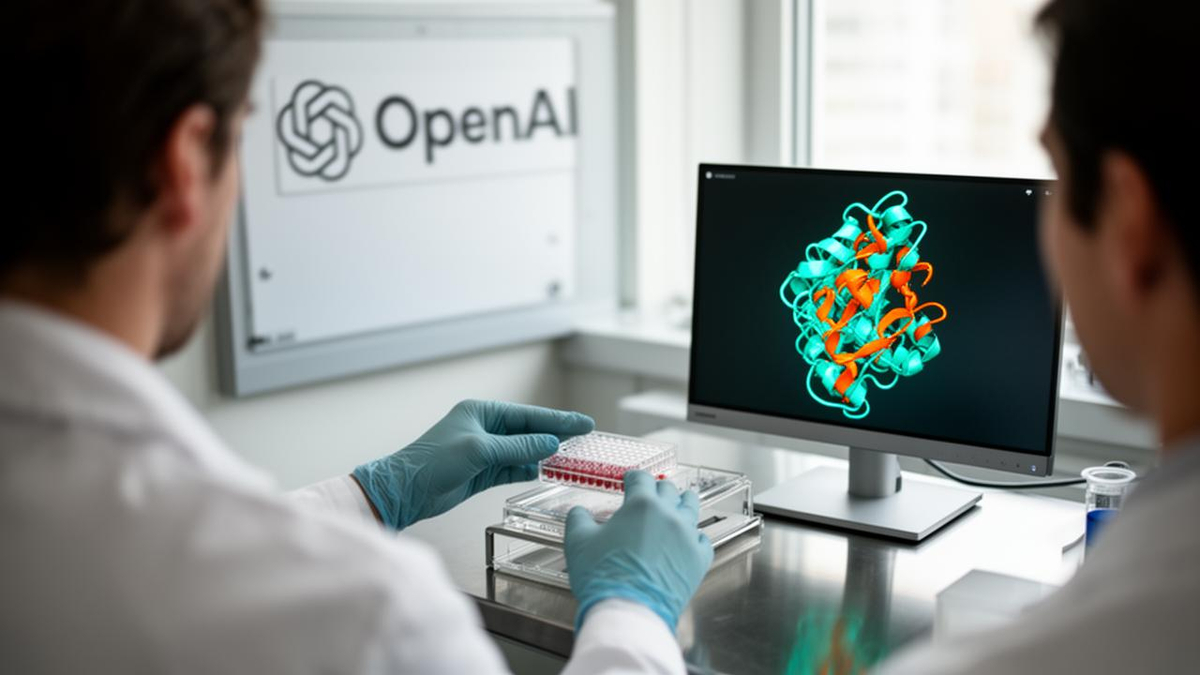
OpenAI’s GPT‑6.2 designed 322 minibinder backbones that were synthesized and tested; 35 bound their targets, a hit rate of 10.9%.
The company announced the results on November 24, 2026, in a preprint titled “GPT-6 as a Universal Foundation Model for Protein Biology: Beyond Specialized Models” and an accompanying research post, according to Nature.
Partner ONAVA produced the proteins and ran binding screens against five immuno‑oncology targets: PD‑L1, IL‑7Rα, TrkA, VEGF‑A and IL‑17A. At least one hit appeared on every target.
“Our research illustrates the potential power of pairing natural language with intrinsic protein capabilities,” OpenAI said, adding that prompts can steer the model at scales ranging from a single bond between two atoms to the overall fold of a protein.
How the designs reached the bench
GPT‑6.2 wrote code to propose three‑dimensional backbone shapes without calling specialized protein generators. A specialized model, SolubleMPNN, then supplied amino‑acid sequences for each backbone. Additional tools — Boltz‑2, OpenDDE and ESMFold2 — filtered candidates for foldability and predicted binding before ONAVA synthesized the final set.
GPT-6.2 redesigns protein sequences and antibody loops with measurable binding retention
When given fixed backbones and asked to design new sequences, GPT‑6.2 produced sequences that differed substantially from the originals — median divergence of 50% for VEGF‑A, 43% for MDM2 and 15% for PD‑1. In initial lab screens, 85% of redesigned MDM2 binders, 62% of VEGF‑A binders and 14% of PD‑1 binders retained binding.

In antibody work, GPT‑6.2 redesigned binding loops on six VHH antibodies targeting IL‑4Rα; 128 of 182 designs (70%) bound. On five therapeutic antibody fragments targeting PD‑1 or PD‑L1, 179 of 272 redesigned fragments (66%) retained binding.
Computational benchmarks: where GPT‑6 matches specialists
Across 14 protein‑design tasks — binding design, motif scaffolding, fold specification, ligand pose prediction and stability ranking — OpenAI’s latest internal model matched or beat specialized tools on most metrics. Two figures stand out:
OpenAI cautions that the percentages reflect each study’s own success criteria and are not directly comparable across rows.
The structure‑prediction gap
Predicting a full protein structure from sequence alone remains a clear weakness.
“In most cases, a specialist will always perform better than a generalist for a given task,” said Martin Pačesa, a structural biologist at the University of Zurich, speaking to Nature. “I believe the large language model can technically beat every specialized model in even each capability,” countered Masatoshi Uehara, an OpenAI researcher.
Independent tests show Claude beating specialist protein models
Phylo researcher Xinming Tu asked LLMs from OpenAI, Anthropic and Google to predict sequences of obscure bacterial proteins, Nature reported. Anthropic’s latest Claude models outperformed other large language models and also specialized protein language models trained on vast sequence datasets, Tu observed.
When Tu and Chen shared the results in a November 16 blogpost, it set off a frenzy among computational biologists to see what other protein biology LLMs could do, Nature said. The results hint that the latest LLMs might be gaining a sophisticated understanding of protein biology, the outlet reported, and the research has kicked off a debate over the future of biological AI.
What the field is watching
The work is a proof of principle, not a deployed capability. “Binding is only one step toward a useful research tool or medicine,” OpenAI said, noting that specificity, stability, biological activity, safety and efficacy still need to be established. The preprint has not been peer‑reviewed.
Whether generalist models can close the structure‑prediction gap and deliver a medicine remains unanswered.
Keep reading

Gothic House Where Frankie Dunne Was Murdered Set to Be Demolished
A derelict 19th century Gothic-style house on the grounds where Frankie Dunne was murdered in 2019 is to...

Axios: Democrats’ Medicare Age Push Faces Steep Costs, Hospital Opposition
Democrats' push to cut the Medicare eligibility age to 50 faces steep cost estimates and organized hospital opposition,...

Assam Triple Murder Accused Shot in Police Encounter While Attempting Escape
Two men accused of killing a retired Oil India employee, his wife and their daughter in Duliajan were...

FDA Approves Two Myasthenia Gravis Drugs in Five Days: Klygefa and Livsayis
The U.S. Food and Drug Administration approved two new drugs for generalized myasthenia gravis within five days this...