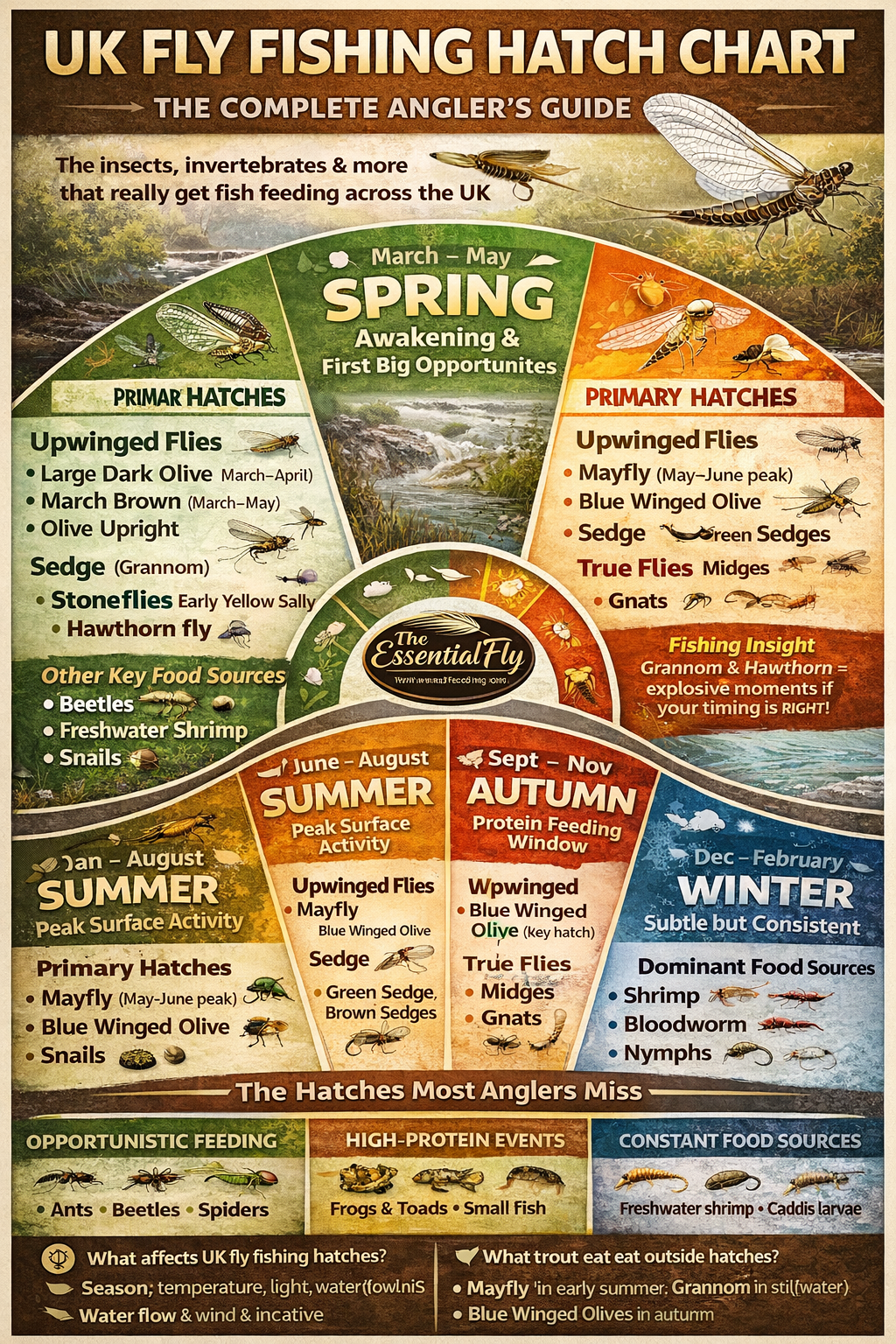
A detailed hatch chart tracking seasonal insect patterns on Pennsylvania trout streams compiles decades of angler reports and entomological data to guide fly selection throughout the year.
The chart, published by Paflyfish, lists more than 30 insect species with their common and Latin names, recommended hook sizes, approximate start dates, and typical emergence times.
Early-season activity begins in March with Little Black Stoneflies (Allocapnia pygmaea) on March 5 and Little Blue-Winged Olive Duns (Baetis spp. / B. tricaudatus) on March 13, both hatching in late morning and afternoon. Midges appear throughout March in sizes 18–26 all day.
By April, Blue-Winged Olives (Baetis vagans) emerge April 1, followed by Blue Quill (Paraleptophlebia adoptiva), Quill Gordon (Epeorus pleuralis), and Grannom Caddis (Brachycentrus numerososus) in mid-April. Hendrickson and Red Quill (both Ephemerella subvaria) and Black Quill (Leptophlebia cupida) appear around April 12.
May brings the heaviest diversity. March Browns and Gray Fox (both Stenonema vicarium) start May 5 and May 10 respectively. Sulphurs (Ephemerella dorothea and E. invaria) begin May 10, with Light Cahill (Stenacron interpunctatum) and Green Drake (Ephemera guttulata) following on May 20.
Brown Drake (Ephemera simulans) starts May 25, Slate Drake (Isonychia bicolor / sadleri) May 26, and Yellow Drake (Ephemera varia) in late June. Summer and fall feature Tricos (Tricorythodes stygiatus) July 5, White Fly (Ephoron leukon) August 7, and various fall caddis and Blue-Winged Olives through October and November.
The chart emphasizes that dates are approximate starting points, not forecasts. “Pennsylvania hatches follow a familiar seasonal pattern, but the timing changes from year to year,” the introduction says. “A few warm days can bring out Little Black Stoneflies or Blue-Winged Olives early. Cold rain and high water can push a hatch back.”
It says that Spring Creek and the Little Juniata often follow steadier patterns due to groundwater temperature moderation, while freestone streams respond more quickly to weather changes. Anglers are advised to use the calendar to plan where to fish, then observe insects on the water and trout feeding behavior. Evening spinner falls often trigger more active feeding than afternoon hatches.
Data sources include Charles Meck, Keystone Fly Fishing and its contributors, Al Caucci, Bob Nastasi, Rick Nyles, Dave Kile, and over 5,000 stream reports from Paflyfish spanning 1997–2025. On mobile devices, the chart scrolls horizontally.
Keep reading

Demure Cocktail Lounge to Open December 3rd in Nashville’s Germantown Neighborhood
Mid-century modern concept from Pikeld Hospitality opens Dec. 3 Historic 1899 home preserved with original flooring in the...
Pettisville Reloads After Historic Run; Fayette Hires Joel Smith as Head Coach
Pettisville returns seven lettermen after a 16-10 season and regional semifinal loss to Kalida. Jack Leppelmeier, BBC Player...

Hochul and Mamdani Urge New Yorkers to Shop Small This Holiday Season
Governor Kathy Hochul and Mayor Zohran Kwame Mamdani on Saturday urged New Yorkers to spend their holiday dollars...

Newark’s First Chick-fil-A Opens Dec. 1 With Drive-Thru, Free Food for Cow Print Outfits
"As the first Chick-fil-A restaurant in Newark, we're excited to create a place where families, friends and neighbors...