
The Pentagon released its eighth batch of declassified records on unidentified anomalous phenomena Friday, including a 538-page contractor report detailing plans for a 5,000-square-foot underground vault in Nevada designed to store “exotic material or tissue” and recovered hardware.
The July 2009 report, produced by Bigelow Aerospace Advanced Space Studies (BAASS) under a Defense Intelligence Agency program, describes a facility buried under 15 to 20 feet of earth with 3-foot-thick reinforced concrete walls, a steel vault door and a heavily guarded access tunnel at the company’s North Las Vegas complex, New York Post reported.
“The need for a highly secure underground vault operated by BAASS became apparent in line with a BAASS priority to pursue and acquire recovered hardware and biological samples from the corporate world and/or from private individuals and groups located elsewhere, including Brazil,” the report says.
Reid and Inouye steer $10 million earmark to Bigelow firm
The Advanced Aerospace Weapon System Applications Program — also referenced as the Advanced Aerospace Threat Identification Program — launched in 2008 through a $10 million congressional earmark steered by then-Senate Majority Leader Harry Reid (D-Nev.) and the late Sen. Daniel Inouye (D-Hawaii). Billed as a study of foreign aerospace threats 40 years into the future, the effort drew only one bidder when the DIA solicited proposals in August 2008: BAASS, founded by longtime Reid supporter Robert Bigelow.
The DIA awarded the contract the following month.
By May 2009, BAASS employed 47 full-time staff including scientists, engineers and former military and law enforcement investigators.
The company fortified a building on South Polaris Avenue in Las Vegas with soundproofed offices, electronic deadbolts, tinted windows, security cameras and an 8-foot perimeter fence while removing all exterior signage, New York Post reported. Congress added another $12 million in fiscal year 2010, bringing total funding to $22 million.
Reid pushes for restricted access list over DIA objections
Reid pushed to place portions of the program inside a Restricted Special Access Program governed by a “Bigoted Access List” limited to 14 pre-approved individuals including himself, Inouye, Deputy Defense Secretary William Lynn III, Senate aide Robert T. Herbert, seven government and military personnel and three BAASS contractors. In a June 24, 2009 letter to Lynn, Reid warned investigators had uncovered “several highly sensitive, unconventional aerospace-related findings” requiring “extraordinary protection” and that standard classification protocols were insufficient.
DIA Deputy Director Letitia A. Long formally rejected the request on Nov. 13, 2009. “All program documents delivered to [the Defense Warning Office] during FY 2009 (the first year of the program) were unclassified because the contractor had not established a secure facility, and program employees were being vetted for clearances,” Long wrote.
She noted federal regulations prohibit classifying basic scientific research unless it clearly relates to national security, adding the agency was “unaware of any report containing information sufficiently sensitive and vulnerable to require extra protection.”
BAASS produces 26 papers on exotic propulsion and cloaking
In its first year, BAASS commissioned 26 research papers on topics including warp drives, wormholes, antigravity, invisibility cloaking and mind-controlled machines. While a DIA office initially praised the papers as solid academic surveys — noting several received positive peer reviews including from researchers at Sandia National Laboratories — DIA Director Lt. Gen. Ronald L. Burgess Jr. and Lynn later met with Reid and told him the contractor’s reports were of “limited value to DIA,” recommending the project be moved out of the intelligence agency altogether, according to a December 2010 memo by Burgess.
The DIA did not continue the contract beyond its second year. There is no public record the underground vault was ever built, CBS News reported.
Additional materials in the release
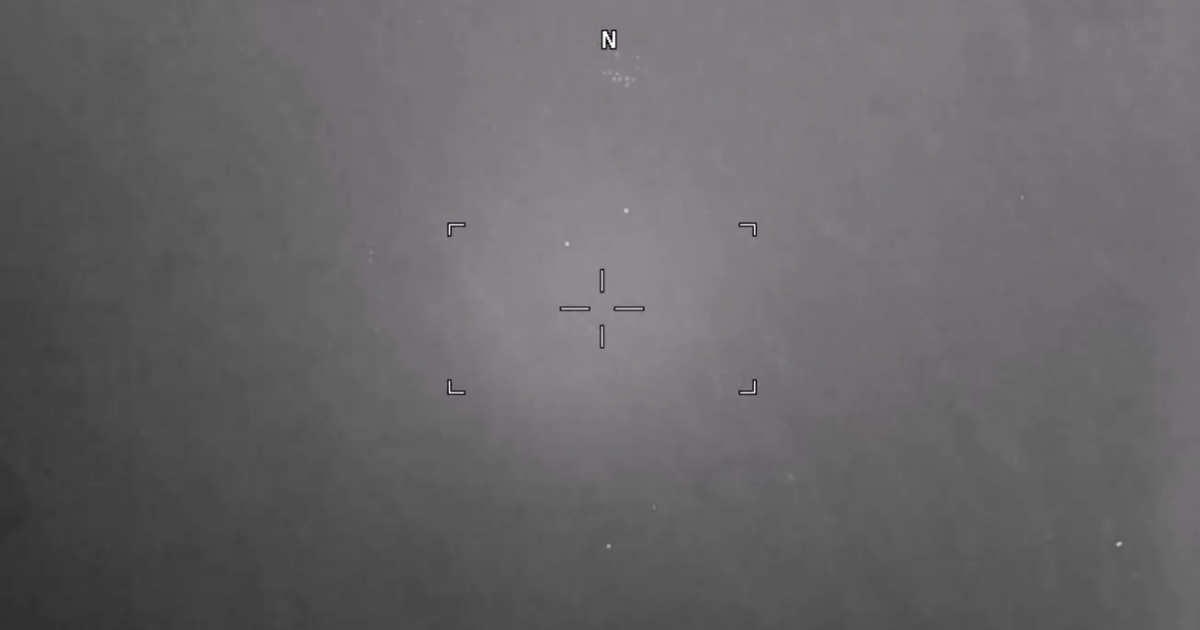
The eighth tranche of records also includes three newly declassified infrared and electro-optical sensor videos submitted by U.S. Central Command to the All-domain Anomaly Resolution Office (AARO). Recorded aboard military platforms in 2020, 2023 and 2026, the clips show sensors tracking unidentified “areas of contrast,” including a 54-second 2026 recording tracking two separate objects before intermittently losing contact. Pentagon officials noted the video descriptions do not reflect analytical conclusions and said no redactions were made to hide information about UAP encounters under President Trump’s transparency directive.
A separate file details 2023 civil air-surveillance radar detections of eight objects over 84 seconds between 55,000 and 70,000 feet. “If the detections were associated with a single continuous track, their cumulative point-to-point displacement would be approximately 38.5 miles, yielding a minimum mean horizontal ground-speed estimate of 1,650 mph,” the Pentagon summary says, noting the data was “not sufficient” to establish all eight detections were caused by the same object.
More on Pentagon
Keep reading

Virginia Requires DPOR Contractor License for Window Replacement Over $1,000
Virginia Beach homeowners looking to replace windows must prioritize installer experience and credentials to avoid water damage and...

The North Coal Hangs More Than 1,500 Ornaments for Christmas Display
Burlington restaurant decorates ceiling with 1,500 Christmas ornaments. The North Coal has transformed its Elizabeth Street location with...

Syracuse Women’s Basketball Beats Wisconsin 75-62 Behind Izoje Double-Double, Rodriguez Career High
Syracuse women's basketball (6-1) beat Wisconsin (6-3) 75–62 on Thursday at Coliseo Guillermo Angulo in San Juan, Puerto...

JJ Jackson Named to 2027 AHSAA Hall of Fame Class
James "JJ" Jackson has been named to the 2027 Alabama High School Athletic Association Hall of Fame Class....