
A trans theatre company is staging Virginia Woolf’s Orlando as an explicit “anti-adaptation” that centers sex work, pornography, and the labor of transition, marking their first major institutional commission after years on the fringe circuit.
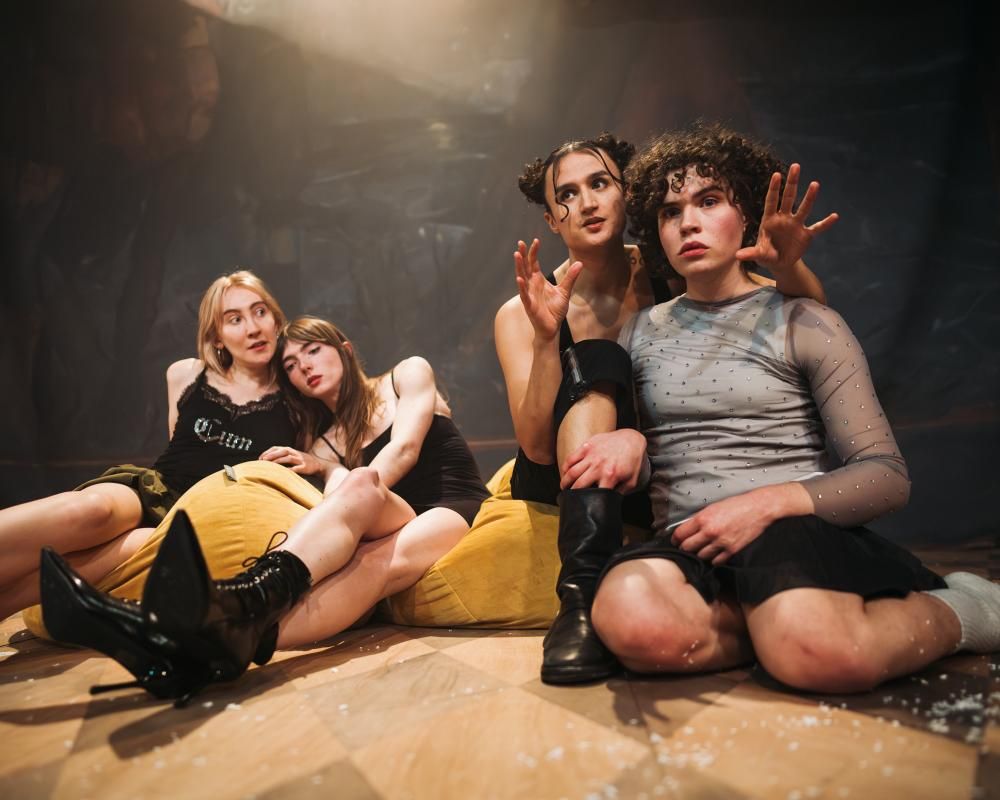
The production, Orlando: A Porno-Biography, opened at the New Diorama Theatre in London and runs until 12 December. It is created and performed by piss/CARNATION, the duo Charli Cowgill and Laurie Ward, alongside a transfemme ensemble of five.
The Guardian reported that the show reimagines Woolf’s 1928 novel not as a frothy costume drama but as a brutal, messy dialogue with transfeminine interiority, replacing the book’s magical sex change with a “goon cave” scene of obsessive masturbation to “sissy” pornography.
“One of the whole points of transition as a lived experience is that there is no magical sex transformation,” Ward told the Guardian. “It’s a lot of labour. It’s kind of like throwing yourself against an idea and hoping you like where you land.”
From Fringe Spit to Arts Council Funding
The commission represents a sharp material shift for a company known for confrontational work. Their 2022 debut, 52 Monologues for Young Transsexuals, collected audience spit to be thrown back during the performance; Ugly Sisters staged a real-life encounter with Germaine Greer. “As a company, we tend more towards brutal than twee,” Ward said.
This is their first Arts Council England grant, secured on the sixth attempt. “We came up through the Edinburgh fringe circuit, where it feels like you’re knocking on doors until you get a convert, and that is totally gruelling,” Cowgill told the Guardian.
“For the previous two shows, we’ve only known by the last performance whether or not we’ve made enough money to pay us back. Now we know we have the money to pay everyone for the run.”
Casting Against the ‘Handle With Care’ Instinct
The five-person cast — Cowgill, Ward, Sharon Le Grand, Mary Malone, and Macy Seelochan — begins the show playing men. “We’re making a big ask of our transfemme ensemble by asking them to play men in a really earnest way,” Cowgill told the Guardian. “We’re interested in doing things with trans actors that are a bit button-pushing.”
Ward framed the approach as a refusal of the limited roles typically offered: “Dolls deserve complex roles. And when dolls are cast, there’s an attitude of: handle with care. Because we’re working in a predominantly trans space, we’re like, let’s push it.”
The adaptation leans into what Ward calls the “smuttiness very alive in the book” that Woolf “Trojan horse-ed in because of all the obscenity laws.” The opening scene drops Orlando into a ketamine comedown in a Berlin club, surrounded by sharp-tongued trans sex workers. During a read-through, Ward stopped the action: “It’s feeling a little safe. How can we make it riskier?”
Cowgill told the Guardian that many trans women “discover this desire for themselves to transition through the body of another trans person. It’s in the wanting that other person where you actually realise what you want for yourself.”
Anti-Adaptation Centres Trans Inner Lives
The duo describes the work as an “anti-adaptation” — “we get to be in dialogue with people’s expectations, and dance over and desecrate them,” Cowgill said. They were disappointed by European stagings that cast androgynous actors, staging a “restoration rather than a transformation.”
“Cis people really aren’t in the world of the play,” Cowgill told the Guardian. “It’s about the inner lives of trans people and their relationships with one another.”
Since their last production, the UK Supreme Court ruling on the definition of “woman” and subsequent EHRC guidance on single-sex spaces have intensified the climate. “It emboldens us to do something pretty high risk, because there’s nothing to lose,” Cowgill said.
“We’ve come out of a period where so much of our art is asking for acceptance and sharing our lived experience in the hopes of reaching mutual understanding,” Cowgill added. “Now we’re more interested in putting a radical honesty on the table that is cathartic for people like us. The way that sits in the broader world is, actually, not our problem.”
Keep reading

Registered Sex Offender James Muzzi Pleads Guilty in Federal Court to Child Porn Charges
James Muzzi, 61, of Medford, pleaded guilty in federal court in Boston to distribution and possession of child...

Still Forces Fumble to Seal Chargers Win; Diggs, Moore Score TDs, Ryland Hits Two 49-Yarders
Former Maryland cornerback Tarheeb Still forced a fumble from Zay Flowers with two minutes left to secure the...

Maine Business Debt Settlement Firms Shift for 2026; Attorney-Led Firms Lead on MCAs
Maine small businesses are carrying debt loads that have become unmanageable for roughly one in three operators, a...

Kansas Lands $226 Million in Federal Rural Health Funds, Two-Year Total Nearly $450 Million
Kansas landed $226 million in new federal money for rural health care on Monday, the second year of...