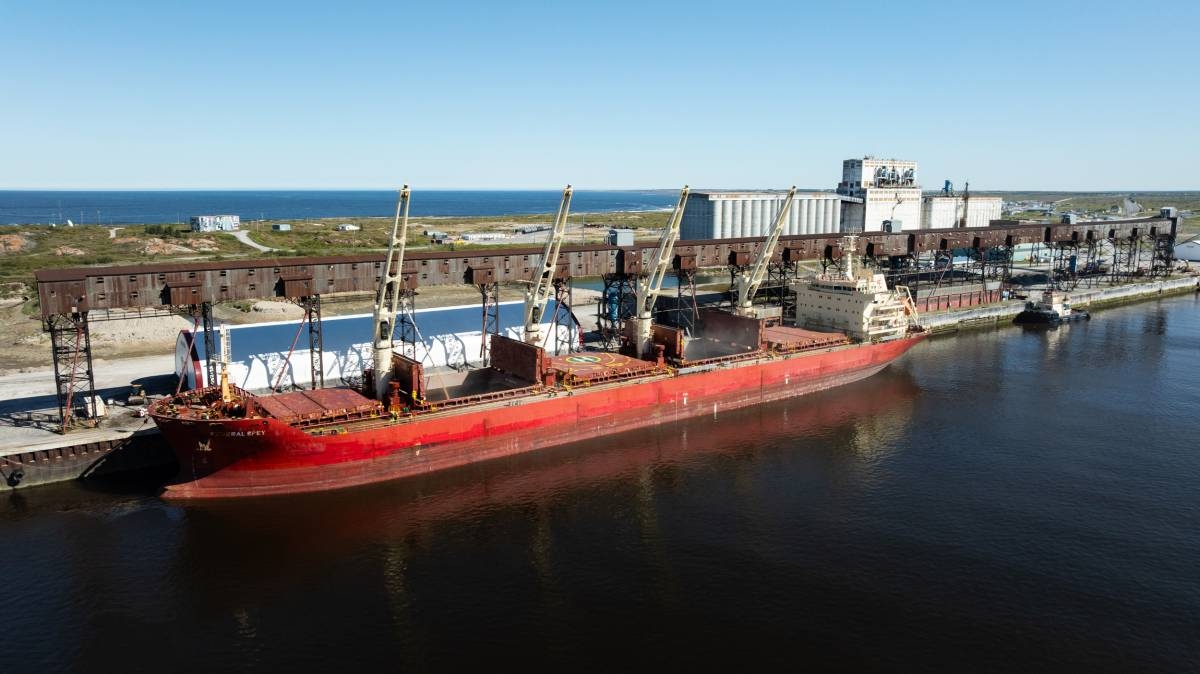
For the first time since 2020, the Port of Churchill loaded approximately 30,000 tonnes of Canadian durum wheat bound for Europe. The milestone shipment marks a major turning point for the Indigenous- and community-owned northern Manitoba trade corridor amid shifting global trade dynamics and ongoing international trade pressures.
The vessel carrying Saskatchewan-based AGT Foods grain represents the first of three scheduled grain ships expected at Churchill this season as part of a new customer relationship between Arctic Gateway Group (AGG) and AGT Foods that will continue into future years. Stakeholders gathered at the port on Monday to celebrate the milestone, which coincides with the most diversified shipping season in the port’s history.
Shipments out of Churchill — Canada’s only railway-accessible deep-water arctic port — were halted after the start of the COVID-19 pandemic, with the last grain shipment leaving Churchill in 2020. Port owner Arctic Gateway Group, which also owns the Hudson Bay Railway, announced in July that grain shipments would resume this summer.
A Changing Global Trade Landscape and Regional Resilience
Federal and provincial officials tied the resumption of commercial grain shipping directly to broader economic shifts and trade friction involving the United States. Speaking at the waterfront ceremony, government leaders emphasized the necessity of home-grown supply chains and independent trade routes. Federal Northern and Arctic Affairs Minister Rebecca Chartrand alluded to the ongoing Canada-United States trade war in her remarks.
“At a time when the United States has fundamentally changed all of its trading relationships, we are focused on what we can control. This means building strength at home and diversifying trade, so that Canada is no longer reliant on a single trading partner,” said the Honourable Rebecca Chartrand, Minister of Northern and Arctic Affairs, and Minister responsible for CanNor, Government of Canada.
What you’re seeing behind me right now is Team Canada working together,
Chartrand said during the ceremony at the port, adding that federal, provincial, municipal, and Indigenous governments are all working together. “The Port of Churchill has an important role to play, providing an Indigenous and locally-owned northern gateway connecting Western Canadian producers and resources to global markets. The return of grain exports is another example of what this northern corridor can deliver as we strengthen and diversify Canada’s trade infrastructure.”
Chartrand also stated that investing in the port will help Canada reach more markets amid dramatic changes in global trade and the country’s relationship to the U.S., noting that the U.S. has fundamentally altered its trading relationships.
What we're witnessing is the return of Churchill as a vital northern gateway connecting the Prairies, the Arctic to the rest of the world,
Northern Affairs Minister and Churchill-Keewatinook Aski member of Parliament Rebecca Chartrand said.
Seeing Prairie grain once again moving through the Port of Churchill to European markets is an important milestone for Manitoba agriculture,
said the Honourable Ron Kostyshyn.
First-Ever Potash Shipments and Expanded Cargo Diversity
Beyond the durum wheat transport organized in partnership with AGT Foods, the port is managing a wider array of commodities than in previous years.
The Port of Churchill says another vessel will arrive at the Port of Churchill this week to load zinc concentrate as well as the port’s first-ever shipment of potash, mined in Manitoba by Potash and Agri Development Corporation of Manitoba (PADCOM). AGG is also reportedly loading a northern resupply vessel destined for Nunavut, demonstrating the Port of Churchill’s growing role as both an international trade gateway and a supply hub for Canada’s Arctic.
Indigenous Leadership and the Rebuilding of Northern Infrastructure
Denver-based OmniTrax, the former owner, closed the deep-water port in 2016, and the railway washed out the following year. Chartrand speculated what might have happened if the federal government hadn’t brokered a deal in 2018 to transfer the ownership to local hands, which has led to Arctic Gateway and various levels of government working to revitalize the port and rebuild a customer base.
The Port of Churchill and the Hudson Bay Railway are owned by OneNorth, a partnership of 29 First Nations and 12 northern communities, and operated by Arctic Gateway Group. The people behind us have seen this as an opportunity to rebuild, and to do so through infrastructure that would be owned by northern and Indigenous communities,
Chartrand said. And today that determination is delivering results.
For War Lake First Nation Chief Betsy Kennedy, seeing the ship and the train cars that delivered the grain to the port was deeply personal.
She was born in a community along the railway, which has provided jobs for Indigenous people for decades.
“This time, the northern First Nations and the northern communities are leading the way,” she said.
Future Shipping Windows and Environmental Balance
This week’s surge in activity at the port comes amid some hope its four-month shipping season could be extended. A series of studies commissioned by Arctic Gateway released earlier this month suggested year-round shipping without the use of the most expensive icebreakers could be feasible as sea ice melts.

Wallabies seek bounce-back victory against All Blacks
Australia hosts New Zealand in a historic quad-header at Sydney’s Accor Stadium on Saturday, October 17, 2026.

Australia thrash Samoa 40-0 in women’s Rugby League World Cup opener
Australia launched its women's Rugby League World Cup title defense on Friday night with a commanding 40-0 victory...

NBA releases 2026-27 Kia MVP Ladder Watchlist with 10 contenders
The NBA released its 2026-27 Kia MVP Ladder Watchlist, featuring 10 players vying for the league’s top individual...

Virgil van Dijk backs ‘introverted’ Bradley Barcola to shine at Liverpool after Champions League hat-trick
Bradley Barcola ended his goal drought with a Champions League hat-trick as Liverpool thrashed LASK 6-3, silencing critics...