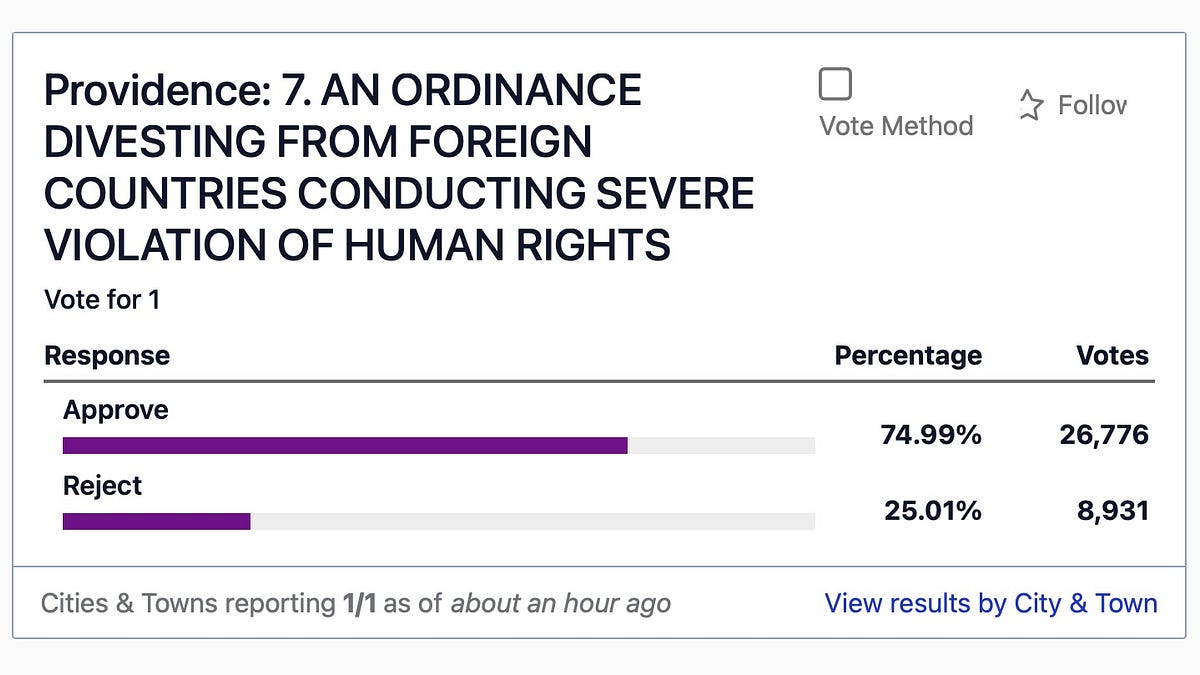
Providence Voters Order Divestment from Genocide in 75% Landslide
Providence, Rhode Island, will soon pull its public dollars from any foreign government engaged in ethnic cleansing, apartheid, illegal military occupation, or genocide, making it the largest American city to impose such a binding restriction on its investments through a direct popular vote.
On Tuesday, 75% of voters approved Question 7, with the Rhode Island Board of Elections tallying the measure ahead by more than a 3-to-1 margin as 81 of 82 polling locations reported, according to the Jewish Telegraphic Agency.
The ordinance marks the first time a binding municipal divestment law has been decided by ballot in U.S. history, and city archivists confirm it is the first citizen-led measure to qualify for the Providence ballot, according to a report on Steve Ahlquist’s Substack. For the city’s roughly 15,000 Jewish residents—about 7% of the population—and the broader coalition that drove the campaign, the vote represents a direct democratic demand that local tax dollars reflect human rights values.

A Ballot Measure Born in February
The path to Tuesday’s vote began in February, when more than 130 volunteers with the Providence for Palestine coalition fanned out across the city to collect over 10,000 signatures from voters, including city workers, teachers, and members of the local Jewish community. The coalition brought together Jewish Voice for Peace–Rhode Island, the Rhode Island Democratic Socialists of America, AFT Local 6516, Reclaim RI, and American Muslims for Palestine MA/RI.
The effort built on momentum from nearby Somerville, Massachusetts, where voters in November 2025 overwhelmingly approved a non-binding question calling for divestment from companies profiting from the genocide of Palestinians. Activist campaigns challenging U.S. financial support for Israel have accelerated since the Oct. 7, 2023, Hamas attacks and the ensuing Gaza war, reshaping local politics in the process and turning municipal ballots into a new front in the debate over foreign policy.
Who Led the Charge
The campaign was disproportionately led by Jewish residents who framed divestment as an expression of Jewish values rather than a rejection of them.
A 2025 Washington Post poll found that 61% of American Jews believe Israel has committed war crimes in Gaza, with a plurality supporting an end to military funding.
Progressives Win Providence Leadership
They also elected progressive champion David Morales as mayor and a slate of progressive city councilors, including Jackie Goldman in Ward 5, who has pledged to work toward enacting the divestment.
As a future member of the Providence City Council, Jackie Goldman said they would work to make sure that the city enacts divestment.
The results came after incumbent Mayor Brett Smiley, a pro-Israel Democrat, lost his primary to Morales—an early indicator of the electorate’s mood, according to the Jewish Telegraphic Agency. According to Providence’s financial records and research by the American Friends Service Committee, millions in city funds are currently invested in companies facilitating Israel’s actions in Gaza and the occupied West Bank, and Providence has a 20-year history of investing millions in Israel Bonds.
What the Ordinance Covers—and What It Doesn’t Name
A representative for the Jewish Alliance of Greater Rhode Island told the Jewish Telegraphic Agency that the group would explore legal options to challenge the ballot measure now that it has passed.
Divestment Gains Momentum Nationwide
Providence’s vote lands amid a broader shift in municipal finance. Last month, New York City’s comptroller committed to not reinvesting in Israel Bonds, which function as direct loans to the Israeli government and military, and over the past year more than $90 million was divested from those bonds in Michigan, Minnesota, North Carolina, and Maryland. A 2025 Washington Post poll found that 61% of American Jews believe Israel has committed war crimes in Gaza, with a plurality supporting an end to military funding to Israel.
What Comes Next for Providence
The ordinance takes effect as a binding city law, meaning Providence must now audit its portfolio and divest from targeted holdings and countries. Legal challenges from opponents could complicate the timeline.
In Providence, the question of divestment was settled democratically. This will be a model for other cities.”
“Today marks a political transformation in Providence.”
Whether the ordinance survives legal challenge or inspires similar measures in other cities, one thing is already clear: Providence voters have tied their city’s investments to its conscience, and the ripples are likely to travel far beyond Rhode Island.
Related reading

Democrats Seize Control of Congress in Massive Blue Wave Rebuke to Trump
Voters delivered a staggering verdict on Tuesday, handing Democrats control of both the House and Senate in a...
Georgia Election Results: Democratic Sweep and Divided Legislative Control
Georgia voters delivered a decisive Democratic sweep across every statewide contest on the ballot Tuesday, ending a 24-year...

Kraft Heinz to Sell North American Coffee Business to One Rock Capital for $650 Million
JACKSONVILLE, Fla. — In a deal that will reshape the future of American coffee manufacturing, Kraft Heinz has...

Josh Green Wins Hawaii re-election with 72% of the vote
263,274 voters cast their ballots for Gov. Josh Green and Lt. Gov.-elect Derek Kawakami on Tuesday, delivering the...