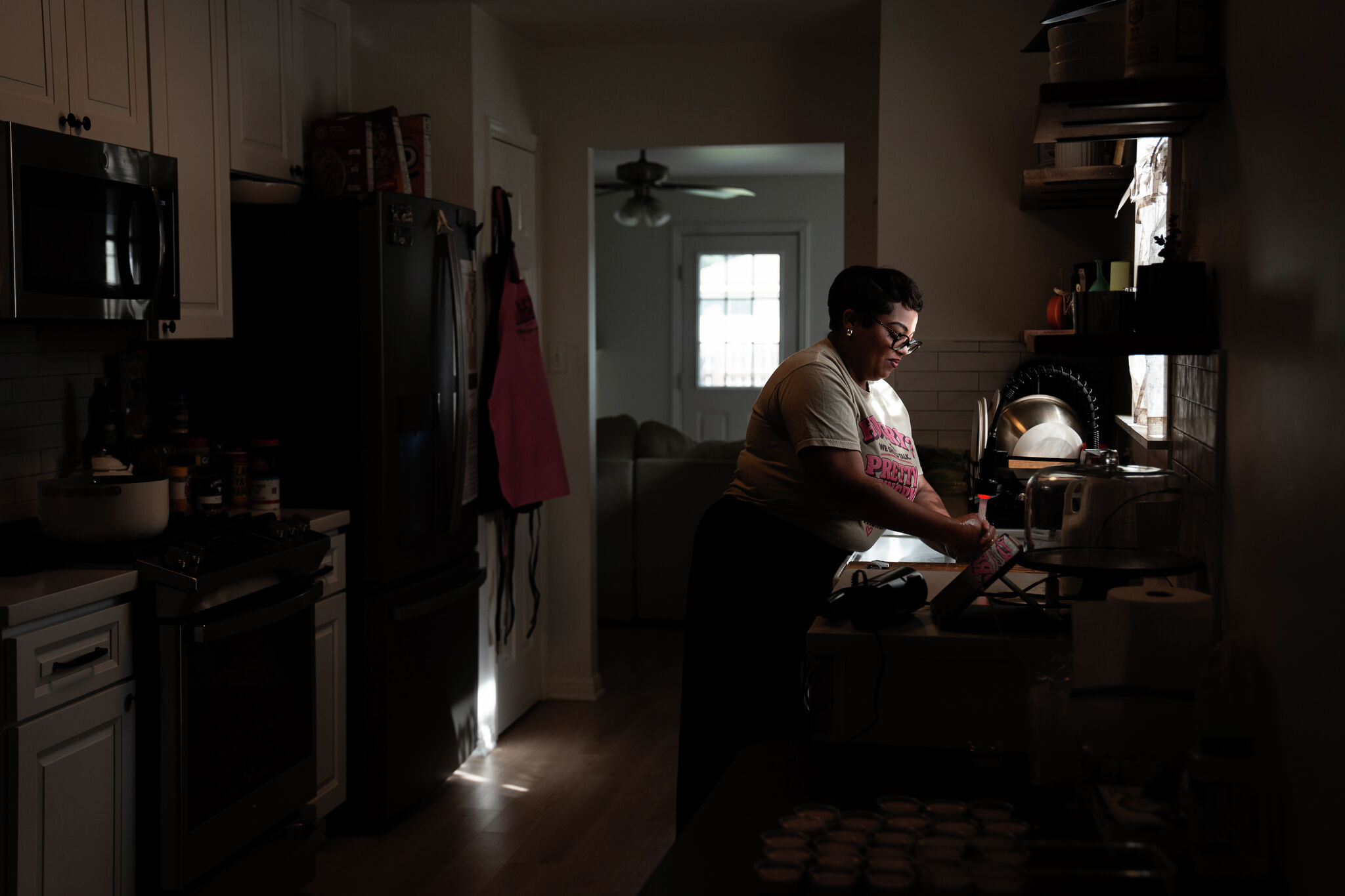
Queen Lockhart’s home-based food business, Pretty Hungry ATX, has outgrown her Round Rock kitchen, leaving her caught between rising demand and the high cost of moving into a commercial space, Austin American-Statesman reported.
Lockhart estimates she now serves 50 to 75 customers a week through Facebook Marketplace, TikTok and Instagram, up from a $2,000 launch in September. “It’s becoming too large for my house, but it’s not big enough for the brick and mortar financially,” she told Austin American-Statesman.
On busy weekends, Lockhart pushes aside her dining table to set up three workstations for prepping, plating and keeping meals warm. Customers pick up orders at a nearby neighborhood pool parking lot. Without commercial refrigeration and bulk storage, she cannot buy ingredients at restaurant volumes, squeezing margins at Restaurant Depot, Sam’s Club, Costco and H-E-B.
Lenders quoted roughly $50,000 to open a restaurant and $20,000 to $30,000 for a food truck. Austin-area retail asking rents rose about 24% from mid-2019 to $26.87 per square foot annually in the third quarter of 2026, according to Partners and its predecessor NAI Partners. The bank prime rate, a benchmark for business loans, was 7% in November, compared with 3.25% in 2021.
A 2025 Institute for Justice report estimated opening a small restaurant in Austin requires 105 regulatory steps and $8,962 in permitting and licensing fees before rent, equipment and construction. The National Restaurant Association said average restaurant operating expenses rose 36% between 2019 and 2026.
Lockhart explored shared commercial kitchens. Moonbeam Kitchen in East Austin advertises 20 hours for $400 a month plus a $350 deposit. Wingman Kitchens lists 20 hours for $500 with a three-month minimum. Lil’ Mama’s Kitchen in Round Rock offers space starting at $30 an hour with a four-hour minimum and a $500 deposit. Insurance, permits and storage add to those costs. Loan applications stalled on requirements for established cash flow and credit history. “If someone is lending you a large amount of money, they need to see that you’re able to pay them back,” Lockhart said.
Texas expanded its cottage food law in 2025, raising the annual sales threshold to $150,000 and allowing more temperature-controlled foods, but Senate Bill 541, effective Sept. 1, 2025, still excludes meat, poultry and seafood.
Lockhart’s menu includes chicken wings. She holds a food manager certification and formed an LLC, but acknowledged her home operation presents regulatory concerns.
Lockhart learned to cook at 9 and worked in restaurants, food trucks and corporate dining before earning a hospitality management degree. She ran a home bakery in Miami, then taught in Pflugerville and Round Rock schools for four years. She left teaching in May to pursue an MBA after frustration with pay. When her husband lost his technology job, she launched Pretty Hungry ATX on Sept. 2, building the logo, menus and social accounts in two days.
Most customers are strangers. “I’m just amazed at how great the community has been in supporting us with this business venture because, again, I don’t know most of my customers,” she said. A 2026 Food Liability Insurance Program survey found 34% of cottage food operators cited social media as a leading customer source, compared with 38% for local events.
Lockhart charges $22 for a platter of eight wings, two sides and honey-butter cornbread, earning an estimated $20 to $23 an hour for her labor. Moving to a commercial kitchen would likely push the price to $25 or $26. “I think a lot of customers don’t understand that as a small business, my food cost is different than, let’s say, Denny’s food cost,” she said.
She publishes up to 10 social media posts a week, sharing preparation videos and responding to comments.
“A lot of people eat with their eyes,” she said. Her husband, who works in marketing, helps. “People want to feel like they know you,” she said.
Her long-term goal is a small takeout restaurant with a few tables. “I would never recommend for anyone to just jump straight into owning a restaurant,” she said. “You want to make sure that there is a need for your food.”
Related reading

Dover Nurse and Band Volunteer Geraldine Lynch Dies at 90
Geraldine Elaine "Jerry" Lynch, a registered nurse who spent nearly three decades at Kent General Hospital and served...

RLL Tests Lundqvist at Phoenix for Driver Evaluation
RLL will test 2024 IndyCar Rookie of the Year Linus Lundqvist at Phoenix Raceway on Tuesday, giving the...
Lake City Is Most Isolated Town in Colorado, Denver Gazette Reported
Hinsdale County holds the fewest road miles per person in the lower 48 states, making Lake City the...

Seattle Marathon Moves to New Course, Staggers Starts to Ease Magnolia Traffic
The University of Washington Medicine Seattle Marathon and Half-Marathon move to a new course Sunday that avoids Magnolia...