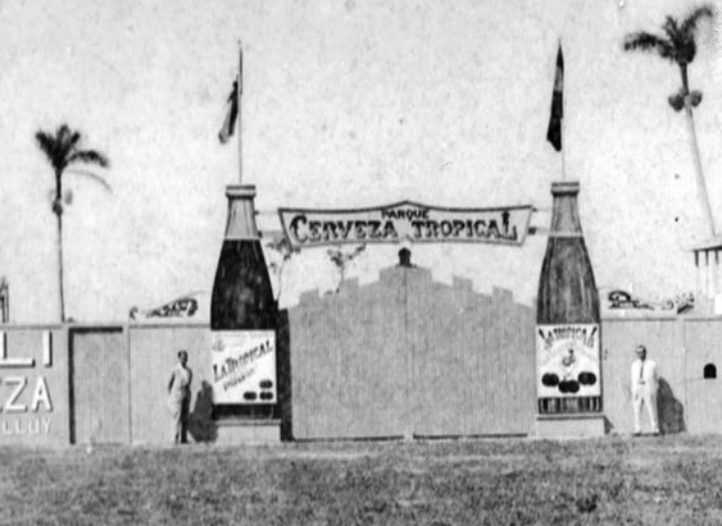
In the late 2010s, a collection of 16 photographs from the 1927–28 Cuban winter league season led Mark Rucker and a small team to the overgrown ruins of Estadio Tropical Cerveza in Güines, about 50 km southeast of Havana, Our Game reported.
The prints — 7-by-5-inch images mounted on decorative 10-by-8-inch boards — surfaced in Havana in an “astounding state of preservation” despite Cuba’s “sauna-like climate,” Rucker wrote. Sixteen of the original 18 photographs were eventually assembled. Each bore the embossed credit of photographer Raphael Santiago of Calle M. Gomez 120, Güines, a name Rucker had never encountered in more than 15 years of Cuban baseball photo research, according to Our Game.
The most significant image was a team portrait of the Cuba Baseball Club, an integrated professional squad managed by Armando Marsans, one of the first Cubans to play in the major leagues across eight seasons in the American, National, and Federal Leagues.
The roster included Negro Leagues stars Willie Foster, Judy Johnson, Oscar Charleston, Walter “Steel Arm” Davis, and catcher Larry Brown alongside Cuban standouts Basilio “The Witch” Rosell, Pelayo Chacón, Cando López, Francisco Correa, and José Pérez.
Guided by the photographs, Rucker traveled south from Havana with Cuban baseball historian Ismael Sené, author Peter Bjarkman, and a driver identified only as Eduardo. After passing horse carts and 1930s-era tractors on the two-lane highway, they reached Güines’ modern municipal stadium — freshly painted in red and ochre — where a guard redirected them toward the town center, Our Game reported.
East of town, they found the former ballpark site. A stylized, weather-beaten gateway and high white cement wall had replaced the original entrance. The outfield wall bore a painted “352” marking at the intersection with the right-field line, matching the left-field distance symmetrically.
An interior cement wall with attached dugouts separated the field from the grandstand area, where crumbling foundations still traced the footprint of the original wooden stands, according to Our Game.

The paved street beside the park did not exist in 1928; the venue likely held 10,000 spectators at the time, Rucker estimated in Our Game.
The site had undergone at least two distinct construction phases: the original wood-framed “Beer Park” and a later 1930s–40s art-deco cement structure used extensively into the 1950s. Pitching rubber and home plate remained in place, and the grass was closely cropped, indicating the field still hosted games, Our Game reported.
“As I turned my head to leave, I could have sworn that I saw from the corner of my eye the long, tall Willie Foster, arms and legs in motion, tossing to Larry Brown, with Oscar Charleston shouting exhortations from the beyond,” Rucker wrote in Our Game.
Keep reading

MacKenzie Scott Donates $12.5 Million to Georgia Education Nonprofits
Philanthropist MacKenzie Scott gave $12.5 million to two Georgia nonprofits that help students pursue education after high school,...

Six Charged in East Orange County Halal Butcher Shop Animal Cruelty Investigation
Six people tied to Ali Meat International, a halal butcher shop in east Orange County, were charged over...

Dutch Court Bans BYD Ti7 Sales in EU Over Land Rover Defender Design Infringement
BYD shares fell 4% in Hong Kong on Monday before closing 1.9% lower after a Dutch court barred...

Jodeci Cancels Louisville Concert After K-Ci Hailey Medical Emergency; Fans Wait Hours
"I'm still waiting," Macarra Hunter said, playing the Jodeci track on her drive home after the group's Louisville...