
“What a really cold winter does, it kind of knocks down these parasites a little bit,” said Todd Brinkman, a wildlife ecologist at the University of Alaska Fairbanks.
“But if it’s a mild winter it doesn’t knock down that load.”
Milder winters are allowing parasites to survive and reproduce earlier each spring, raising the risk that new tick species become established in Alaska, researchers told the Alaska Science Forum. The concern centers on species such as the western black-legged tick and the moose winter tick, neither of which has established a foothold in the state but both of which are present in neighboring Canadian territory.
Alaska has six native tick species, but researchers know relatively little about them, according to Christina Hansen, a veterinarian and associate dean for the Department of Veterinary Medicine at UAF.
“We do have native ticks in Alaska,” Hansen said. “We just don’t have the ticks common to dogs and cats in the Lower 48 states.”

The Alaska Submit-A-Tick Program, run by the University of Alaska, lets veterinarians and the public send ticks in for identification and testing. In a 2023 report, Micah Hahn, an associate professor of environmental health at the University of Alaska Anchorage, said that researchers identified 988 tick records representing 2,207 individual ticks in Alaska from 2010 through 2022, UAF Sun Star reported.
Among those submissions was a black-legged tick, Ixodes scapularis, found on a dog in Eagle River. The dog had recently traveled to rural upstate New York, where black-legged ticks are common. The tick carried Borrelia burgdorferi, the bacterium that causes Lyme disease. No other pathogens known to cause human disease were detected in the submitted ticks, the report said.
Hahn’s research includes modeling where different tick species might survive under current and projected climate conditions. “In general, our models show that much of Southeast is suitable habitat for the western black-legged tick,” Hahn said, adding that the tick could likely overwinter in the region.
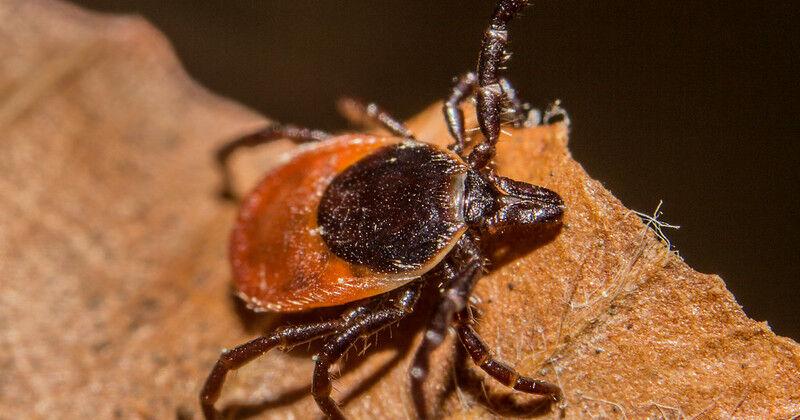
One concern for wildlife managers is the moose winter tick, Dermacentor albipictus, which has not yet been documented in Alaska. The parasites feed on moose blood. Heavily infested animals may scratch and rub against trees, damaging the insulating winter coats they need to survive cold temperatures. Some infestations can leave moose weakened and vulnerable to starvation.
Winter ticks have affected moose populations in parts of Canada and the Lower 48. “[Winter ticks are] present in British Columbia. They’re present in the Yukon territory of Canada,” Brinkman said. “So these are some of the climate-related issues that we have to keep track of.”
Meanwhile, researchers have more questions than answers about Alaska’s native ticks. They do know that tularemia, sometimes called rabbit fever, can spread through bites from infected ticks, as well as to humans through contact with infected animals. Ticks arriving from outside Alaska could also potentially contribute to the spread of diseases that are already present in local wildlife.
Brinkman recommended that people traveling with pets to areas where ticks are common discuss preventive measures with their veterinarian before they go. If you find a tick on a pet, you should carefully remove it, placing it in a closed container such as a baggie or pill bottle. Then contact your vet, who can help identify it and determine whether it should be sent to the Submit-A-Tick Program.
Worth a look

Three Tied NJ Municipal Elections, One-Vote Mayoral Race May Force Court Battles, Special Elections
Three tied municipal elections and a one-vote mayoral race in New Jersey may force court battles and special...

Highland Opens 4A Title Defense, Chasing Fourth State Championship in Six Seasons
Highland opens its Class 4A boys basketball title defense Tuesday, chasing a fourth state championship in six seasons...

Oklahoma State Beats Virginia Tech 106-80 in Charleston Classic
Julius Halaifonua led Oklahoma State with 22 points; Kashie Natt added 21 on 8-of-9 shooting. The Cowboys outscored...

Chiefs Beat Cardinals 34-7; Mahomes, Kelce Shine as Emmett Johnson Stars in Win
Kansas City moved to 8-2 with a 34-7 win over Arizona on Sunday, resting starters early ahead of...