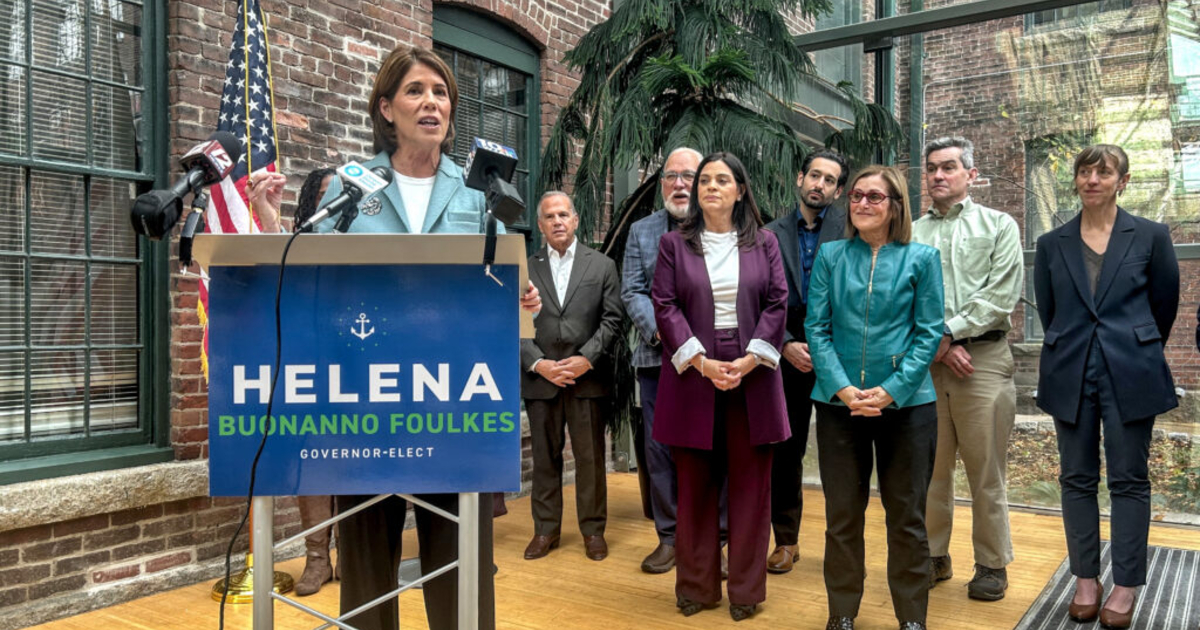
Governor-elect Helena Buonanno Foulkes will have an extra $109 million to manage when she crafts her first tax and spending proposal for the upcoming fiscal 2028 budget.
This nine-digit influx arrived following the biannual Revenue and Caseload Estimating Conference on Tuesday, where state budget analysts confirmed that general revenue is trending $108.7 million higher than the spring projections used to finalize the fiscal 2027 budget.
While the sudden cushion might appear to be a windfall, Rhode Island’s leadership is treating the news with marked restraint. The reality of the state’s financial ledger remains clouded by long-term deficits and the looming shadow of federal policy shifts.
“We need to think about more than just one year,” Foulkes said at a press conference on Tuesday. “One of the challenges will be to be really disciplined about this.”
The Structural Deficit Reality
The caution voiced by the Governor-elect stems from a clear mismatch between short-term revenue spikes and long-term liabilities. While the current fiscal year looks healthier, the House fiscal office projected in June that the state faces a $240 million deficit for fiscal 2028, a gap expected to swell to $540 million by fiscal 2031.

These figures do not account for the volatility introduced by federal legislative changes. Under H.R. 1, Rhode Island is bracing for federal funding cuts, particularly involving massive overhauls to the Supplemental Nutrition Assistance Program and Medicaid. Given that Medicaid comprises one-third of the state’s $15 billion budget, the stakes for the incoming administration are high.
Legislative leaders are framing the revenue news as a temporary reprieve rather than a permanent fix. Senate President Valarie Lawson emphasized that the state must remain mindful of the economic uncertainty facing residents. “As the state budget is developed and considered, we must also account for the significant fiscal challenges posed by changes in federal policy and their potential impact on our state,” Lawson said on Tuesday.
Clashing Perspectives on Fiscal Health
The interpretation of these numbers has created a sharp divide between the outgoing administration and the incoming leadership. Outgoing Governor Dan McKee struck an optimistic chord on Tuesday, pointing to the revised estimates as proof of his administration’s fiscal stewardship.
“We are leaving Rhode Island in a better fiscal position than we found it, and I’m proud of the stronger foundation we’ve built for our state’s future,” McKee said.
In contrast, House Speaker Christopher Blazejewski utilized a more somber tone, citing “punishing” federal policy choices and “ongoing harm and uncertainty” from the federal government. This friction highlights a broader concern: while the state’s 7% sales tax outperformed expectations by $61 million and business taxes rose by $49 million, personal income taxes actually fell by $25 million.
The mixed nature of these revenue streams suggests that the state’s economic engine is not firing on all cylinders. Lottery revenue is projected to drop by $300,000, as gains in sports betting and table games at casinos in Lincoln and Tiverton fail to fully offset losses in iGaming and video lottery terminals.

Priorities for the Incoming Term
Despite the budgetary pressure, Foulkes has maintained her campaign focus on housing development. During the campaign, she pledged to build 20,000 homes over the next eight years, a goal partially tied to the state’s new surtax on income over $1 million. That surtax begins in January, though the initial $22 million in expected revenue for fiscal 2027 has already been integrated into the general fund.
For now, the specific allocation of the additional $109 million remains an open question. Budget analysts are scheduled to meet again in May to refine these projections, a process that will ultimately dictate how much room the General Assembly has to maneuver during the review of the inaugural budget proposal.
Whether this revenue serves as a bridge to stability or merely a temporary mask for deeper structural issues remains the central point of contention. As the state moves toward the January budget unveiling, the question of how to balance long-term fiscal health against the immediate needs of residents continues to dominate the discourse in the State House.
Worth a look

Christenson Family Deaths in Grand Meadow Fire Ruled Homicide and Suicide
Four family members discovered inside a fire-damaged Grand Meadow home Sunday died from gunshot wounds, the Mower County...

Two Die and 17 Are Injured in Brooklyn Building Collapse
Two people died and 17 others were hospitalized when a three-story building collapsed in Brooklyn on Wednesday afternoon,...

Philadelphia Woman Charged With Assaulting Central Park Carriage Drivers
Abigail Holbrook, 27, of Philadelphia was arrested and charged with two counts of assault following a confrontation with...

Alessia Mirhashemi Joins Notre Dame Women’s Soccer
The Fighting Irish announced the incoming class, which includes defender Alessia "Lolly" Mirhashemi from Rancho Santa Fe, California....