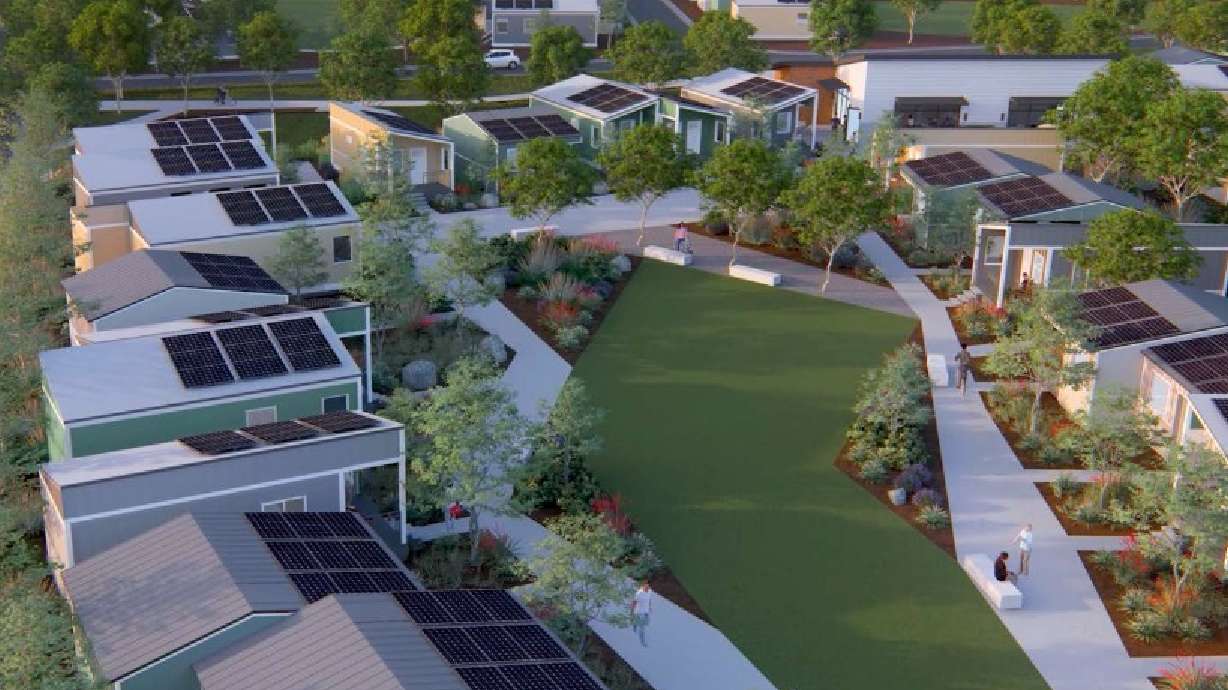
Salt Lake City will consider a $2-per-year lease to expand The Other Side Village from 8.1 acres to 37.5 acres, quadrupling capacity to 420 units with 378 designated affordable, KSL.com reported.
The City Council will hold a public hearing on Dec. 1 at 7 p.m. at City Hall, with a formal vote tentatively scheduled for Dec. 8. The proposed lease would run through at least October 2063 on city land valued at over $20 million, according to city documents.
From pilot to expansion
Salt Lake City leaders passed a resolution in 2022 allowing a $40, 40-year discounted land lease on 8 acres to test the concept as homelessness spiked after the pandemic. The Other Side Village opened at the end of 2024 with 32 homes for people who had experienced chronic homelessness and completed a recovery program led by The Other Side Academy. The initial phase called for 60 deeply affordable rental units with supportive services.
City officials now say the pilot has demonstrated it can provide “long-term, community-supported housing to residents who have experienced chronic homelessness,” according to a memo from the Department of Community and Neighborhoods. The expansion would add 14,400 square feet of neighborhood centers, 16,000 square feet of retail and a non-denominational chapel, supplementing 30,000 square feet of existing community and social enterprise space.

Funding and conditions
Contributions include state allocations and large donations from The Church of Jesus Christ of Latter-day Saints and other public and philanthropic donors. Gail Miller, a donor, said last year, “We support initiatives that restore dignity, open doors to opportunity and bring real hope. This is more than housing.”
Under the proposed term sheet, at least 324 units must be affordable for individuals or families meeting HUD’s definition of chronically homeless — those experiencing homelessness for at least 12 months or on at least four occasions within three years. At least 5% of affordable units must be wheelchair accessible, and no more than 10% of all units can carry unrestricted rents tied to staff housing.
Scrutiny and next steps
The Other Side Academy, which owns the village, faced scrutiny in June when the Utah Investigative Journalism Project published an investigation in which alumni offered conflicting views on the academy’s strict rules and intensity in treating addiction. Co-founder Joseph Grenny defended the academy’s practices at the time.
The city memo states the expansion advances “reasonable goals and objectives to increase the availability of affordable housing, provide job training and support the city’s unsheltered population on a path to stable housing,” and that a below-market ground lease is “an appropriate use of City resources” at a scale the city likely could not provide on its own.
City defines who qualifies for the new affordable units
This standard is stricter than the general affordable-housing thresholds used in many city programs and mirrors the eligibility criteria applied during the village’s pilot phase.
Live poll gauges public sentiment ahead of the vote
A live poll published alongside the proposal asks whether Salt Lake City should expand discounted land for homeless housing villages, offering simple “Yes” and “No” options for respondents.
The site notes that the seven-member City Council holds the legislative authority to approve or reject the lease, while the Department of Community and Neighborhoods has formally endorsed the expansion as advancing the city’s affordable-housing and job-training objectives.
The Other Side Village operates as a Human First Model community where housing is paired with six interconnected pillars — Self-Governance, Growth, Self-Reliance, Love, Safety, and Support — to address the isolation and disconnection that often precede chronic homelessness.
The model requires ongoing accountability through peer-led democratic governance, community covenants such as paying rent on time and following civil law, and engagement in social enterprises that provide jobs, skill development, and revenue to fund village operations toward self-sustainability.
The public hearing is set for Dec. 1. The Council’s tentative vote follows on Dec. 8.
Polis, Primavera Wish Coloradans Happy Thanksgiving, Urge Community Service
Gov. Jared Polis and Lt. Gov. Dianne Primavera issued Thanksgiving greetings to Coloradans on Wednesday, urging gratitude and...

Mirage F1 Jets from Luke AFB Candidate for Tucson Sonic Booms
Thousands of southern Arizona residents reported hearing and feeling sonic booms on Nov. 23 and 24, and a...

Sound FX Automotive: DelDOT Brine Clings to Cars Days Before Snow, Even Without Storms
Road brine reaches Delaware cars days before any snow falls, DelDOT's pre-treatment program shows. The state applies salt-water...

Post and Courier Highlights Charleston Burger Scene With Fritos, Lobster, Duck Sausage
Charleston's burger scene spans long-standing institutions, pop-up graduates and French-leaning bistros, each pushing the sandwich past the standard...