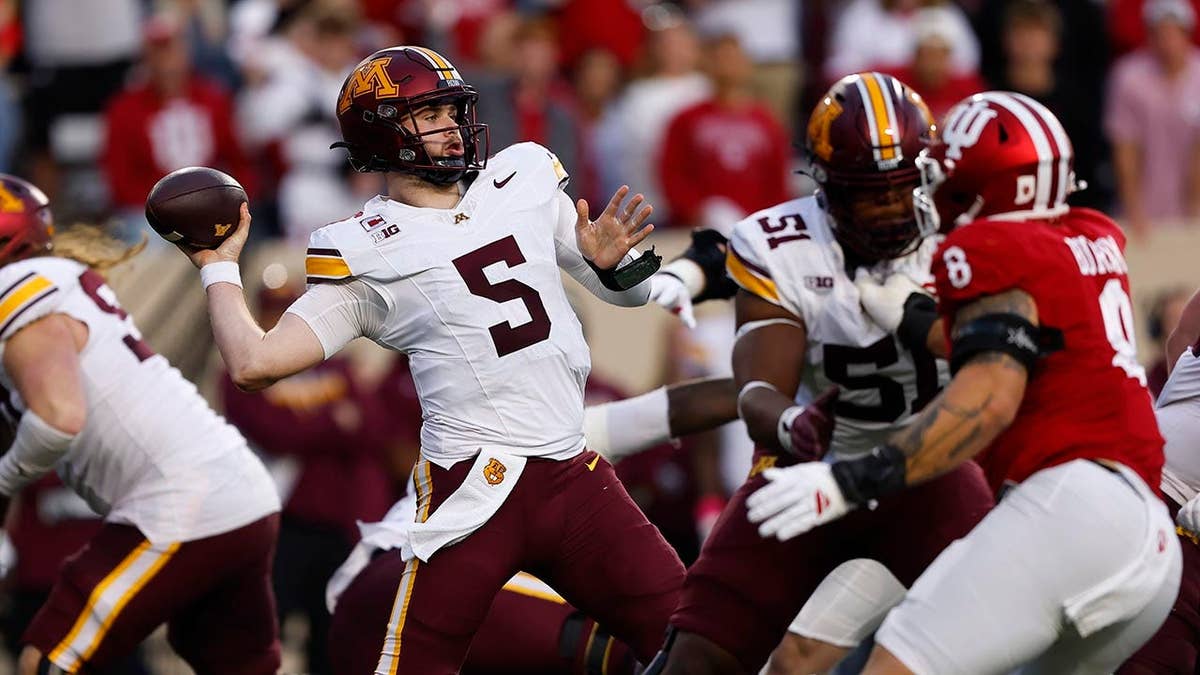
Minnesota finished the regular season 6-6 after a lopsided loss at Wisconsin on Friday night, extending a road record of 1-9 over the past two seasons and prompting coach P.J. Fleck to call for major changes on both sides of the ball, Star Tribune reported.
The Gophers were outgained and outclassed in Madison, managing only 115 yards and six first downs in a performance Fleck described as entirely his responsibility. The defeat capped a 4-5 Big Ten record and left the program at what columnist Chip Scoggins called an inflection point after a decade under Fleck.
Road futility defines two-year stretch
Minnesota has lost nine of its last ten true road games, with seven of those defeats effectively decided by halftime. That trend, Scoggins wrote, signals something fundamentally flawed rather than a string of bad breaks.
The Gophers entered the finale as underdogs in every conference game but one, a schedule Fleck cited as context for the 4-5 league mark. Star Tribune said that parity across the Big Ten — fifteen of eighteen teams with at least three losses — makes the schedule a constant, not an excuse.
Quarterback uncertainty looms over offseason
Drake Lindsey regressed this season and never regained his footing, making it uncertain whether he will enter the transfer portal or warrant a multi-million-dollar investment to stay. Wisconsin’s Colton Joseph, by contrast, torched Minnesota’s defense with both his arm and legs, illustrating the advantage of a mobile quarterback that Fleck’s offense currently lacks. Fleck acknowledged the offensive coordinator hire is his most critical decision of the offseason.
Defensive coordinator change expected
Danny Collins’ unit was pushed up and down the field again Friday, continuing a pattern of struggling against mobile quarterbacks. Fleck has already fired his offensive coordinator and told reporters he needs to be in the market for a defensive coordinator as well.
Athletic director Mark Coyle will need to authorize spending for an established play-caller, Scoggins argued, because the program “will not climb higher than middle of the pack with an offense that continually sabotages the operation.”
Fleck admits full responsibility for offensive failure
Fleck accepted complete blame for the Gophers’ offensive collapse, telling reporters after the Wisconsin loss that the lack of production falls entirely on him as head coach. He acknowledged that his team entered the season as underdogs in every Big Ten game but one, yet insisted the schedule is a constant across the conference, not an outlier.

Fleck also highlighted the parity defining the Big Ten, noting that fifteen of eighteen teams carried at least three losses and six remained alive for the championship game entering the final week. He described the current environment as life in the pay-for-play era, where the margin between average and elite is razor-thin.
Program faces inflection point after decade under Fleck
Columnist Chip Scoggins wrote that the lopsided defeat at Wisconsin represents an inflection point in Fleck’s ten-year tenure, with the program spinning its wheels rather than advancing. Scoggins argued that Minnesota’s road futility — seven of the last nine true road losses effectively decided by halftime — indicates a fundamental flaw rather than a string of bad breaks.
He pointed to Iowa’s comparable payroll and potential playoff berth as evidence that limited resources are not an impassable roadblock.
Fleck accepts blame but signals urgency
“When you don’t play up to your standard, that 100 percent falls on the head football coach,” Fleck said after the game. “I did not do a good enough job for our guys to have a chance to win that football game.”
He later added, “I’m responsible for all the lack of offensive production. That 100 percent falls on me.” The school’s leadership now faces a decision on whether a program spinning its wheels — not going backward but not advancing — is good enough for a Big Ten program in the pay-for-play era.
Keep reading
Gulls Build 3-0 Lead, Suchanek Stops 35 Shots in 5-2 Win Over Eagles
San Diego built a 3-0 lead and rode that hot start to a 5-2 victory over the Colorado...

Pre-Order 2026 Big 12 Championship Utah Utes Zephyr Headway Hats
Utah has clinched a berth in the 2026 Edward Jones Big 12 Football Championship after a 38-17 win...

Aiden Flora’s 280 Yards, Three TDs Lead Iowa State Past Kansas State
Iowa State (6–6, 4–5 Big 12) earned a bowl berth; Kansas State fell to 4–8 (1–8), its worst...
No. 8 Wake Forest Defeats Duke 31-7, Secures CFP Spot
No. 8 Wake Forest defeated Duke 31-7 on Saturday, securing its spot for the College Football Playoff and...