
The South Dakota Open Meetings Commission dismissed a complaint Monday alleging that eavesdropping on a closed city council meeting violated state open-meetings law, while reprimanding the Tripp City Council for failing to properly justify executive sessions.
Eavesdropping complaint dismissed
Gary resident Rachel Hinsvark accused the Gary City Council of violating the law by allowing the city finance officer to sit in a hallway close enough to hear an executive session. According to Hinsvark’s complaint, the finance officer “positioned herself directly outside the executive session room, in the hallway between the library and city office — close enough to hear the ongoing discussion,” South Dakota Searchlight reported.
Hinsvark also alleged council members included city employees in the executive session without a vote approving their presence. She told commissioners “there must be procedures in place that do not rely solely on trust” for meeting attendees to vacate an executive session, and that the city council “has a responsibility to safeguard executive sessions.”
“This is not simply about an employee sitting at the door,” Hinsvark told commissioners. “It’s about public trust, accountability and ensuring the rules governing public bodies mean something.”
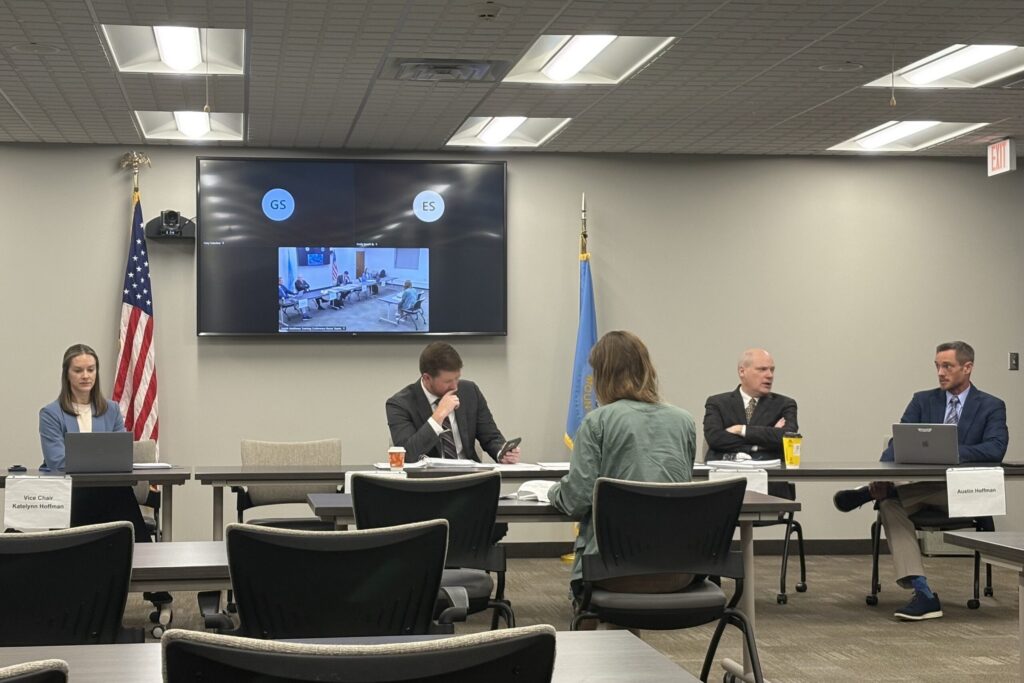
Commission members voted unanimously to dismiss the complaint after finding nothing in state open-meetings laws addressing eavesdropping on a closed meeting. “What statute would’ve she specifically violated?” commission member Austin Hoffman said of the finance officer. “I’m not certain there’s anything directly pertaining to that situation.” The commission also found no state law requiring a vote on who may attend an executive session.
Tripp City Council reprimanded twice
In a separate case, the commission unanimously reprimanded the Tripp City Council for entering an executive session in July without stating a purpose. State law requires a motion to enter executive session to cite the specific statute justifying it. “I don’t think there’s any way to defend the violation,” Commission Chair Michael Smith said.
For an August meeting where council members cited only “general descriptions ‘personnel & legal'” and minutes did not reference specific statutory sections, the commission voted 4-1 to reprimand. Smith cast the sole no vote.
“I felt like it was improper, and I still do, that we’re asking laypeople to cite the statute,” Smith said. “I mean, while we as legal counsel need to ensure that what they’re going into executive session for is defensible legally, I don’t expect a farmer or a retired individual to have that state law recitable.”
Hoffman agreed with Smith’s sentiment but voted for the reprimand based on existing law. “I’m not saying I think it’s right. I think there needs to be broader language there,” Hoffman said. “But I think that’s what meets that statute.”
Other reprimands issued
The commission also voted to reprimand the Town of Hermosa Board of Trustees for gathering at a campaign meeting for a board member with a majority of members present, and with the possibility of discussing public policy, but without notifying the public:
- Egan Board of Trustees for failing to provide notice of a public meeting.
- New Effington Board of Trustees for conducting an executive session without adequately explaining the reason.
- Hermosa Board of Trustees for gathering at a campaign meeting with a majority present and the possibility of discussing public policy without public notice.
The commission approved written reprimands from April hearings, including violations by the city of Gary for disallowing public participation in a public meeting and the Hermosa Town Board for discussing city business an hour before official meeting starts.
The five-member commission consists of county prosecutors appointed by the state attorney general.
Keep reading

Jeffery Simmons Brings Thanksgiving Turkey Giveaway to Chicago South Side With CHAMPS Mentoring
"It was an inspirational moment where I think people not only just saw Jeff the football player. "They...

Fargo Commission Advances Airport Rental Car Tax, Approves MATBUS Reorganization
The Fargo City Commission unanimously advanced a 1% rental car tax Monday that would apply only to vehicles...

Greater Manchester Police Selects Mark43 for £19m Records Management System
Greater Manchester Police has appointed Mark43 to supply its new records management system after signing a four-year G-Cloud...

No. 3 Nebraska Shuts Out No. 24 Penn 36-0, Wins Six Titles at Keystone Classic
No. 24 Penn wrestling lost 36-0 to No. 3 Nebraska on Saturday, then watched the Huskers win six...