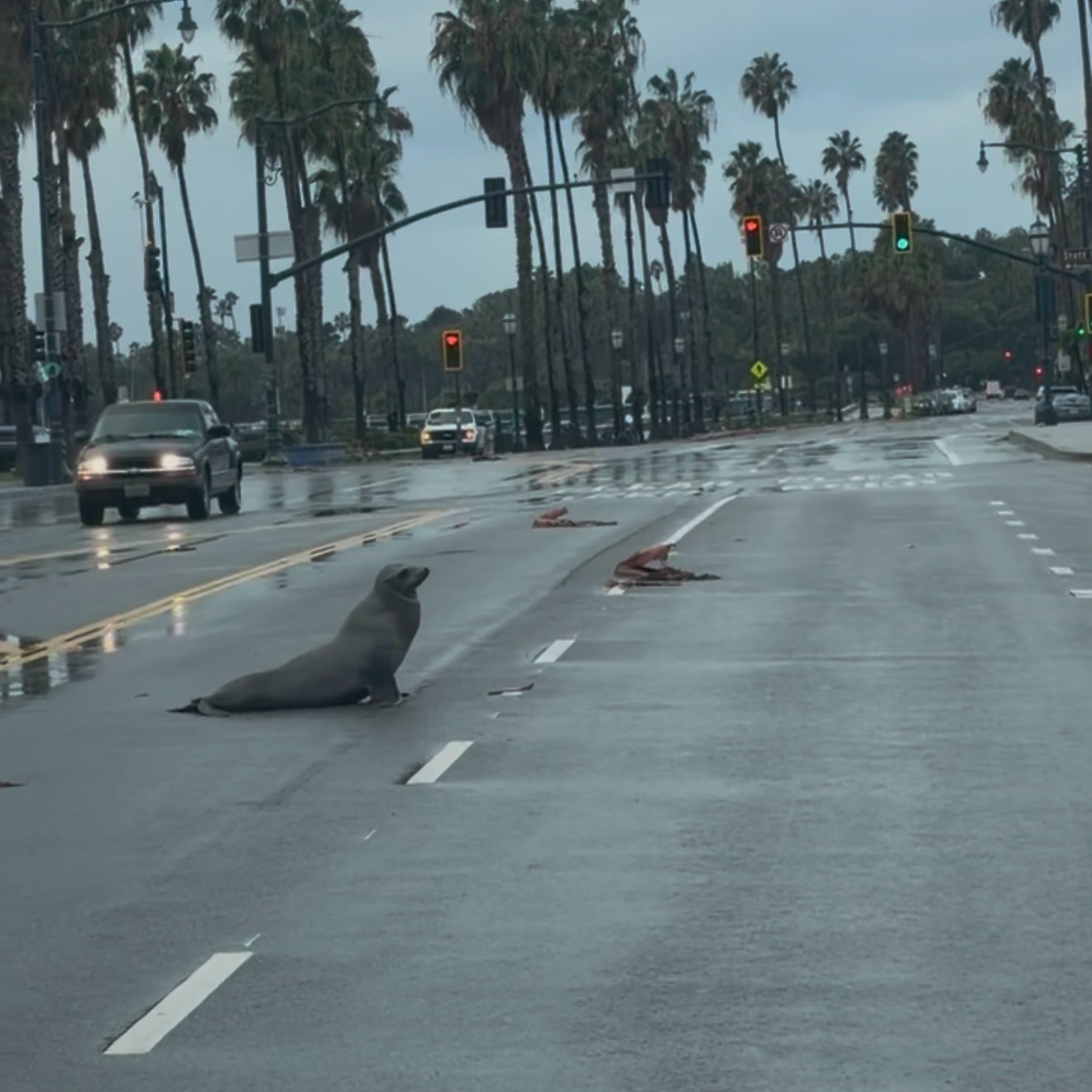
- CIMWI has rescued 22 malnourished sea lion pups in the past 23 days: 12 in Santa Barbara and 10 in Ventura.
- Four pups were taken in on each of November 14 and November 16.
- Many pups are roughly five months old but still at birth weight, dehydrated and hypothermic.
- Dover warns of a potential repeat of the 2013–2016 unusual mortality event driven by warm ocean conditions.
The wandering adult arrived amid a sharp rise in stranded pups.
Over the past 23 days CIMWI has taken in 22 malnourished sea lion pups — 12 in Santa Barbara and 10 in Ventura — including four on November 14 and four on November 16, The Santa Barbara Independent reported. Many are about five months old yet weigh roughly the same as newborns, arriving dehydrated, exhausted and hypothermic after what Dover described as a prolonged state of starvation.
Warmer waters push prey farther out
Dover attributed the crisis to warmer waters and a marine heatwave, The Santa Barbara Independent reported. Warmer temperatures displace the fish sea lion mothers depend on, forcing them to travel farther to forage while pups, lacking sufficient blubber, cannot dive deep enough to find food themselves. “The pups are getting hungry, and they’re swimming to the mainland, and they’re stranding on our beaches,” Dover told The Santa Barbara Independent.
Regional pattern matches earlier die-off
The current strandings echo the 2013–2016 unusual mortality event, when a mass of warm water known as “the Blob” left hundreds of starving sea lions on California beaches, according to NOAA Fisheries. Hoodline reported that NOAA Fisheries notes stranding events are often associated with ocean-warming episodes that reduce prey availability.
The Los Angeles Times has reported that rescue centers farther south fear a similar influx this winter, with the Marine Mammal Care Center in Los Angeles County and the Marine Mammal Center in Sausalito both seeing elevated numbers, including more than 100 sea lions treated for domoic acid poisoning in Sausalito since July compared with a typical annual average of 75 to 90.
First responder on the Central Coast
CIMWI, a nonprofit based on the Central Coast, serves Santa Barbara and Ventura counties and sits across the street from the ocean near the Channel Islands, a primary sea lion rookery. That proximity means the institute often sees strandings first, Dover told The Santa Barbara Independent.
She described the organization as a “canary in the coalmine” for other marine mammal rescue networks that have not yet recorded comparable pup numbers, though northern groups have reported historically large domoic acid outbreaks. “We’re right across the street from the ocean,” Dover said.
What comes next
Dover said CIMWI is bracing for a challenging winter and spring. “Are we going to see something that is just really bad this winter and spring, or is this going to be a prolonged event?” she told The Santa Barbara Independent. “Our environment is changing — but to what degree and how quickly?”

Adult sea lion crosses Cabrillo Boulevard
The sea lion was a healthy weight, bright, alert and responsive. In an Instagram post, Dover joked that the sea lion was “impatiently waiting” for Flor de Maiz to open. “He was ready for a signature margarita after weathering the storm!” she wrote in the caption. But Flor de Maiz didn’t miss the chance to praise “the cutest guest we’ve had in a while,” on its Instagram.

Huntsville Airport Parking Full; Travelers Urged to Arrive Early for Thanksgiving
Parking at Huntsville International Airport is already full as Thanksgiving traffic builds toward the Nov. 26 holiday. The...

Bucky’s 5th Quarter Column: Flawed Roster, Janicki Injury Cloud 2026-27 Outlook
In a column for Bucky's 5th Quarter, the author argues that the 4-2 Wisconsin Badgers face a flawed...
Missouri Mom Charged With Murder After Toddler’s Cancer Death
Destiny Schliefert and Debbie Sue Potter charged with second-degree murder in Christian County on Nov. 19. Boy diagnosed...

Controversial No-Catch Ruling on Parker Washington Costs Jaguars Potential TD vs. Giants
Jaguars wide receiver Parker Washington had a potential go-ahead touchdown overturned by replay review Sunday in a 23-18...