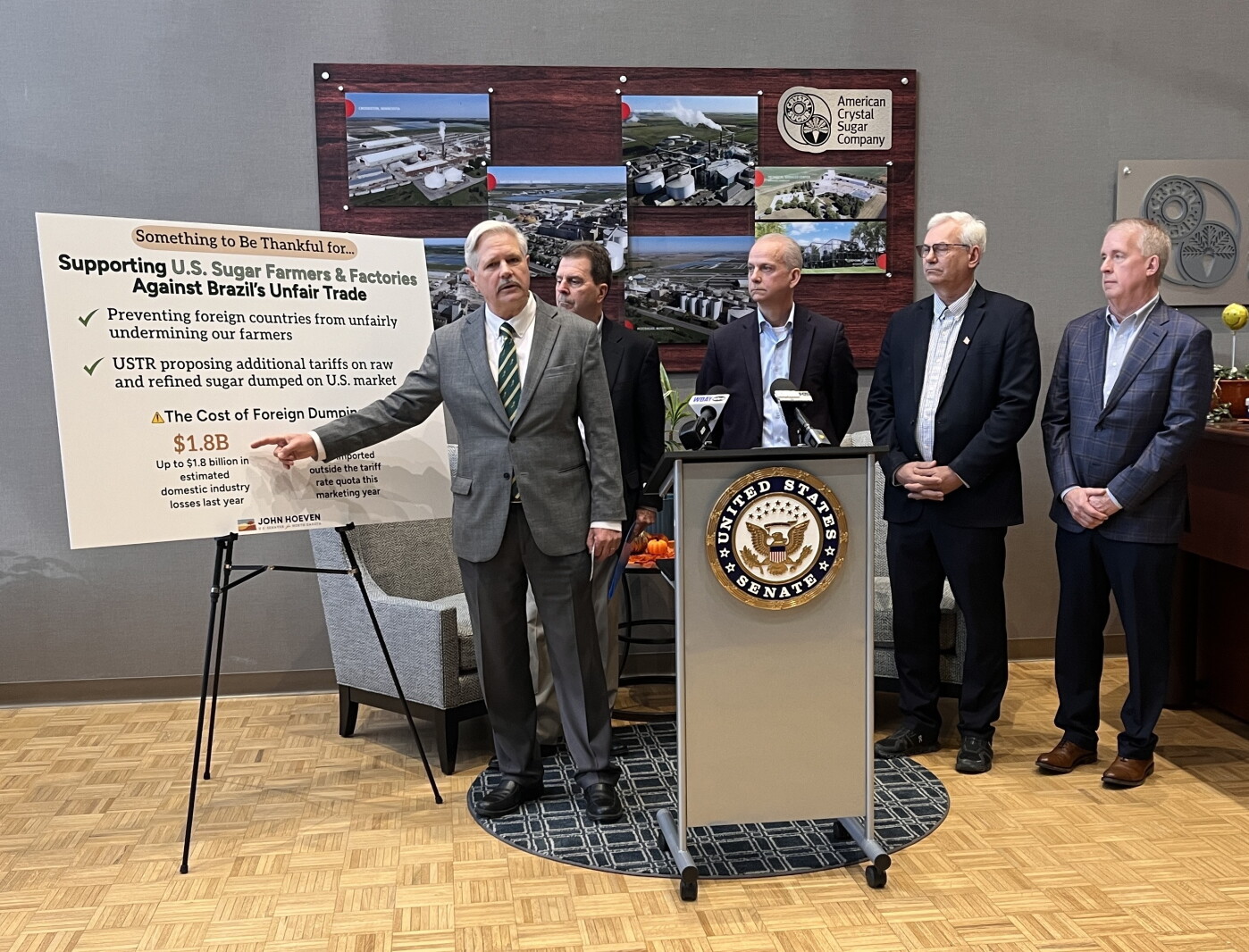
U.S. Sen. John Hoeven announced a proposed tariff on sugar imports on November 25, to protect domestic producers from foreign trade pressures, InForum reported.
- U.S. Trade Representative Ambassador Jamieson Greer proposed the new tariff on raw and refined sugar entering the U.S. from any origin.
- The U.S. sugar industry suffered an estimated $1.8 billion loss last year due to record out-of-quota imports.
- Written comments on the proposed tariff policy are due Dec. 30, with a public hearing scheduled for Jan. 14.
Speaking at American Crystal Sugar Company in Moorhead, Hoeven said that U.S. Trade Representative Ambassador Jamieson Greer proposed the additional tariff on raw and refined sugar entering the United States regardless of origin, AgWeek reported.
The measure modifies an ongoing investigation into unfair trade practices by Brazil and other countries. Customs and Border Protection. “We have a vibrant, important sugar industry in this country and we’re going to lose it if we don’t take some action,” Hoeven said.
According to Main Street Independent, the tariff increase targets Brazil specifically while applying broadly to other nations. In the Red River Valley, the sugar beet industry directly supports more than 4,400 jobs and generates over $6 billion in business activity annually.
Data from the U.S. A study by the North Dakota State University Agricultural Risk Policy Center linked those elevated imports to an estimated $1.8 billion industry loss. “No industry can sustain that,” Hoeven said.
Industry Leaders Back Trade Action
Local agricultural executives joined Hoeven to voice support for the federal initiative, pointing to long-standing market disruptions. Rick Kasper, president and CEO of Minn-Dak Farmers Cooperative, said that the existing 25-year-old tariff no longer allows the USDA to properly manage national sugar supplies.
“We will urge USTR to take this opportunity to update the sugar tariffs, thereby ensuring that foreign producers are not enriched at the expense of American farmers and workers,” Kasper said.
“The impact of these unfair practices extends well beyond our family farms, threatening the viability of cooperatives, processing facilities and rural communities that depend upon them,” said Tom Astrup, president and CEO of American Crystal Sugar.
“We are proud of these milestones, and we would like to be around for many more,” he said.
KFGO reported that Hoeven also criticized specific trade circumvention methods, such as importing foreign sugar into Alaska and processing it into syrup to bypass quotas.
“There’s also sugar coming in through other means, for example, sugars going to Alaska from Brazil, and then they put it in molasses and basically turn it into sugar syrup and call it molasses which is bunk, it’s sugar syrup and then they bring that in, that’s a clear violation of our trade laws,” Hoeven said. Hoeven argued that inaction leaves consumers vulnerable to foreign pricing control.
“If these unfair trade practices wipe out our industry, the consumer is disadvantaged because then we’re at the mercy of whatever price they want to charge,” Hoeven said, according to Main Street Independent.
Hoeven details import circumvention tactics
The senator argued that such practices distort the market and violate existing trade statutes. He warned that failure to enforce the rules leaves consumers vulnerable to foreign pricing control once domestic capacity is lost.
Senator John Hoeven chose American Crystal Sugar Company’s Moorhead headquarters for the November 25 tariff announcement, underscoring the cooperative’s status as the largest beet sugar producer in the United States, selling about 15 percent of America’s sugar.
Owned by nearly 2,800 shareholders raising approximately one-third of the nation’s sugarbeet acreage in the Red River Valley, the company anchors a regional industry directly supporting more than 4,400 jobs and generating over $6 billion in annual business activity.
Comments due Dec. 30, hearing set for Jan. 14
Written comments on the draft tariff proposal are due December 30, and the trade agency will hold a public hearing on January 14. Hoeven estimated that the draft proposal could take 45 to 60 days to be fully implemented.
Keep reading

6abc Dunkin Thanksgiving Day Parade Canceled Due to Storm Airs as TV Special
The 6abc Dunkin' Thanksgiving Day Parade, the nation's oldest Thanksgiving parade, has been canceled for Thursday due to...

Red Wings Beat Canucks 5-1 With Finnie and Arvidsson Points
The Detroit Red Wings defeated the Vancouver Canucks 5-1 on Wednesday night in a matchup between teams occupying...

Capriotti’s Sandwich Shop in Springfield, PA, Offers Signature Bobbie® and Diverse Sub Menu
Capriotti's Sandwich Shop offers a diverse menu of signature subs, including its renowned Bobbie® sandwich. The shop is...

Everblades Head to New Mexico for First Meeting With Goatheads
The Florida Everblades leave their longest home stand of the season for Rio Rancho, New Mexico, to face...