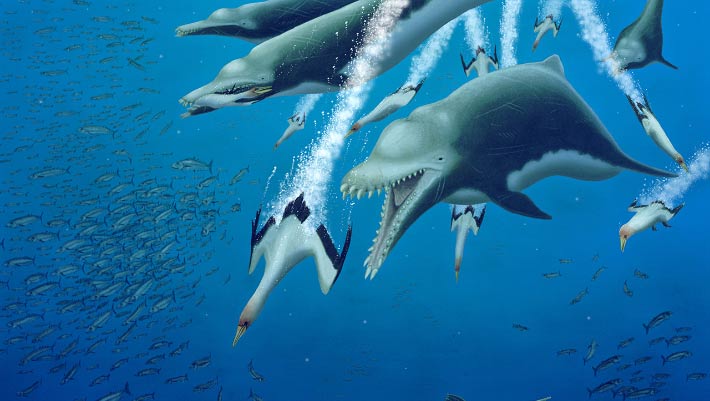
A single fossil pulled from a South Carolina riverbank has given science its first look at a toothed whale with serrated teeth.
The animal, named Ankylorhiza serratidens, swam off the Carolina coast roughly 30 to 28 million years ago. Its rear cheek teeth carried saw-like edges measuring 0.9 to 1.3 millimeters — a feature never before documented across multiple teeth in any toothed whale, living or extinct. The study appeared online October 30 in Acta Palaeontologica Polonica.
“The Oligocene epoch is a key period in the evolution of cetaceans as it marks the diversification of Odontoceti and toothed and toothless baleen whales, with a major increase in diversity and disparity relative to the Middle and Late Eocene and a peak in evolutionary rate,” said Robert Boessenecker, a paleontologist at the University of California, Berkeley.
“This period of nascent evolution is characterized by increases in encephalization, the first appearance of baleen, the evolution of echolocation and an explosive diversification in feeding morphology.”
The specimen — both lower jaws, about a dozen teeth, and neck, back and rib bones — sits at the Mace Brown Museum of Natural History at the College of Charleston. It came from the Ashley Formation near the Edisto River in Dorchester County, the same rock layers that previously yielded its close relative Ankylorhiza tiedemani.

Ankylorhiza tiedemani was already recognized as the largest toothed whale of the Oligocene, estimated at 4.5 to 6 meters (15 to 20 feet) long. The new species was roughly the same size but more specialized for macropredatory feeding. Its fifth lower cheek tooth was about 26 percent larger than that of tiedemani, and the serrations cluster on the rear postcanine teeth.
“The dentition of this specimen has extensive serrations (measuring 0.9–1.3 mm) on the posterior postcanine teeth,” Boessenecker said. Wear on some serrations had exposed the dentine underneath, confirming they were true denticles rather than surface damage.
That distribution suggests a division of labor: front teeth to seize prey, rear teeth to saw through it. “Coarsely serrated vertebrate teeth function like a saw blade, where movement of the flesh parallel to the serrated edge results in a ‘grip and rip’ action, concentrating tissues, including tough connective tissue and skin, into the notches and ripping the tissue with relative motion between the tooth and prey item,” Boessenecker explained.
Modern macropredatory marine mammals — killer whales, false killer whales, leopard seals — all have smooth teeth. Serrations are common in sharks, some marine reptiles and predatory dinosaurs, but until this find they had not been reported across multiple teeth in any odontocete. The fossil overturns the assumption that toothed whales carry only smooth teeth.
The paper places Ankylorhiza in a pattern of repeated convergence: basilosaurids, “killer” sperm whales, and now this early dolphin lineage each evolved large-body, large-tooth adaptations for hunting big prey. Ankylorhiza serratidens simply added a cutting edge the others lacked.
The analysis rests on a single partial skeleton. The size estimate of 4.5 to 6 meters applies to the earlier tiedemani; for serratidens the only direct size proxy is the 26 percent larger fifth cheek tooth. Whether the serrations were typical of the species or an individual variation remains unknown. Bite marks on prey bones — direct evidence of the “grip and rip” action — have not been found.
The Ashley Formation continues to produce material. More specimens would show whether this saw-toothed morphology was a brief experiment or a persistent adaptation in the early radiation of odontocetes.
Related reading
Omaha Symphony Returns to Norfolk for Annual Holiday Concert Dec. 14
The Omaha Symphony is coming back to Norfolk for its annual holiday concert on Dec. 14, The Norfolk...
Fiona the Beloved Hippo Dies at Cincinnati Zoo After Swallowing Knit Hat
"She brought so much love in her lifetime," read a note left in crayon at the Cincinnati Zoo...

Madison Multi Lips Sneaker Sales Details Emerge November 21, 2026
Madison Multi Lips Low-Top Lace-Up Rhinestones Women's Sneaker sales details emerge November 21, 2026. The specifics surrounding the...
Arizona Reports Nine Confirmed New World Screwworm Cases Across Four Counties
Arizona now has nine confirmed cases of New World screwworm across four southern counties after federal officials verified...