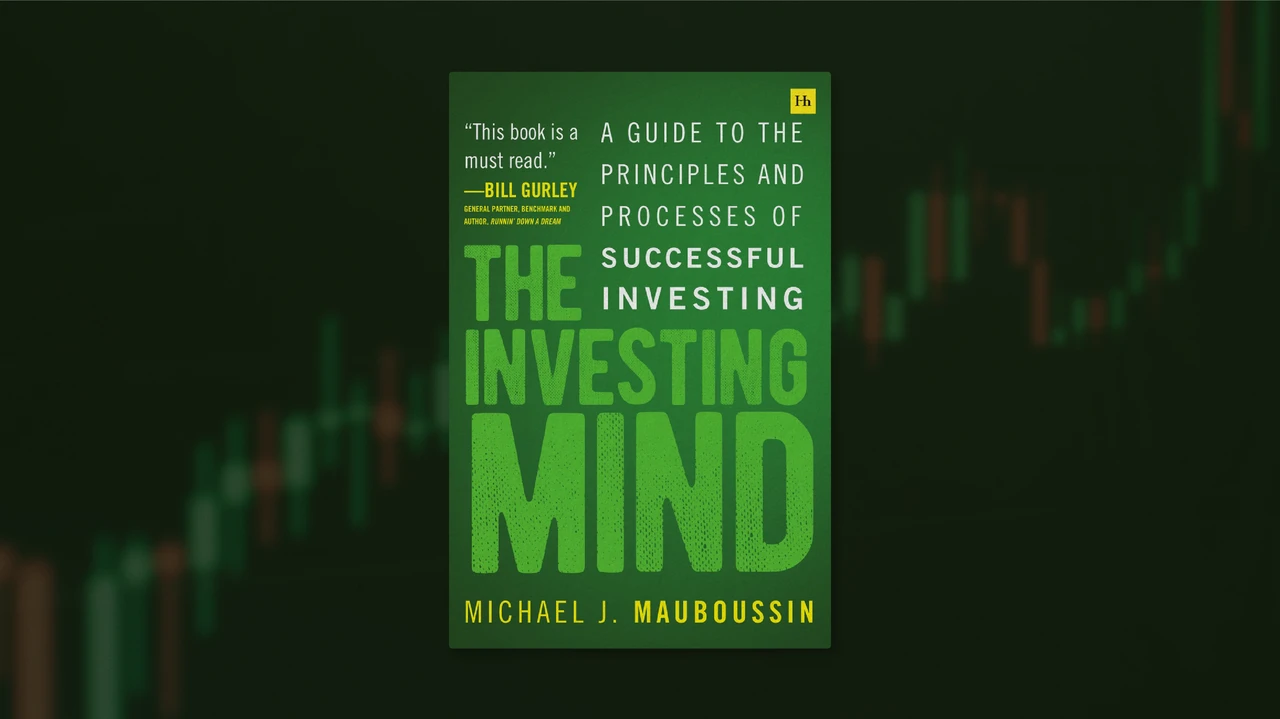
Michael Mauboussin’s “The Investing Mind” publishes November 24, 2026, via Harriman House, a 256-page hardcover priced at $32 that examines decision-making processes rather than investment outcomes.
Katherine Collins, an SFI board member, reviewed the book for the institute, describing it as a work that “condense[s] tremendous amounts of high-fidelity information into a compact space.”
Structure and SFI connections
The book opens with Mauboussin’s professional development and closes with implementation strategies for team environments. Its core covers ten qualities for critical thinking and decision-making, from numeracy to capital allocation.
SFI people and stories appear throughout. Jim Rutt features in the analysis of identifying easy games. Ian McKinnon’s framework for structural inefficiencies is cited. Scott Page’s work on information diversity appears in the examination of prices. Ole Peters’ ergodicity research informs the discussion of compounding. Murray Gell-Mann, who co-founded the Institute, appears in an anecdote about team-based decision making.
Focus on process over outcomes
“What makes Michael’s work so unique within the realm of finance is that it focuses not on the ‘what’ but on the ‘how,'” Collins wrote. “We are drowning in data that assesses outcomes in every possible manner. But there is a great empty space that leaves any curious observer unsatisfied — the exploration of how those outcomes came to be.”
The book addresses how opportunities arise, how they are spotted and assessed, and how decisions are made regarding action, how big to bet, and over what time horizon.
Companion resource
A website accompanies the book where readers can “roll the snowball” to see how different factors influence compounding over time. The text includes sourcing and endnotes for further exploration.
Michael Mauboussin and Katherine Collins are both current SFI Trustees and formerly served as Board Chairs, as did Jim Rutt; Ian McKinnon currently chairs the Board. Scott Page and Ole Peters are SFI External Professors.
Founded in 1984 as an independent, nonprofit theoretical research institute in Santa Fe, New Mexico, the Santa Fe Institute (SFI) is dedicated to the multidisciplinary study of fundamental principles governing complex adaptive systems across physical, computational, biological, and social domains.
Its mission centers on synthesis across disciplines, operating through a small resident faculty, roughly 100 external faculty, and the Applied Complexity Network of private and government partners, guided by a Science Board of eminent scholars and governed by a Board of Trustees chaired by Katherine Collins of Putnam Investments.
Research at SFI spans evolutionary computation, metabolic and ecological scaling laws, fundamental properties of cities, viral evolutionary diversification, primate social group dynamics, language history, food web structure, financial market dynamics, and the emergence of hierarchy and cooperation in humans.
“We are all investors — of time, energy, and resources of all sorts — and so we all have some version of an investing mind that can be cultivated and improved,” Collins wrote. “Anyone who aims for that sort of cultivation will benefit from a close read of this book. It is the richest of soils.”
Related reading

Colorado Delegation Urges Trump to Approve Disaster Aid for Back-to-Back Floods
Colorado's entire congressional delegation on Monday urged President Donald Trump to approve two major disaster declarations for southwestern...

Iowa DOT Announces Overnight I-35/80 Closures for Construction Phase
The Iowa Department of Transportation’s Grimes construction office announced a series of overnight closures on Interstate 35/80 between...
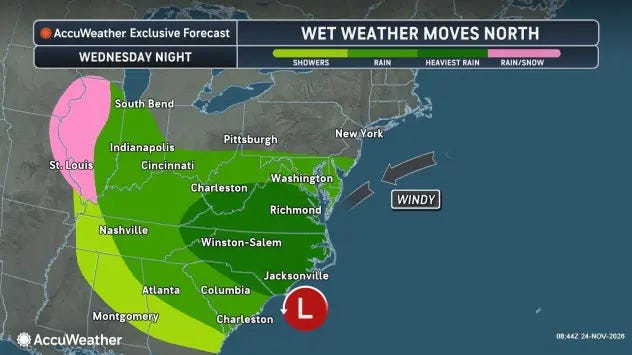
Coastal Storm Brings Heavy Rain, Flood Risk to Wilmington Area Through Thanksgiving
A coastal storm is expected to bring heavy rain and flooding to the Wilmington area Wednesday into Thanksgiving...

Georgia Holds 5.5-Point Power Ratings Edge Over Notre Dame
CBS Sports columnist Tom Fornelli's power ratings show Georgia holding a 5.5-point edge over Notre Dame at No....