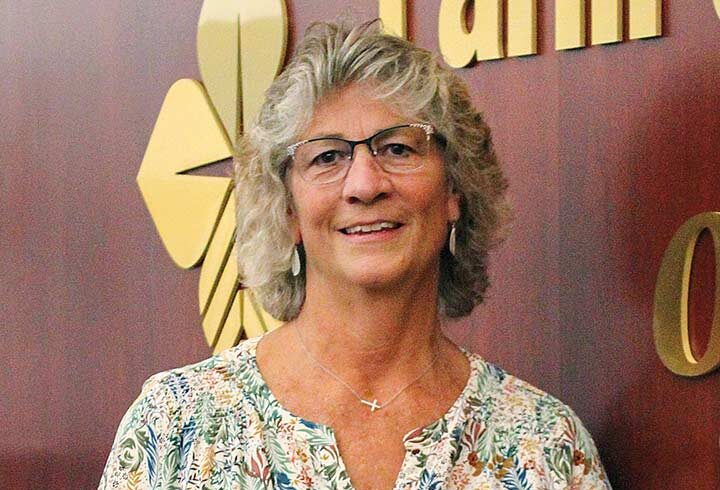
Theresa Johnson named 2026 Agribusiness Citizen of the Year
Theresa Johnson spent her childhood mornings washing down barn walls and feeding cows in stanchion barns west of Sioux Falls. Today, she spends those mornings helping farmers manage the complex financial realities of modern agriculture.
The Sioux Falls Chamber reported that Johnson has been named the 2026 Agribusiness Citizen of the Year, recognizing a career that has spanned more than three decades of service to the farming community. While she grew up on a family farm with six siblings, her professional path transitioned from the physical labor of the barn to the administrative and financial support systems that keep rural operations running.
Her career at Farm Credit Services of America has lasted 31 years. She currently works directly with customers, managing everything from processing payments and loans to assisting loan officers with the heavy paperwork required to finance agricultural operations.
A career built on farm roots
Johnson’s connection to the industry is foundational. Growing up, her family managed a diverse operation that included milking cows twice a day, raising chickens, and putting up hay. Before the installation of a milking parlor, Johnson’s responsibilities included feeding cows while they were being milked in the stanchion barn.
Though she once considered a different future, her professional life eventually circled back to the sector that shaped her. After initial roles in banking and at a title company, she found her niche at Farm Credit Services of America.
“Everybody grew up different,” Johnson said regarding the diverse management styles she encounters. “Everybody operates their farm a little different than the guy down the road.”

This observation has driven her approach to client relations. Johnson, who describes herself as a “social bug,” has built multi-generational relationships with customers. She has witnessed families and operations evolve over decades, often becoming a consistent presence for clients who specifically request her assistance.
The volatility of the modern farm
Working at the intersection of finance and farming has provided Johnson with a front-row seat to the economic pressures facing the American producer. She has observed the rising costs of equipment and fuel, which prevent younger generations from entering the industry.
Beyond the balance sheets, she notes that environmental and market factors introduce a level of instability that requires specific temperament to manage.
“Being a farmer is like waking up in Vegas, because it’s a gamble every day,” Johnson said.
The unpredictability of weather and market fluctuations means that a successful harvest one year offers no guarantee for the next. This volatility necessitates a mindset defined by patience and long-term planning.
“You have to have time and patience,” Johnson said. “Nothing happens overnight or even in two months. You have to work to get where you want to go.”
Agribusiness success relies on interconnected stakeholder networks
The role of agribusiness extends beyond the individual farm to a broader network of support. Johnson’s perspective is shaped by the realization that the success of a single operation is tied to a web of interconnected businesses.
Farmers, financial institutions, and equipment dealers all function as part of a single ecosystem. She suggests that the stability of this system relies heavily on the quality of human interaction and mutual respect among these various stakeholders.
“Everybody has their own personal problems and issues,” Johnson said. “If we’re just kind to one another and respect each other, that goes a long way.”
While her childhood was spent in the hay and the barn, her impact is now felt through the financial stability and community connections she helps maintain for the producers of South Dakota.
Keep reading

Three Charged in Deadly Madison Youth Football Game Shooting
Three charged in Madison football shooting Three individuals face criminal charges following a shooting that killed a 64-year-old...

Billy Strings Announces 15-Date Spring 2027 U.S. Tour
Billy Strings has announced a 15-date Spring 2027 tour across U.S. arenas and amphitheaters, starting April 6 in...

Jerome Chandler Dies After Triple Shooting in Burlington City
Jerome Chandler dies after Burlington City triple shooting A 23-year-old Burlington City man has died following a triple...

Wayshawn Parker Expected Back for Utah After Heel Bruise Injury
Utah running back Wayshawn Parker is expected to play this Saturday against Arizona following MRI results that revealed...