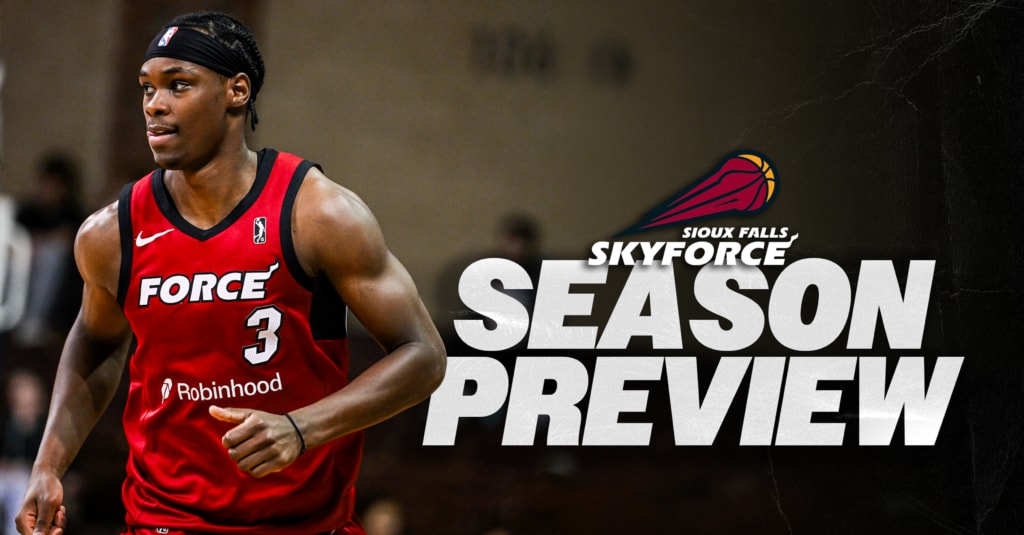
The Sioux Falls Skyforce open their 2026–27 campaign this Saturday, November 7, against the Grand Rapids Gold at Van Andel Arena. This season represents a significant transition for the Miami HEAT’s G League affiliate, as the team debuts a new front office and coaching staff tasked with blending veteran experience with the developmental requirements of the HEAT system. According to the team’s official media release, the organization is looking to instill a more disruptive defensive identity from the outset.
Mario Casamajor, who was appointed as the 23rd head coach in franchise history this past September, faces an immediate test during the 14-game Tip-Off Tournament. He is joined by a staff that includes Remy N’Diaye, Norris Cole, Nate Wilson, and Darius Johnson-Odom. The pressure on this unit is tangible; they must translate the rigorous, high-intensity defensive principles of the Miami HEAT into a cohesive on-court product in a league where roster turnover is a constant variable.
Establishing an Uncomfortable Pace
The stylistic shift toward a more aggressive, disruptive defense is not merely a coaching preference; it is a strategic necessity for a team aiming to compete in the highly competitive G League environment. During Wednesday’s media day, Casamajor was clear about his expectations for the group.
A staff built to compete 💪 pic.twitter.com/uj9AEvonRn
We’re going to try and be disruptive. We’re going to try to muck up the game. We’re going to get you hopefully in an uncomfortable setting.
For the players, the transition involves integrating three Miami HEAT two-way players—Tre Donaldson, Keshad Johnson, and Vladislav Goldin—into a core that already features seasoned professionals. This roster construction highlights the G League’s dual purpose: serving as a proving ground for young talent while providing a competitive environment for established players looking to secure a standard NBA contract.
The Return of Familiar Faces
Continuity remains a vital component of the 2026–27 roster. Guard Bez Mbeng returns to Sioux Falls after a notable stint last season, which included signing a 10-day contract with the Utah Jazz on March 13, 2026. His experience navigating an NBA call-up provides the backcourt with a degree of stability that is often missing at this level of play. Mbeng’s ability to contribute across multiple statistical categories—he averaged 6.5 points, 5.0 rebounds, and 1.8 steals over 41 games last year—makes him a cornerstone for Casamajor’s defensive schemes.
The team has also bolstered its offensive production by adding Lester Quinones, who earned All-NBA G League First Team honors last year with the Osceola Magic. Quinones brings a high-volume scoring threat, having averaged 23.3 points per game while shooting 41.1 percent from beyond the arc. Alongside returning forward Gabriel Madsen, who recorded a career-high 27 points against the Texas Legends on February 1, 2026, the Skyforce appear equipped to balance their defensive intensity with perimeter scoring.
The Road to the Sanford Pentagon
The immediate schedule offers little room for adjustment. Following the back-to-back road games against Grand Rapids on November 7 and 8, the team will navigate the remainder of the Tip-Off Tournament before records reset for the 36-game regular season in December. The local community will get its first look at the new-look roster when the Skyforce host the Windy City Bulls at the Sanford Pentagon on Friday, November 20.
BEZ "Mr. Triple-Double" MBENG🫳🎤 12 PTS | 13 REB | 12 AST | +26 +/- 21st player in Force history with a triple-double🔥 pic.twitter.com/F657DN0dcb
While the front office, led by new general manager Liam Doyle, has prioritized depth and versatility, the ultimate metric of success remains the development of players who can eventually thrive in the Miami HEAT’s system. Whether this specific mix of veteran playmakers like Dennis Smith Jr. and emerging prospects can maintain the team’s standard of play through the winter remains the central question for the organization.
As Madsen noted during media day, the atmosphere within the locker room feels uniquely cohesive for a professional squad, drawing comparisons to a college environment. Whether that chemistry manifests as wins in a league defined by rapid roster changes is a story that will unfold over the coming months on the hardwood.
Keep reading

Family Scammed Out of $100,000 Bond for Man Charged in Fatal High-Speed Chase
James K. Moore, a man born in 1999, currently sits in a Laramie County jail cell, caught in...
Wisconsin Badgers host Delaware Fightin’ Blue Hens on Big Ten+ tonight
The Wisconsin Badgers host the Delaware Fightin' Blue Hens tonight, Friday, November 6, at the Kohl Center in...

Wilson Ave S Bike Lane Upgrades to Feature Concrete Barriers
The city of Seattle is moving forward with a permanent redesign of the Wilson Ave S bike lane,...

Marcia Erickson says housing shortage stalls rural SD Economy
The Housing Bottleneck Stalling South Dakota’s Rural Economy In a recent column for plaintalk.net, Marcia Erickson, the founder...