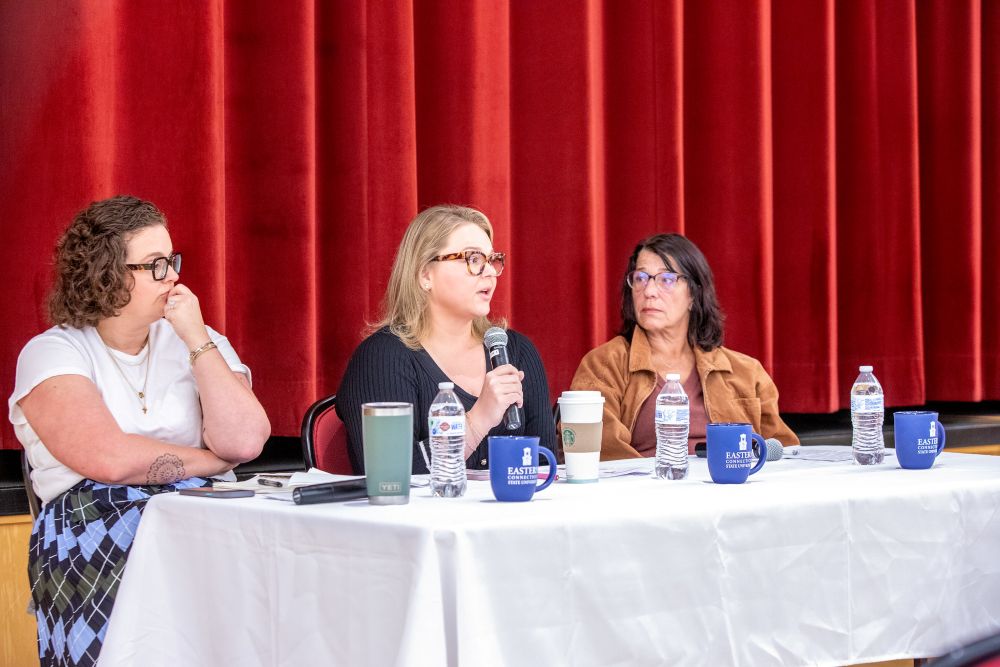
“Housing really is a crisis,” Professor Paul Trubey announced during his opening remarks at the 12th Annual Social Policy Summit, Eastern reported.
Held on Nov. 3, the annual gathering brought together junior and senior social work students to examine Connecticut’s shortage of affordable housing, a pressing issue recognized by organizations like the National Low Income Housing Coalition.
To unpack the complex mechanics of the shortage, the university hosted a panel of regional experts, including Monika Nugent, manager of public policy/advocacy with The CT Community Nonprofit Alliance; Beth Sabilia, director of the Center for Housing Opportunity-Eastern Connecticut; and Emma King, executive director of Access Community Action Agency in Willimantic, Eastern reported.
Sabilia brought the macro-level crisis down to a personal scale for the students in the room. “Where are you going to live when you graduate?” she asked the assembled undergraduates, according to Eastern, using the question to highlight how retirees, families, and the economically disadvantaged all struggle to secure stable homes in the state.

Nugent followed with a detailed look at how the Connecticut Legislature shapes housing policy, walking the audience through the legislative lifecycle using last year’s HB 8002, which successfully became Public Act 25-1. She also pointed to HB 5002 to illustrate how intense public opposition and a gubernatorial veto can derail a measure even after it passes, Eastern reported.
Building on the legislative overview, King examined the friction between high-level policy intentions and daily casework realities. Citing the “Housing First” model—which aims to place clients in permanent housing without preconditions like sobriety—King said that the approach frequently forces caseworkers and clients into less-than-ideal living arrangements simply to secure basic support services.
“That’s what makes social work so important: bridging that lived experience to policy,” King told Eastern, emphasizing the need to keep centering the actual experiences of clients to drive meaningful legislative reform.
Nugent said students do not need to wait for a career in advocacy to influence the legislative process. Every bill requires a public hearing, and all submitted testimony travels alongside the legislation as it moves through the system, giving everyday citizens a direct channel to voice their concerns.
To connect classroom theory with practical advocacy, Eastern required the participating social work majors to collaborate on poster presentations covering rural homelessness, CHFA loans, and strategies for combating the Not In My Backyard (NIMBY) movement. The summit concluded with interactive planning sessions where attendees prioritized housing issues and mapped out localized solutions.

Louisville Massage Therapists Report Rise in Sexual Requests
Licensed massage therapists in Louisville are facing an increase in inappropriate sexual requests as the city cracks down...

Indiana Tech Sweeps Lawrence Tech to Advance to WHAC Semifinals
FORT WAYNE, Ind. – The three seed Indiana Tech swept six seed Lawrence Tech 3-0 in the WHAC...

University of Iowa Gymnastics Announces Three New Recruits
Three recruits signed to join the Iowa Hawkeyes gymnastics program, University of Iowa gymnastics head coach Jen Llewellyn...

Souza and Kiakona Secure Historic Wins in Hawaii House Races
Hawaii's final election results released Tuesday confirmed a pair of historic outcomes in closely watched state House races,...