South Dakota colleges and technical schools are compressing degree timelines, expanding online options and partnering with high schools to cut student costs and accelerate entry into the workforce, responding to what presidents call a fundamental shift in how families weigh the return on a degree.
Almost 43 million Americans hold federal student loan debt averaging about $40,000 per borrower, making student loans the second-largest consumer debt category after mortgages, according to the Education Data Initiative. In South Dakota, about 116,000 residents carry federal loan debt; their average balance runs 20% below the national average, with three-quarters owing $40,000 or less and roughly one-third owing $10,000 or less.
Why are colleges shortening degrees?
“What we see most often is students either prioritize time or money,” said Fredel Thomas, vice president of admissions, marketing and technology at Dakota Wesleyan University in Mitchell, “so those two pieces work together in very different ways.”
University of Sioux Falls President Brett Bradfield said easily half of prospective families who visit his office measure the value of college by gainful employment.
“They’re looking for something to help them pursue their passions, advance their careers, advance who they are as human beings and they all want it in a different way. And if we can’t deliver it, then they’ll go get it where someone can deliver it in the manner they want it delivered,” Bradfield told South Dakota News Watch.

How are schools changing programs?
Augustana University hit a record enrollment of 2,652 students this fall. While the South Dakota Board of Regents is considering 90-credit bachelor of applied science degrees — the Higher Learning Commission approved reduced-credit degrees in 2024 — Augustana has no immediate proposals for reduced-credit bachelor’s degrees.
Associate Vice President of Enrollment Management Adam Heinitz said the school remains “convicted that the liberal arts core and portion of the education that we provide here is maybe more important than it ever has been in a world where artificial intelligence is all around us.” Augustana does offer combined bachelor’s and master’s pathways completable in five years, and some students finish both in four depending on incoming credits.
University of Sioux Falls sees a growing number of students graduate in three or three-and-a-half years. Bradfield said the last three freshman cohorts arrived with aggregate pre-college credits of roughly 2,700, 2,800 and 2,800 respectively, earned through dual and concurrent enrollment programs that let high school students take college courses at reduced cost.
Dakota Wesleyan University commonly sees students finish in three years and is exploring 90-credit degrees. DWU maintains “2+2” transfer agreements with South Dakota technical schools and community colleges in Nebraska and Iowa. A specialized partnership with Mitchell Technical College allows DWU students to take 18 of 120 credits at Mitchell Tech toward agriculture business, construction management or architectural design degrees.
“People embrace the need for both universities, and we’ve always looked at each other that way. We need two-year technical education, and we also need four-year bachelor’s prepared students and master students,” Thomas said.
Mount Marty University offers a Student to Teachers through Educator Pathways (STEP) dual-credit program with Northeast Technical High School and Watertown High School, letting students potentially finish an elementary education bachelor’s in three years.
An accelerated nursing track developed with Bishop O’Gorman Catholic High School and Avera Health similarly compresses a BSN to three years. Provost Bill Miller said faculty will soon begin updating the general education curriculum, a multi-year process that will consider lower-credit degree options.
What is happening at technical colleges?
Lake Area Technical College reports that E-Degree pathways account for nearly 19% of enrollment. From 2024 to 2026, online course sections rose from 139 to 159 and enrollment in those sections grew from 1,214 to 1,382. Dean of Student Services Hannah Abel said the college continues adding entry points — online and hybrid learning, dual credit, stackable credentials, and transfer pathways — “trying to create different entry points that ultimately lead students toward a career.”
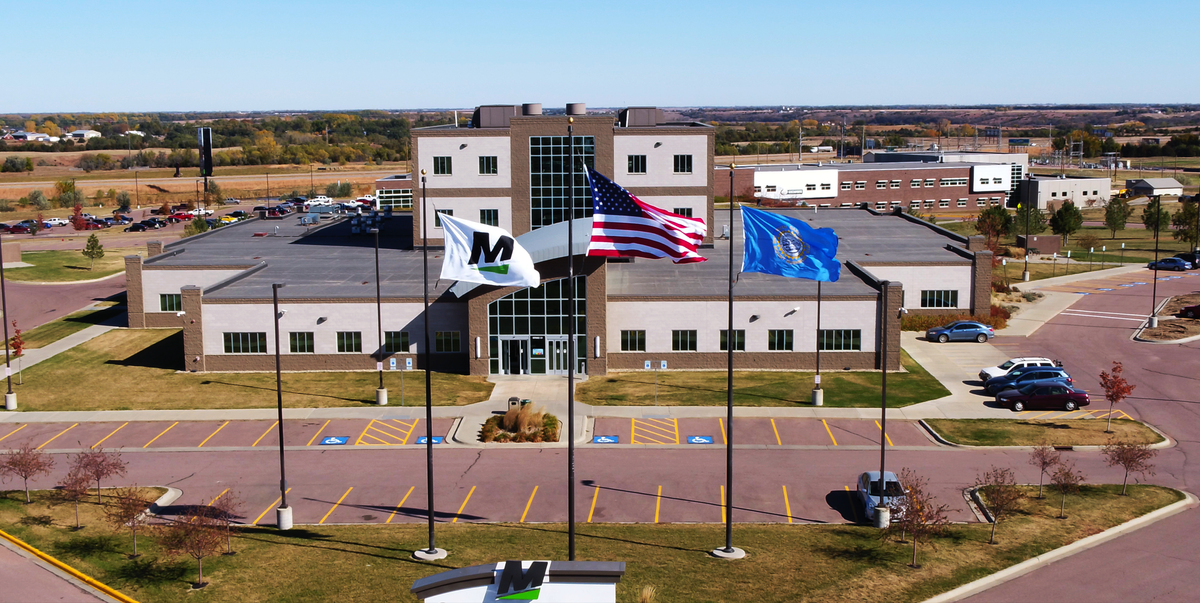
Mitchell Technical College will launch an online nursing program next fall expected to double LPN and RN enrollment. The school hit enrollment records two years running; fall 2026 enrollment reached 1,344 with a record freshman cohort of 616 first-time students. “I definitely think that students are wanting to get out into their careers a lot sooner than maybe they have in the past,” said Kaitlyn Van Peursem, director of marketing and public information.
“They want to spend less money than they have in the past. They don’t want to go into their career with a ton of debt.” Mitchell Tech currently offers five online programs with plans to expand; its speech language pathologist assistant program draws students from as far as California.
Sisseton Wahpeton College is considering 90-credit degrees. Business instructor Samuel Bonsu said the college is “actually excited about it as it reduces the burden of school fees and guarantees early graduation.” Associate and certificate programs already allow completion in two years or less.
How big is dual enrollment?
Dual enrollment accounted for over 18% of South Dakota technical colleges’ total enrollment in 2026, according to the system’s fall 2026 enrollment report. At Lake Area Technical College, one quarter of students were high schoolers dual enrolled. Bradfield said that in the last reporting period, South Dakota State University and the University of South Dakota enrolled the most South Dakota 18-year-olds, followed by three technical colleges.
“We’re in this moment where college is linked to employment. We have great technical colleges in South Dakota. Most of their degrees lead directly to some sort of gainful employment, usually measured in good pay,” Bradfield said. “All schools like us are recognizing they need to diversify sustainable revenue. That’s the whole premise. If there aren’t enough students to support your operations — which we know is a challenge — then, in our industry, you have”
Worth a look
- Moore Urges Congress to Treat AI Oversight as Emergency in First 100 Hours of Democratic Control
- Illinois Residents Rally at Capitol Demanding POWER Act Passage for Data Centers
- Inflation Since October 2024 Adds About $4,720 a Year to Household Costs (daybreakwire.com)
- Charitable Food Demand Stays Elevated as Costs Climb and Benefits Shrink (newsarchyuk.com)
Moore Urges Congress to Treat AI Oversight as Emergency in First 100 Hours of Democratic Control
"We are watching a fast-moving technology that is being protected at a snail's pace," Maryland Gov. Wes Moore...

Illinois Residents Rally at Capitol Demanding POWER Act Passage for Data Centers
Hundreds of Illinois residents and environmental advocates rallied at the state Capitol Wednesday to demand lawmakers pass the...
Consumer Affairs: Verify Window Contractor Insurance, Warranties in OKC
Oklahoma City homeowners looking to replace windows in 2026 should verify contractor insurance and registration before starting any...

Jacksonville Opens Victorian Holiday Season With Tree Lighting, Parade
Jacksonville will open its 2026 Victorian Holiday Celebrations with a tree lighting ceremony at City Hall on November...