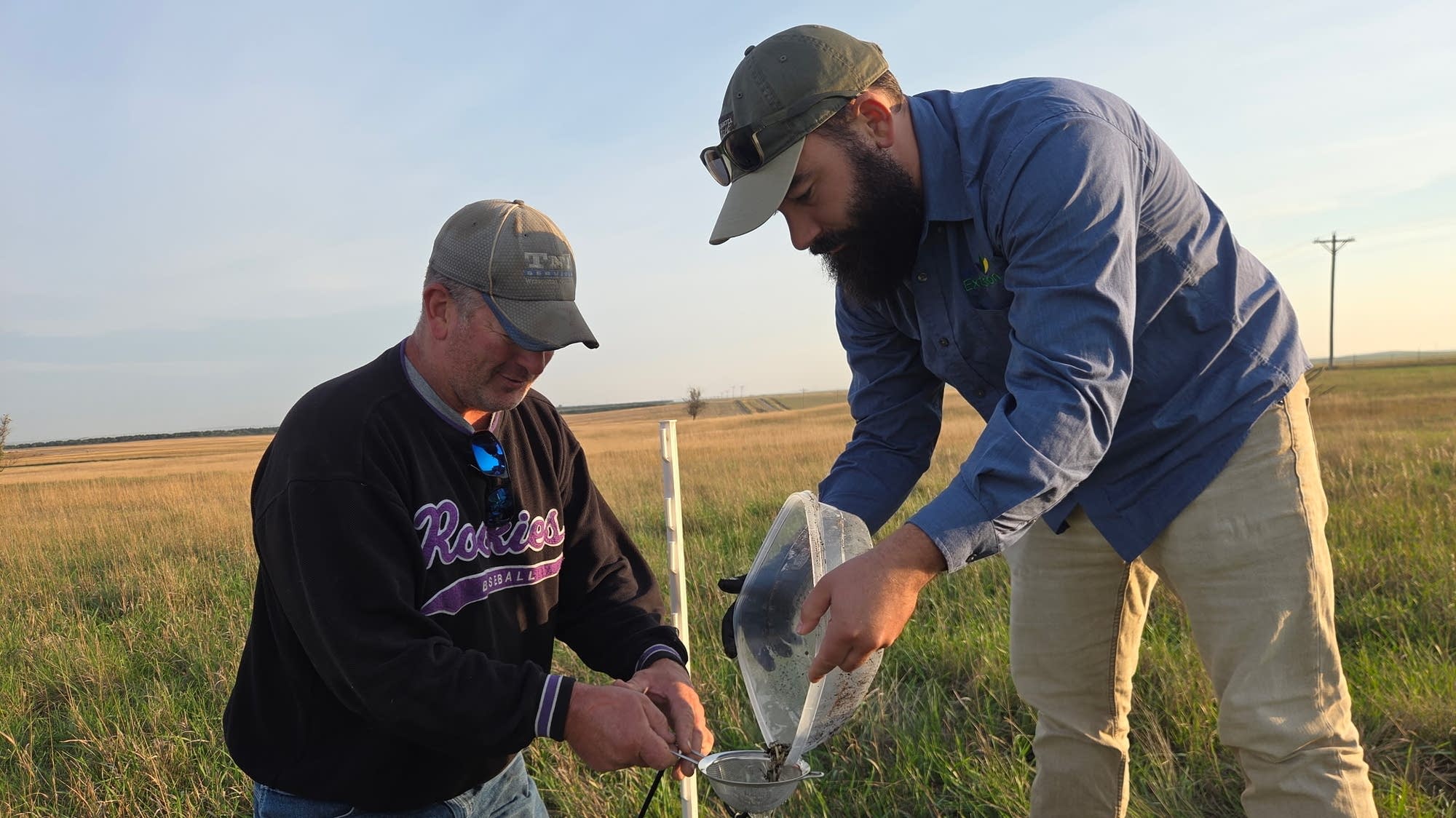
“I consider them one of the garbage disposals of the insect world,” Patrick Wagner, entomology field specialist for South Dakota State University Extension, said.
“They have the lovely job of feeding on dung and breaking it down and then burying it. Basically, injecting it into the ground. So, it’s fertilizer — boom — straight into the ground.”
Wagner found three types of dung beetles in a drop trap set last August in a central South Dakota pasture managed by fifth-generation farmer Scott Kolousek. He also found an insect that preys upon dung beetles, which he said is a sign of a healthy ecosystem because it has a food source enough to sustain that population.
Kolousek, who raises 600 head of cattle, stopped de-worming his cows because the parasiticide used to get rid of parasites stays in the manure and kills dung beetles. He also got serious about rotational grazing, noting that the longest any of his pastures support a cow herd is two-and-a-half to three weeks, which mimics how buffalo herds moved.

“We’re grass farmers selling our grass through the cattle,” Kolousek told MPR News. “Sunshine and water and cow manure is what makes the grass grow. You got to work with Mother Nature by letting the manure become the fertilizer rather than lay there on top of the ground and letting the dung beetles do their work.”
Wagner said if there are enough dung beetles, especially rollers, they can get rid of a dung pile within an hour, faster than flies can even develop. This story comes from the Upper Midwest Newsroom, a public media collaboration between Wisconsin Public Radio, South Dakota Public Broadcasting, Prairie Public in North Dakota and Minnesota Public Radio News made possible by the Corporation for Public Broadcasting.

UAE Allows Financial Free Zone Firms to Operate on Mainland Without Physical Office
The UAE issued a federal decree-law on Sunday that lets financial firms licensed in free zones operate on...

Wichita Studies Crosswalk on North Amidon After Two Pedestrian Deaths in Six Months
Two pedestrians have been killed in six months on North Amidon Avenue near 25th Street North in Wichita,...

Delaware Blue Hens 4-4 After Eight Games: Team Averages 75.1 PPG, 45.8% FG Led by Senior Forward’s 11.8 PPG, 6.1 APG
Delaware's men's basketball team has played eight games to open the 2026-27 season, with the Blue Hens posting...

Anchorage Holiday Tree Lighting Moves to Fourth Avenue Saturday Amid Park Renovations
Anchorage's annual Holiday Tree Lighting moves to Fourth Avenue in front of Historic City Hall on Saturday, November...