
South Korea’s economy grew over 3 percent in the third quarter and annual exports topped $1 trillion, yet the Bank of Korea raised its benchmark rate to 3.25 percent Thursday, warning that the chip-led boom remains fragile and unevenly felt.
The central bank upgraded its growth outlook to 3.9 percent for this year and 4.1 percent for 2025, up from previous estimates of 3.3 percent and 2.9 percent, The Korea Times reported. Governor Shin Hyun-song defended the quarter-point increase — the third this year — by pointing to stronger-than-expected growth fueled by semiconductor exports.
“The 700 trillion won ($524.8 billion) in operating profits from semiconductors won’t disappear into a black hole; they will flow back into the national economy,” Shin said at a press conference. “When growth is strong, monetary policy has to be calibrated accordingly.”
Household incomes fall as borrowing costs climb
For many households, that promised trickle-down has yet to materialize. In the third quarter, inflation-adjusted average monthly household income dropped 2.1 percent from a year earlier — the first decline since the first quarter of 2024, according to the Ministry of Data and Statistics. Disposable income dropped 1.7 percent to 4.3 million won across all income quintiles, while nonconsumption expenses including interest payments, taxes and transfers climbed 11 percent.

Mortgage rates at deposit-taking banks averaged 4.98 percent in October, the highest since March 2012, the BOK said. The recent policy rate hike is projected to drive borrowing costs upward, increasing interest outlays for new borrowers and households with existing variable-rate loans.
“As a small business owner, I don’t feel much of that growth in my day-to-day life,” said Park, a 60-year-old manufacturing business owner in Seongnam, Gyeonggi Province. “They say the economic numbers are strong, but it’s the big companies and exporters that are making money. For those of us scraping by, it’s a story from another world,” Park told The Korea Times.
Chip boom adds 576 trillion won in value, but distribution is skewed
This year’s semiconductor boom will generate 576 trillion won in additional gross value added, according to BOK analysis cited by Seoul Economic Daily. The government receives 177 trillion won, or 31 percent, and households 41 trillion won, or 7 percent.
The BOK said nominal gross value added grew at an average annual rate of 4.8 percent from 2023 to 2025, compared with a sharp increase to 21.9 percent in the first half of this year, measured against the same period a year earlier.
“We need to expand infrastructure and our pool of skilled workers and strengthen supply chains encompassing materials, parts and equipment so that accumulated funds lead to productive domestic consumption and investment,” said Lee Jaeho, deputy director of the BOK’s Survey Statistics Team, according to Asia Economic Daily. The Hyundai Research Institute warned that “households’ interest balances will worsen and their spending capacity will contract” under a tight monetary policy stance.
Export dependence deepens as other sectors stall
Semiconductors’ share of South Korea’s overall export growth is forecast to climb to 88.9 percent next year, up from 80.4 percent this year, the Korea Institute for Industrial Economics and Trade (KIET) projected at a symposium Thursday. Semiconductor exports are expected to grow 197.1 percent this year before slowing to a 29.9 percent increase in 2025, a moderation attributed largely to a high base effect.
“Export growth in other industries such as automobiles, oil refining and petrochemicals is expected to be weaker than this year,” said Hwang Kyung-in, head of KIET’s strategic industry analysis division.
“South Korea’s dependence on semiconductors within its export growth structure will only deepen,” Hwang told Herald Business. Lee Jun, head of KIET’s strategic industry research center, added: “When semiconductors dominate so overwhelmingly, resources inevitably flow in that direction because they are finite.”
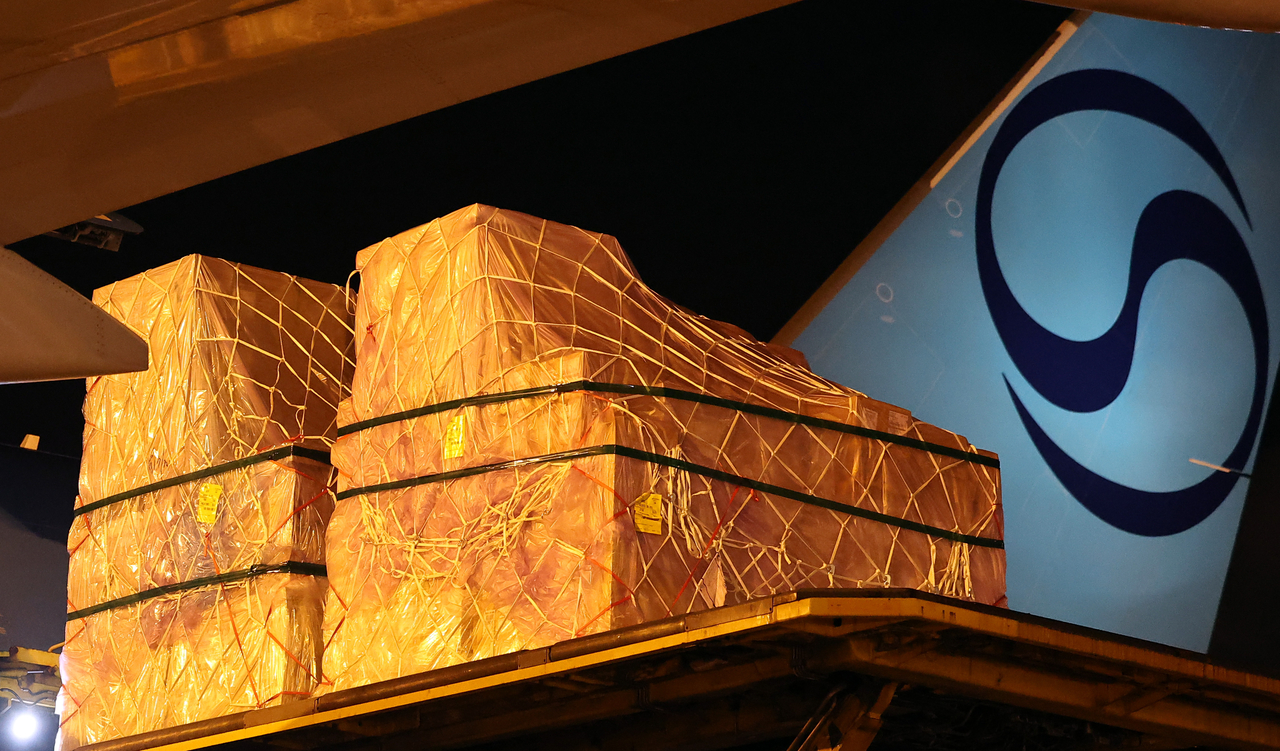
Current account surplus widens on structural gaps
The current account surplus is being driven by structural savings and investment gaps tied to aging demographics and sluggish domestic investment, the Korea Institute for International Economic Policy (KIEP) found.
Citing an IMF report, KIEP said expansion of semiconductor demand accounts for about 90 percent of the increase in Korea’s current account surplus to GDP. However, construction investment has contracted more than facility investment has expanded, and households are increasing savings in preparation for retirement amid insufficient social safety nets.
“Semiconductor export income is first accumulated as corporate savings, and if it is not returned to domestic investment and household income, the gap between savings and investment can be structurally widened,” the Korea Economic Research Institute said, according to Maeil Business Newspaper. KDI predicts private consumption will rise only 1.8 percent while real GDP grows 3.8 percent this year.

AI investment cycle ties chip outlook to financial markets
The semiconductor cycle is becoming more sensitive to financial conditions as big tech firms rely increasingly on external funding for data center buildout. Combined bond issuance by Amazon, Alphabet, Microsoft, Meta and Oracle rose from $20.4 billion in the first half of 2025 to $88 billion in the second half and $169.1 billion in the first half of 2026, according to the report.
That means big tech, which in the past continued investing during periods of rising interest rates on the back of ample cash flow, may now be more reliant on external funding,” the central bank said in its study “The AI-Led Semiconductor Boom: Distinctive Features and Future Outlook.
Together, those shocks would leave memory prices 15 percent below baseline in 2027 and 51 percent below in 2028.
Finance minister acknowledges uneven recovery
The BOK’s own report cautioned: “The expected underlying growth of the AI industry does not guarantee that the semiconductor boom will last.”
Related reading

Magnitude 5.0 Earthquake Near Manhattan Beach Triggers Aftershocks and Second Tremor
A magnitude 5.0 earthquake struck near Manhattan Beach on Saturday morning, causing dozens of aftershocks and a second...

Stony Brook Holds Off Delaware Rally for 74-69 Win
Delaware erased a second-half deficit to take the lead late on Saturday, Nov. 28, 2026, but Stony Brook...

Salt Lake City Coffee Shops and Bakeries: A Guide for Utah Valley Travelers
A guide to fifteen coffee shops and bakeries in Salt Lake City highlights a dense concentration of spots...

Salem County Inmate Search: Official Online Portal, Jail Data, and Limitations
The Salem County Sheriff's Office provides an online inmate search to help the public locate incarcerated individuals. This...