
The Wembanyama Effect
Victor Wembanyama’s presence on the court continues to defy traditional basketball logic, turning a standard Monday night matchup into a demonstration of sheer physical dominance.
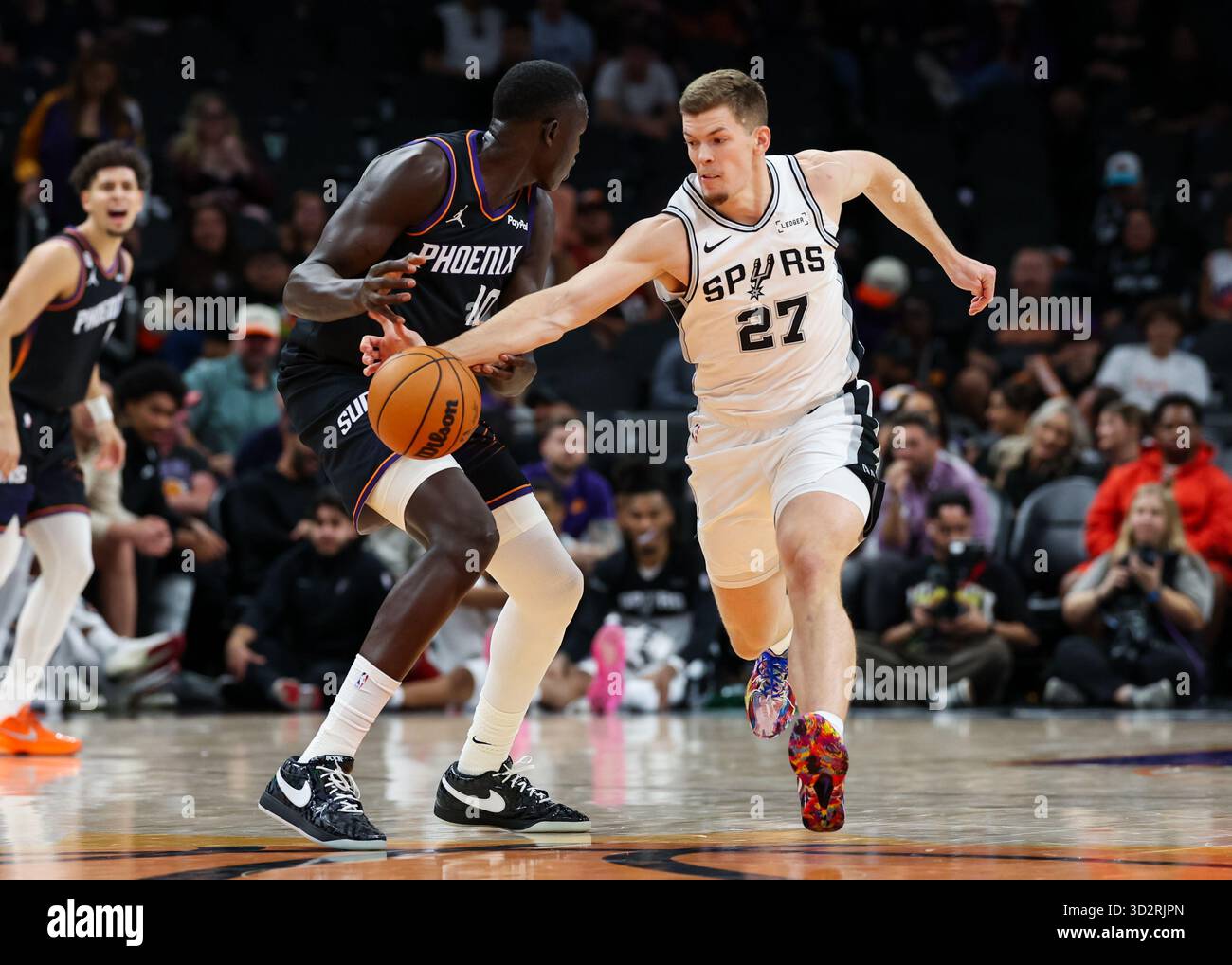
The San Antonio Spurs utilized their youthful energy and Wembanyama’s unique defensive reach to expose the fundamental vulnerabilities of the Phoenix Suns.
According to a report from Bright Side Of The Sun, the game served as a critical litmus test for Phoenix, revealing exactly how far the roster remains from the elite tier of the Western Conference. While the Suns managed to maintain discipline by committing only seven turnovers, they were systematically dismantled in the areas that define winning basketball: the paint and the glass.
The statistical disparity in the interior was staggering. San Antonio outscored Phoenix 62-48 in the paint and controlled the rebounding battle with a 55-35 advantage. This lack of physical presence in the trenches suggests that Phoenix is still struggling to find a way to compete with the league’s most imposing frontline talents.
Phoenix struggles in the paint
The gap between the two teams was most evident in the secondary opportunities created by San Antonio. The Spurs held a 20-10 advantage in second-chance points and a 19-10 edge in fast-break points, capitalizing on the Suns’ inability to secure defensive rebounds and transition defense.
Wembanyama’s impact extends beyond the box score, acting as a psychological and physical deterrent. His ability to manipulate the game from the perimeter while possessing the size of a traditional center forces opponents to alter their entire offensive approach. For the Suns, this meant facing a defensive presence that essentially shrinks the available space within the three-point arc.
SAN ANTONIO 122, PHOENIX 96 SPURS DOMINATE AS WEMBANYAMA SCORES 40 IN ROUT Victor Wembanyama scored 40 points and grabbed 11 rebounds Monday night in Phoenix, where the San Antonio Spurs rolled to a 122-96 win over the Suns. San Antonio led 61-46 at the half after outscoring…
The following table breaks down the key performance metrics for the Phoenix nominees following the matchup:
| Player | Points | Rebounds | Assists | Other Stats |
|---|---|---|---|---|
| Devin Booker | 32 | 2 | 4 | 10-of-17 FG, 3-of-5 3PT, 1 STL, 1 BLK |
| Khaman Maluach | 11 | 5 | 2 | 4-of-6 FG, 1 BLK |
| Oso Ighodaro | 7 | 4 | 2 | 2-of-5 FG |
| Miles Bridges | 7 | 5 | 0 | 2 BLK |
| Jalen Green | 6 | 5 | 4 | 3 TO |
| Collin Gillespie | 6 | 2 | 3 | 2-of-4 3PT |
Devin Booker led the scoring effort with 32 points on efficient 10-of-17 shooting, yet his individual success could not mask the team’s structural failures. Despite his production, his plus/minus rating sat at -8, reflecting the broader struggle to contain San Antonio’s momentum.
The widening gap in the West
The loss highlights a recurring theme for the Suns: the inability to control the glass and protect the interior against high-level competition. While Phoenix has shown incremental progress over the last week, the Spurs' victory shows that being "good" is not the same as being "elite" in a conference defined by physical dominance.
Some analysts might argue that losing to a generational talent like Wembanyama is an acceptable outcome for a team in transition. However, the manner of the defeat—specifically being outrebounded by 20—points to systemic deficiencies that cannot be solved by individual scoring outbursts alone.
For the Suns to move into the upper echelon of the Western Conference, they must address the physical mismatch that Wembanyama and the Spurs’ youth movement exploited. The current trajectory suggests that until Phoenix can stabilize their rebounding and interior defense, they will remain vulnerable to teams with significant physical advantages.
San Antonio’s ability to dominate the glass remains a blueprint for how to neutralize Phoenix’s offensive rhythm.
Related reading

Shawnee County Investigators Seek Party Attendees in Ja’Lanette Harrison Death
The Shawnee County Sheriff’s Office is continuing its investigation into the death of 17-year-old Ja’Lanette Harrison, a senior...

5,047 Fans Attend Indiana vs. Syracuse Basketball Rematch
Only 5,047 fans attended Monday's matchup between Indiana and Syracuse in Indianapolis, according to USA Today. The crowd...

Pac-12 Announces Weekly Players of the Week for Women’s Soccer and Volleyball
Utah State and Boise State dominate Pac-12 weekly honors Utah State and Boise State players swept the major...

Hartford Wolf Pack Defeat Springfield Thunderbirds 5-2
A five-minute major penalty and a subsequent game misconduct to Oskar Sundqvist effectively ended any hope of a...